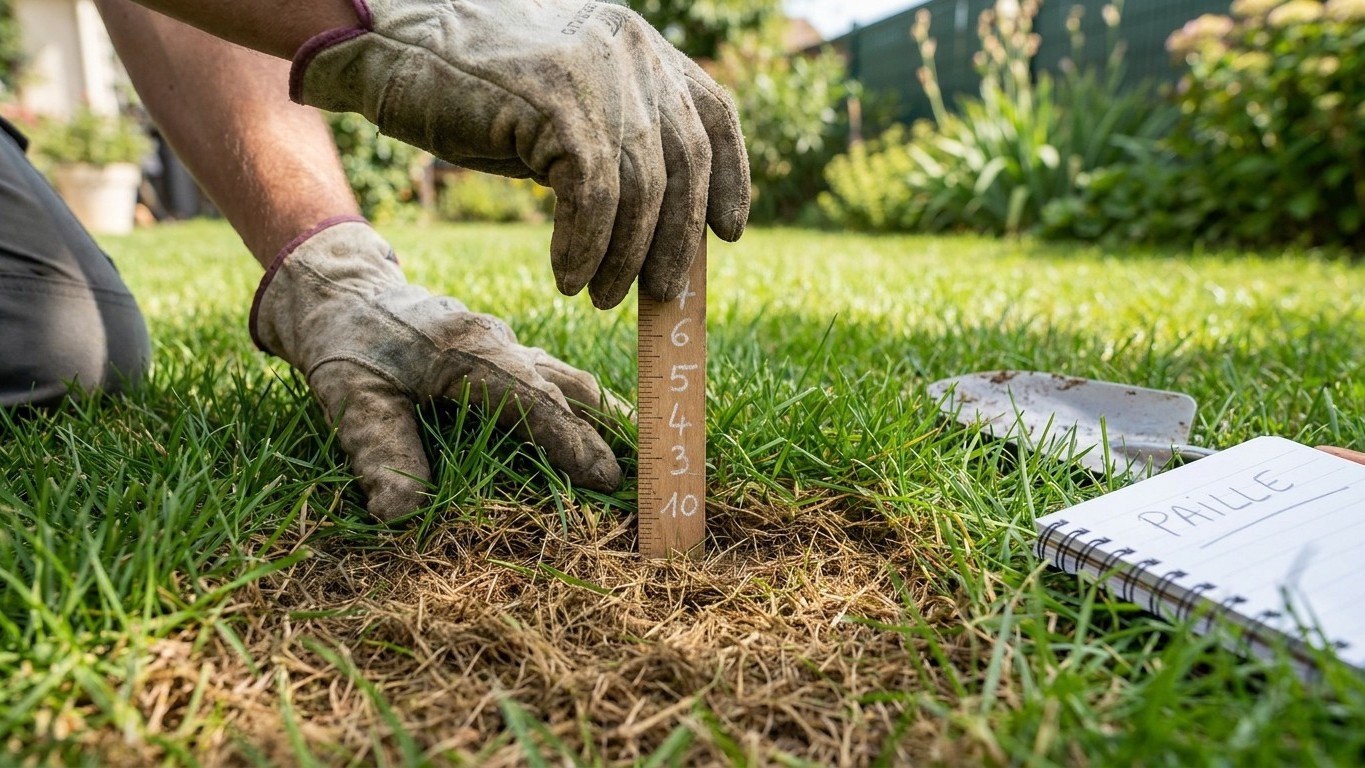

Thatch is the mat of dead and living stems, roots and rhizomes that collects between the green grass blades and the soil. You find out how much you have by cutting a narrow wedge down to bare dirt and holding a ruler against the cross-section, not by guessing from how the lawn looks on top. There’s no single figure that applies to every species, so the plug is the real test. Do that before you rent a dethatcher: a lawn with a thin, springy layer usually needs a change in mowing or watering, not a machine tearing through it.
What you are looking at

The layer itself
Push your fingers into the lawn at the base of the grass, right where the green blades meet the soil. Thatch is the tan to brown, fibrous layer sitting at that junction, made of old stems, roots, stolons and rhizomes that have died but haven’t broken down yet. It looks and feels a little like a thin, dried layer of peat moss pressed flat against the ground, and it sits above the soil, not mixed into it.
Why the shape doesn’t help you here
Unlike a fungal patch or a grub problem, thatch doesn’t show up as a shape you can trace with your foot. There’s no circle, no drift, no straight edge, because it builds evenly across the whole lawn at roughly the same rate. What you notice instead is a change in feel underfoot: the lawn has more bounce and give than it should, almost like walking on a thin foam mat, and a push mower can feel like it’s riding slightly above the soil instead of on it.
Color is a poor indicator on its own. A lawn with heavy thatch can still look green from a distance, because the leaf blades on top are healthy even while the layer underneath is choking the roots. The more reliable sign is that water runs off instead of soaking in during a normal watering, and the lawn wilts faster than it should between waterings even when rainfall has been adequate. If you’re troubleshooting a lawn for the first time, our overview of Lawn Problems is a good place to work out whether you’re looking at a soil issue, a pest issue, or a species issue before you commit to a fix.
What it is not
The pull test
Grab a handful of grass and pull, firmly but not violently. If the turf lifts away in a loose mat with the roots barely attached, and the soil underneath looks chewed or tunneled, that’s grub or sod webworm damage, not thatch. Thatch doesn’t let go of the soil. The roots stay anchored even when the layer above them is thick, because the thatch is sitting on top of the root zone, not replacing it.
The probe test
Compacted soil feels similar underfoot but fails a different test. Push a screwdriver or a soil probe straight down. If it stops well short of going in, the ground itself is hard and compressed, and no amount of dethatching will fix that. Compaction and thatch often show up on the same lawn, since both come from years of the same traffic and mowing habits, but they need different tools: an aerator that pulls plugs out of the soil for compaction, and a dethatching rake or power rake for the fibrous mat.
Dormant, not dead
A brown lawn that still holds its roots is not always a thatch problem, or even a dead one. Cool-season and warm-season grasses both go dormant under stress, and a dormant crown stays pale cream to white and pliable below the brown leaf tissue. If the crown snaps dry and gray, the plant is dead. If it bends, it’s resting. A perfectly circular dead patch with a green rim points to something applied to that one spot rather than a lawn-wide buildup: see Dog Urine Spots: Why the Ring Is Green and the Middle Is Dead for that pattern. And a lawn that looks thin and straw-colored right after a mowing, with no bounce underfoot at all, is more likely to be A Scalped Lawn: What Happens After You Cut Too Short than a thatch problem.
What actually causes it
The mechanism
Thatch forms when grass produces stems, roots and rhizomes faster than the soil’s microbes and earthworms can break them down. It is not caused by leaving grass clippings on the lawn. Clippings are mostly water and leaf tissue and decompose within days. Thatch is made of the tougher, more fibrous plant parts, stolons and rhizomes especially, that take much longer to rot. Grasses that spread by rhizomes or stolons, such as Kentucky Bluegrass among the cool-season types and Bermudagrass, Zoysiagrass and St. Augustinegrass among the warm-season types, build thatch faster than bunch-type grasses like Tall Fescue or Perennial Ryegrass, simply because they are producing more of the underground tissue that eventually becomes thatch.
What speeds it up
Anything that pushes rapid top growth without a matching increase in soil biology adds to the layer. Heavy nitrogen feeding is the most common driver, since it grows leaf and stem tissue quickly while doing nothing for the microbes that would break the old tissue down. Frequent, shallow watering has a similar effect from another angle: it keeps roots near the surface, right in the layer that’s forming, and discourages the earthworms and bacteria that need consistently moist, not soggy, soil to work. Compacted, low-oxygen soil slows decomposition further, since most organisms that digest dead plant tissue need air as much as moisture.
The timing matters more than it looks. Thatch builds up over consecutive seasons, not one, so a lawn that looks stressed this summer is usually showing the result of fertilizing and watering habits from a year or more earlier, not anything that happened last week. That lag is part of why the plug test matters. It tells you where the lawn stands today, instead of asking you to guess backward from a symptom that may have started building long before it became visible.
Fixing it
Take the measurement first
Cut a wedge of turf with a trowel or a bulb planter, going down through the green blades, the tan layer, and into the soil beneath, then set it on its side. You’re looking at three distinct layers: living green growth on top, fibrous tan-to-brown thatch in the middle, and soil at the bottom. Hold a ruler against the middle layer and note the thickness. Do this in three or four spots, since thatch is rarely even across a whole yard, and a shaded, poorly-drained corner often carries far more than the sunny side of the same lawn.
There’s no single figure from a national body that tells you when that number crosses from fine to excessive, because the right amount varies by species and by how the lawn is used. Treat the first measurement as a baseline. Measure again next year, at the same time of season and with the same method, and watch the trend rather than fixating on one number. A lawn that measures the same or thinner than last year does not need dethatching, whatever the figure is, because buildup and breakdown are already in balance.
If the layer is genuinely thick
A thin, springy layer is not a problem. It cushions the crown against foot traffic and helps hold moisture near the roots, and stripping it out for no reason just exposes the lawn to more stress than it started with. If successive measurements show the layer thickening, and the lawn is also wilting fast, thinning, or losing color despite normal watering, core aeration is the first tool to reach for, before a power dethatcher. A core aerator pulls small plugs of soil and thatch out of the lawn and deposits them on the surface, opening channels for air, water and the soil life that break the layer down, without stripping the lawn bare the way a power rake can.
A power dethatcher or vertical mower, which drags blades or tines through the layer to tear it loose, is the tool for a layer thick enough that aeration alone won’t touch it in a reasonable time. Rent one, or hire a lawn service, rather than buying, since most home lawns need this rarely. Do it while the grass is actively growing so it can recover the bare spots quickly, and check the species-specific maintenance calendars from Clemson’s HGIC (HGIC 1215 for Centipedegrass, HGIC 1216 for Bermudagrass, HGIC 1217 for Zoysiagrass, HGIC 1218 for St. Augustinegrass, and HGIC 1219 for Tall Fescue) for the recommended window for your grass, rather than guessing at a date.
Keeping it from coming back
The habit most responsible for thatch buildup is overfeeding with nitrogen, closely followed by shallow, frequent watering. Cut back on both and the lawn’s own soil biology usually keeps pace with what the grass sheds. Feed at the rate and timing recommended for your species rather than by the calendar. Clemson’s HGIC 1201, Fertilizing Lawns, sets out rates and timing by grass type, and following it prevents the rapid, disproportionate top growth that outpaces decomposition in the first place.
Watering deeply and less often, rather than a little every day, pushes roots down into the soil instead of leaving them shallow in the thatch layer, and it keeps the soil aerobic enough for the microbes and earthworms that digest dead plant tissue to keep working. Mowing at the correct height for the species does the same job from another angle. Scalping stresses the crown and slows root growth along with everything else, and a stressed lawn eventually spends more energy replacing top growth than feeding the roots and soil life that keep thatch in check. Clemson’s HGIC 1205, Mowing Lawns, and the heights below are the starting point for setting the deck correctly.
| Grass | Season | Mowing height | Drought tolerance |
|---|---|---|---|
| Kentucky Bluegrass | Cool-season | 2 to 3 in | Fair |
| Tall Fescue | Cool-season | 2.5 to 3.5 in | Fair |
| Bermudagrass | Warm-season | 0.75 to 1.5 in | Excellent |
| Zoysiagrass | Warm-season | 0.75 to 2 in | Good |
| St. Augustinegrass | Warm-season | 2.5 to 4 in | Good |
The Kentucky Bluegrass figure comes from Penn State Extension’s lawn establishment guidance. The Tall Fescue, Bermudagrass, Zoysiagrass and St. Augustinegrass figures come from Clemson Cooperative Extension’s HGIC 1214. Mowing outside that range in either direction adds stress, whether that’s letting a Bermudagrass lawn grow tall for its own good or shaving a St. Augustinegrass lawn down past what its shade and drought tolerance were built for.
Common questions
How thick does thatch have to be before I dethatch?
There’s no single figure that applies to every lawn, so don’t chase one. The right approach is to measure with a plug now, measure again at the same point next season, and act only if the layer is clearly thickening and the lawn is also showing stress like fast wilting or thinning color.
Can dethatching hurt my lawn if I get the timing wrong?
Yes, and it’s the most common mistake. Dethatching a lawn that isn’t actively growing leaves bare, torn ground with no ability to recover quickly, which invites weeds into the gap. Check the species-specific maintenance calendar for your grass before you rent or hire anything.
Does core aeration actually remove thatch, or just help it break down?
Aeration doesn’t strip the layer out the way a power rake does. It pulls small soil plugs and deposits them on top of the thatch, which introduces soil microbes and air into the mat and speeds up its natural breakdown over the following weeks.
I cut a plug and the thatch layer is thin, but the lawn still feels spongy. What else could that be?
A thin thatch layer with a spongy, almost wet feel underfoot usually points to waterlogged or compacted soil rather than a fibrous buildup problem. Push a soil probe down at the same spot. If the ground stays soggy and airless well below the surface, drainage is the issue to fix, not thatch.