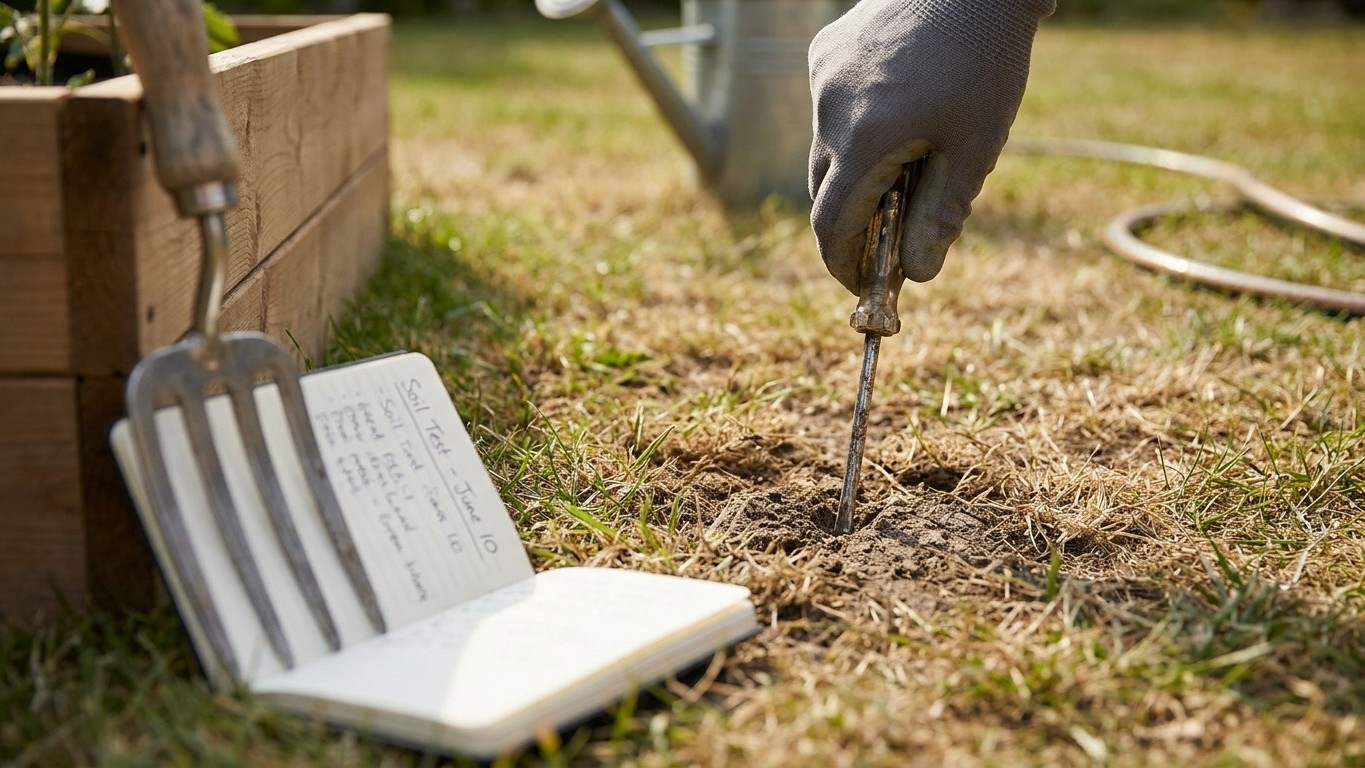

Compacted lawn soil is ground that has been pressed so tightly that air and water can no longer move through it, and the fastest way to confirm it is to push a long screwdriver into the soil after rain. If it stops well short of the handle, or you have to lean on it just to get the tip in, the ground under your grass is too dense for healthy roots to work in. Do the test in both a thin, struggling patch and a healthy patch nearby, and compare how far each one lets the screwdriver travel.
What you are looking at

Compacted soil shows up as a lawn that thins out exactly where feet, tires or paws travel the most. The grass over a compacted patch grows shorter, pales to a duller green, and eventually gives up altogether, leaving bare dirt with a hard, almost polished surface. Water sits on top of it after rain instead of soaking in, and if you walk across it in wet weather it does not squish the way healthy lawn does. It feels more like a sidewalk with a skin of grass over it.
The shape tells the story
The shape of the bare or thinning area is the fastest clue you have. A straight line running from a gate to a clothesline, or along the shortest route between a driveway and a back door, is a traffic path, and traffic is the single most common cause of compaction in home lawns. A tight, near-perfect circle under a swing set, trampoline or dog’s tie-out stake tells the same story on a smaller scale. A broader, irregular patch with no obvious edge, often across a whole side yard or the strip nearest a new driveway, usually points to heavy equipment or repeated parking rather than everyday footsteps.
Compacted ground rarely kills grass outright. It starves the roots slowly, so the lawn over it looks stressed before it looks dead: shorter blades, slower regrowth after mowing, and a color that leans yellow-green rather than the darker green of the lawn around it. Moss often moves in first, especially where the compacted area also gets shade, because moss does not need the loose, aerated soil that grass roots require. If the compacted stretch also sits under trees, it is worth reading Grass That Thins Under Trees: What Will Actually Grow There as well, since the two problems often overlap and neither fix works well without the other.
What it is not
Grub damage looks similar from a distance: patchy, thin turf with no obvious disease spots. The broader troubleshooting steps in Lawn Problems are worth ruling out generally before settling on compaction, and the difference between compaction and grubs specifically shows up in thirty seconds with your hands.
The pull test
Grab a handful of the thinning grass and pull. If it lifts away in a loose mat, like pulling back a rug, with little or no root holding it down, you are looking at grubs or another root-feeding insect, not compaction. Compacted soil holds roots in place even when the grass above them is struggling, because the problem is a lack of air and water reaching the roots, not the roots being eaten.
Dog urine spots are another common mix-up. They tend to be small, closer to perfectly round, and ringed by a border of darker, faster-growing grass where the diluted edge of the urine acted like a light fertilizer dose. Compaction does not produce that green halo, and it does not stay confined to spots the size of a dinner plate. It follows the shape of whatever repeatedly presses on it.
Drought stress is the trickiest look-alike because it also shows up as dull, thinning grass, but it spreads evenly across the whole lawn rather than tracing a path or a circle. A quick way to tell them apart without any tools: compare a stressed patch to an unstressed patch a few feet away. If both are equally hard underfoot, look at watering and mowing habits first. If only the traffic-worn patch is hard, compaction is sitting on top of whatever else the rest of the lawn is dealing with.
What actually causes it
Soil is not a solid block. Healthy topsoil is roughly half solid particles and half open space, pores that hold air and water and let roots push through easily. Repeated weight, whether from feet, mower wheels, a wheelbarrow or a parked car, presses those particles closer together and collapses the pore space. Once the pores collapse, air cannot move down to the roots, water runs off instead of soaking in, and roots that would normally reach several inches down stay shallow because they cannot force their way through the packed layer.
Clay-heavy soils compact faster and stay compacted longer than sandy soils, because clay particles are small and flat and lock together tightly once pressed. Soil that is wet compacts far more easily than dry soil, which is why the same path across a lawn does more damage in a rainy stretch than during a dry one.
Cool-season versus warm-season timing
Timing matters more than most people expect, because the damage shows up weeks after the pressure that caused it, not the same week it happened. On a cool-season lawn built from Kentucky bluegrass, perennial ryegrass or tall fescue, spring foot traffic across wet soil often is not obvious until the heat of summer, when the lawn is already fighting drought stress and compacted roots cannot reach what little water is available. On a warm-season lawn such as bermudagrass, zoysiagrass or centipedegrass, the grass is semi-dormant through winter, so foot traffic and vehicle parking during the cold months does the damage, and it only becomes visible once green-up starts and the compacted patches lag behind the rest of the yard.
None of this involves a pathogen, an insect or a nutrient deficiency on its own, though a compacted lawn is more likely to develop those secondary problems, since a stressed lawn has less capacity to recover from anything else that comes along at the same time.
Fixing it
Core aeration is the standard fix. It works by physically removing plugs of soil, giving the compacted ground somewhere for air and water to go while the surrounding soil relaxes into the gap. A hollow-tine aerator, either rented for an afternoon or run by a lawn service, pulls plugs a couple of inches long and leaves them on the surface to break down over the next mowing or two. Spike aerators, the kind sold as an attachment or a pair of strap-on shoes, only punch holes and press soil sideways as they go in, which can make compaction slightly worse rather than better. Skip the spike tool and rent or hire a hollow-tine machine instead.
Overseeding, topdressing and what to skip
After aerating a cool-season lawn of Kentucky bluegrass, perennial ryegrass, tall fescue or fine fescue, overseed into the holes right away. The open plugs give seed direct contact with soil instead of sitting on top of thatch, exactly the condition overseeding needs to succeed. Warm-season lawns such as bermudagrass, zoysiagrass, centipedegrass and St. Augustinegrass generally are not overseeded the same way. They recover by spreading through stolons and rhizomes once growing conditions are right, so the job after aerating a warm-season lawn is mainly to keep it watered and mowed at its normal height and let it fill in on its own.
Topdressing with a half inch of compost after aerating speeds recovery further, because compost works down into the aeration holes and improves soil structure at exactly the depth where roots are struggling. It is optional but worth the extra bag or two if the compaction is severe enough that bare dirt is showing.
What does not need fixing: a lawn that has simply gone dormant from cold or drought and looks uniformly brown rather than thin in a path or circle. Brown all over is usually dormancy, not death, and it greens back up on its own once conditions improve. Treating a dormant lawn for compaction it does not actually have wastes effort better spent waiting it out.
If the compacted area has also settled into a low spot that puddles after rain, aeration alone will not fix the grade. That calls for the leveling work covered in An Uneven Lawn: Levelling Without Killing the Grass, handled separately from the compaction fix.
Keeping it from coming back
The habit to change is where traffic crosses the lawn, not how often you water or how short you mow, though both of those still matter. If the same shortcut gets walked every day, no amount of aeration keeps that strip open for long. A stepping-stone path, a strip of mulch, or routing foot traffic around the weak point instead of across it does more for compaction over time than any yearly aeration schedule on its own.
Choosing a grass that handles wear
Where traffic cannot be rerouted, such as a path to a mailbox or a side yard that doubles as a shortcut, the grass species itself makes a difference. Clemson Cooperative Extension’s HGIC 1214 fact sheet rates wear tolerance directly for warm-season species, and Penn State Extension’s lawn establishment guidance does the same for cool-season species. The table below groups the strongest options by climate.
| Grass | Season | Wear tolerance | Mowing height |
|---|---|---|---|
| Bermudagrass | Warm-season | Excellent | 0.75 to 1.5 in |
| Zoysiagrass | Warm-season | Very good | 0.75 to 2 in |
| Kentucky Bluegrass | Cool-season | Good | 2 to 3 in |
| Perennial Ryegrass | Cool-season | Good | 2 to 3 in |
| Bahiagrass | Warm-season | Good | 3 to 4 in |
| Seashore Paspalum | Warm-season | Good | 1 to 1.5 in |
| Tall Fescue | Cool-season | Fair | 2.5 to 3.5 in |
Bermudagrass and zoysiagrass rate excellent to very good for wear according to Clemson’s HGIC 1214, which is why they are the usual choice for warm-season lawns that take heavy foot traffic, provided the site gets enough sun, since both rate poor to very poor for shade in the same fact sheet. In cooler climates, Kentucky bluegrass and perennial ryegrass carry a good wear rating from Penn State Extension and tolerate far more shade than bermudagrass, though neither matches bermudagrass or zoysiagrass for standing up to constant pounding.
Mowing height plays a smaller but real role too. Cutting any of these grasses shorter than the range listed above stresses the crown of the plant right at the point where wear damage happens first, compounding whatever traffic is already doing to the soil beneath it.
Common questions
Will aerating my lawn once fix compaction for good?
Usually not with a single pass. Most home lawns need aeration once a year, sometimes twice on heavy clay or high-traffic areas, before the compacted layer breaks up enough that grass roots can hold their own ground.
Can I just add sand to loosen compacted soil?
Spreading sand on top of existing soil does not mix into it and can make drainage worse by creating a layered profile, sand over clay, that water still cannot cross easily. Mechanical aeration followed by a compost topdressing works loosened material into the existing soil instead of layering it on top.
Is compacted soil the reason my grass seed never comes up?
It is one of the most common reasons. Seed dropped onto hard, compacted ground struggles to make the soil contact it needs to germinate, and any seedlings that do sprout often cannot push roots down past the packed layer. Aerating before overseeding solves both problems at once.
How do I know if it’s compaction or just a bad drainage spot?
Push a screwdriver into the soil during both a wet spell and a dry one. If it resists going in even when the soil is moist, that points to compaction. If the screwdriver goes in easily but the area still holds standing water for a day or more after rain, the issue is more likely grade or a high water table than surface compaction, and a separate low-spot fix is the better place to start.