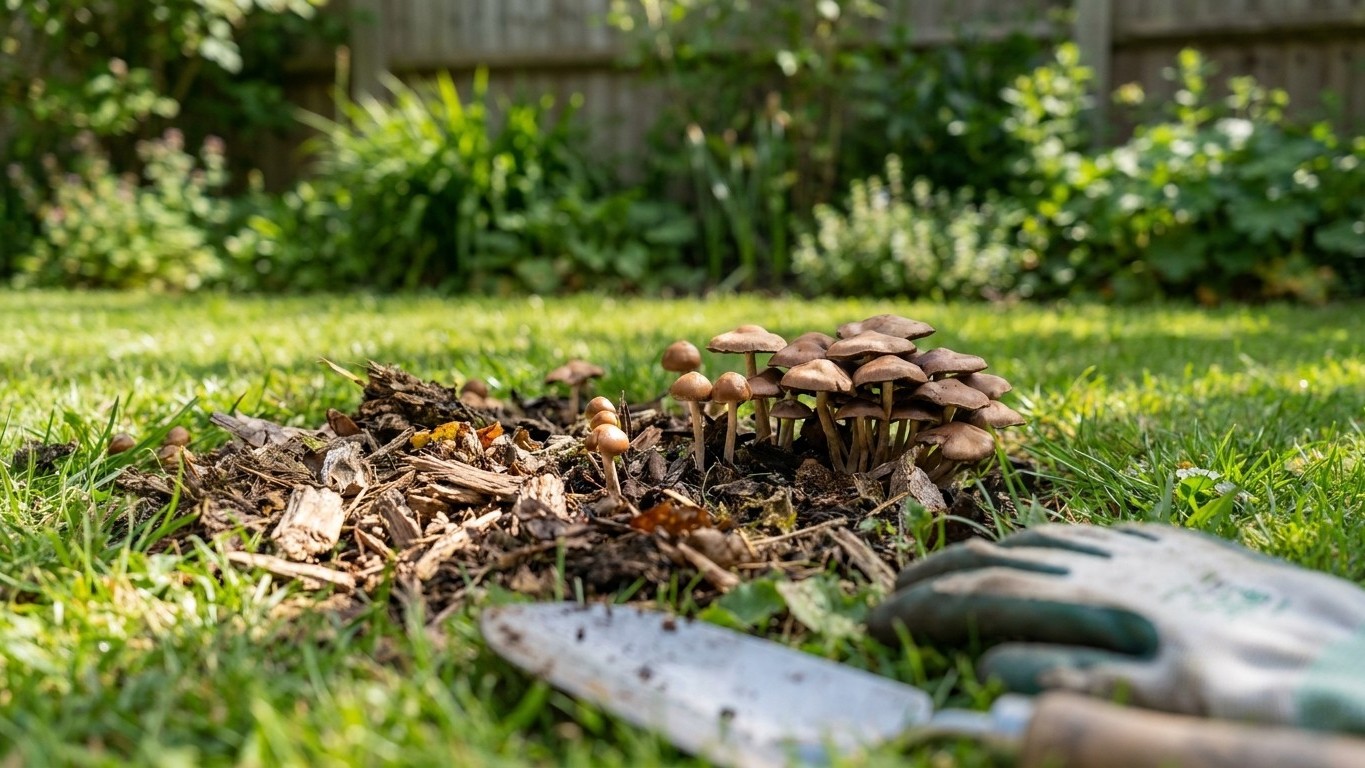

The mushrooms in your lawn are feeding on dead organic matter buried under the turf, not on the living grass. That matter is usually a decaying tree root, an old stump, a buried scrap of construction lumber, or a thick mat of thatch that never broke down. Dig a few inches down where the mushrooms cluster thickest and you will usually find the wood or root mass responsible. That is the one thing worth checking before you do anything else about the mushrooms themselves.
What you are looking at

Mushrooms show up in one of a few recognizable patterns, and the pattern narrows down what is happening underground before you dig anything. The most distinctive is a fairy ring: a circle or a broken arc of mushrooms, sometimes just a few inches across and sometimes ten feet or more, that expands outward a little each year as the fungus works through more buried material.
Ring shapes to check first
- A tight, perfect circle, often with a ring of darker green grass just inside it and a band of thin or dead brown grass right where the mushrooms stand.
- A broken arc or horseshoe, the same ring interrupted where a sidewalk, driveway or old foundation cuts off the buried food source.
- An irregular drift, a cluster that follows the shape of a buried root system or old wood pile rather than a circle.
- A scattered cluster with no ring at all, mushrooms popping up loosely across a patch of lawn after a few days of rain, usually over a thatch layer or old clippings left to mat down.
The mushrooms themselves range from small brown or tan caps on thin stalks to white, ball-shaped puffballs that dry out and release a cloud of spores when kicked. Cap color and shape tell you the species, but for lawn health it barely matters which fungus you have. What matters is the shape of the patch and whether it is spreading. A ring that widens a little each season is feeding on a large buried source, often a stump or a network of old roots, and will keep fruiting mushrooms for as long as that food source lasts, which can run for years.
What it is not
Slime mold is the most common false alarm. It shows up fast after warm, wet weather as a gray, orange or yellowish blob sitting right on top of the grass blades rather than growing up out of the soil. Slime mold is not attached to the plant or its roots at all. It can be hosed off, scooped up, or left alone to dry into a dusty crust that disappears in a day or two. A true mushroom pulls up with a stem set into the ground and, often, a web of thread-like mycelium clinging to the thatch underneath.
The thirty-second pull test
A ring of dead or thin grass with no mushrooms present is a different problem. That pattern is more often a lawn disease such as brown patch, or a buried object like an old walkway edge holding heat and moisture differently than the surrounding soil. If a bare or thinning ring shows up at the same spot every year without ever producing a mushroom, it is worth reading through Brown Patches in a Lawn: Reading the Shape to Find the Cause before assuming a fairy ring fungus is responsible.
The other quick test is a tug on the grass itself. Grab a handful at the edge of the dead ring and pull. If it lifts away like loose carpet with almost no root holding it down, the cause is likely grubs feeding on the roots, not a fungus feeding on buried organic matter. If the roots hold firm and only the blades look damaged, look to watering and mowing habits before blaming a fungus for damage it did not cause.
What actually causes it
A mushroom is a fruiting body, the visible, temporary part of a fungus that has been growing underground as a network of thread-like mycelium for a long time already, sometimes for years, before conditions were right to produce it. The mycelium feeds on buried organic matter: a decaying stump, old tree roots left in the ground after a tree came down, scrap lumber buried during construction, or a thatch layer thick enough to hold its own supply of dead grass tissue. The mushrooms show up only after the right combination of moisture and temperature, typically a warm rain arriving after a dry stretch, which means the mushroom you see today is the visible result of decay that has been happening out of sight for a long time already.
Why fairy rings kill grass but plain lawn mushrooms don’t
Most lawn mushrooms do no direct harm to turf. They break down dead material and leave the living grass alone. A fairy ring is different because the fungal mycelium can build up into a dense mat just under the thatch, and that mat can turn hydrophobic, repelling water rather than absorbing it. Grass roots inside that mat dry out even when the surrounding soil is moist, which is why the dead ring often appears during the driest weeks of the growing season, well after the fungal mat itself formed. Just outside that dry band, the fungus releases nitrogen as it breaks down organic matter, which is why a ring of unusually dark, lush grass often runs alongside the dead one.
None of this is tied to a soil temperature threshold or a mowing height you can act on directly, the way a lawn disease often is. It is tied to what is buried and how long it has been decaying, which is also why fairy rings are so persistent: as long as the buried stump or root mass remains, the fungus has years of food left to work through.
Fixing it
Start by raking or mowing off the mushrooms themselves. They are not feeding on your grass and removing them does nothing to slow the fungus underground, but it clears them out of reach of pets and kids, since a handful of the species that show up in lawns are toxic if eaten. That step costs nothing and takes a few minutes.
Breaking up the dead ring
If you have a fairy ring with a genuinely dead, dry band of grass, the fix is mechanical, not chemical. Core aerate the dry band specifically, punching through the water-repellent mycelium mat, then water that section deeply and repeatedly over the following weeks so the soil underneath actually rewets. A single watering rarely does it. This is the one step that reliably shrinks an established fairy ring, and it costs the price of renting or borrowing a core aerator, or an hour with a garden fork on a smaller ring.
If the ring keeps returning at the same size year after year, dig into the center to check for a buried stump, root mass or old lumber. Removing that food source is the only permanent fix, and for anything larger than a root ball, that usually means paying for excavation. Many homeowners decide the ring is not worth digging up an established lawn to remove, and instead manage the dead band with aeration and watering each time it shows up, until the buried wood finishes decaying, which can take several more years.
Fungicide drenches are sold for fairy ring, but they rarely reach deep enough into an established mycelium mat to do much, and the products effective enough to matter are not generally available to home gardeners. Spend the money on a core aerator rental instead.
Keeping it from coming back
The habit that matters most here is thatch management, not fungicide or fertilizer timing. A thick, spongy thatch layer is exactly the buried organic matter that feeds lawn fungi, and it builds up fastest when a lawn is mowed too short or too infrequently for its species. Clemson Cooperative Extension’s HGIC 1205 (Mowing Lawns) recommends mowing regularly enough that no more than about a third of the blade is removed at once, since heavier clippings left behind break down more slowly and add to the thatch layer instead of disappearing into it.
Matching mowing height to grass type
Mowing height itself varies by grass type, and getting it right matters for more than fungus control. A lawn mowed shorter than its species tolerates thins out and lets more organic debris accumulate at the soil surface instead of staying upright where it breaks down cleanly.
| Grass | Mowing height | Drought tolerance | Shade tolerance |
|---|---|---|---|
| Tall Fescue | 2.5 to 3.5 in | Fair | Good |
| Kentucky Bluegrass | 2 to 3 in | Fair | Fair |
| St. Augustinegrass | 2.5 to 4 in | Good | Excellent |
| Zoysiagrass | 0.75 to 2 in | Good | Excellent |
Figures for the cool-season species come from Penn State Extension’s Lawn Establishment guidance, and figures for the warm-season species come from Clemson Cooperative Extension’s HGIC 1214 (Selecting a Lawn Grass).
Watering habits matter almost as much. Frequent, shallow watering keeps the top inch of soil damp for long stretches, which is exactly the condition that lets a fungus fruit repeatedly through a season. Watering less often but more deeply pushes moisture down to where the grass roots actually are and lets the surface dry between waterings, which is the same fix used for a lawn that will not thicken up, covered in A Lawn That Will Not Grow: Working Through the Four Causes. If mushrooms keep appearing across a wider area of an otherwise healthy lawn, it is usually this watering pattern, not a disease, and it is worth reviewing the whole yard’s care routine over at Lawn Problems rather than treating the mushrooms as an isolated issue.
Common questions
Are the mushrooms in my lawn dangerous to pets or kids?
Treat any lawn mushroom you cannot positively identify as inedible. Several common lawn species resemble toxic look-alikes closely enough that misidentification happens even to experienced foragers, so the safer habit is to rake them up rather than try to tell them apart.
Do I need to dig up my whole lawn to get rid of a fairy ring?
No, not for a typical ring. Aerating the dead band and watering it deeply over several weeks usually shrinks it without disturbing the rest of the lawn. Full excavation only makes sense if the buried stump or root mass is small enough to remove without tearing up a large section of turf.
Why do mushrooms keep coming back in the exact same spot every year?
Because the buried food source is still there. A stump or a large root mass can feed a fungus for years, and mushrooms will keep fruiting from it whenever rain follows a dry spell, until the wood finally finishes decaying.
Does watering less make the mushrooms go away for good?
It reduces how often they fruit but does not remove the underlying food source. Cutting back on shallow, frequent watering slows the fungus down by keeping the surface drier, but a stump or thatch layer will keep producing mushrooms under the right rain pattern regardless of your watering schedule.