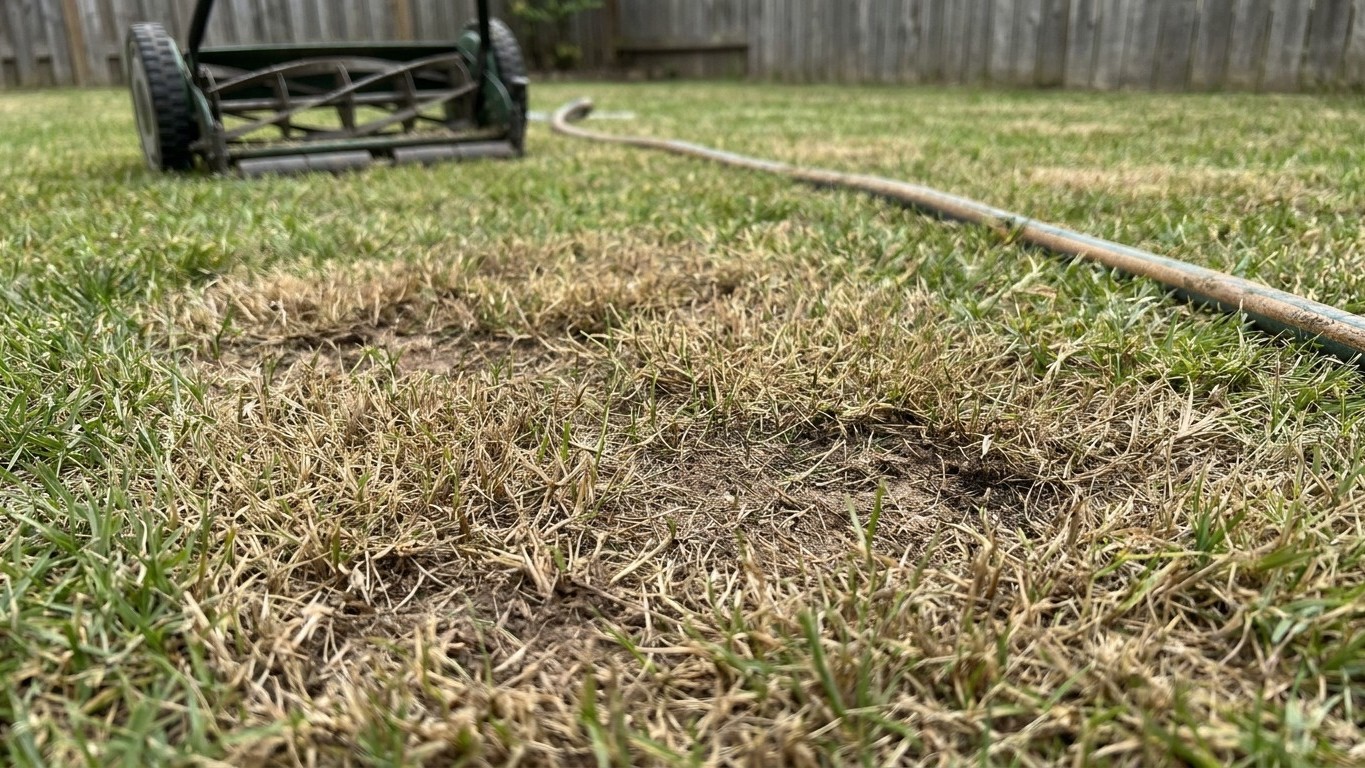

A scalped lawn happens when the mower blade cuts below the green, photosynthetic part of the grass plant and into the pale stem base or bare crown. The result is straw-tan to brown stubble, sometimes with soil or stolons showing through, running in the same straight lines the mower traveled. Set the mower deck to the correct height for your species before you cut again, and do not mow again until the grass has some green leaf back.
What you are looking at

Scalping shows up as straight-edged strips or a checkerboard pattern that match the mower’s path exactly, not a rounded patch or an irregular drift. Where the deck rode a high spot or the ground tipped, the strip is worse in the middle and tapers at the edges. On a slope or an uneven lawn, you often see it repeat in the same low or high spots every time you mow, because the deck contacts the same ridges each pass.
The color shift is the giveaway. Healthy grass is uniformly green from crown to tip. Scalped grass turns pale straw or tan almost immediately in the cut zone, because you have removed the chlorophyll-bearing leaf tissue and left only the whitish, non-photosynthetic base of the stem. In bad cases, especially on grasses that spread by stolons or rhizomes along the soil surface, you will see bare dirt or the horizontal runners themselves, stripped of their upright shoots.
Where it spreads and where it stops
Scalping does not spread on its own the way a fungal disease does. It stays exactly where the mower deck went too low and stops dead at the edge of that pass. If the discolored area keeps expanding outward day by day after mowing, or if it has a scalloped or irregular front edge rather than a straight one, you are looking at something other than a mowing injury and should check for disease or insect activity instead.
What it is not
Scalped grass is easy to confuse with drought dormancy, grub damage and some fungal patch diseases, because all four leave the lawn some shade of brown. The pattern and a thirty-second pull test separate them fast.
- Drought dormancy: uniform tan color across the whole lawn, no straight lines, blades still attached firmly at the crown. Grass that has simply shut down from lack of water looks different from a mowing injury, and the distinction matters because dormant turf needs nothing more than time, as covered in Drought-Stressed Grass: Telling Dormancy From Death.
- Grub damage: pull on a handful of the brown grass. If it lifts away from the soil like a loose carpet with no roots attached, grubs or another root-feeding insect are the more likely cause, not the mower.
- Fungal patch disease: circular or irregular rings that expand week over week, often with a darker or water-soaked ring at the margin, unrelated to the mower’s path.
- Moss encroachment: a soft green mat rather than tan stubble, usually in shaded, compacted or damp ground, a sign covered in Moss in a Lawn: What It Tells You About the Soil Underneath.
The single test that settles most cases: grab a tuft of the discolored grass and tug. If the blades come away clean at soil level while the roots hold firm, the plant is intact and the damage is at the leaf, which points to mowing. If the whole plug lifts, or the pattern is a spreading ring rather than a straight strip, look elsewhere before you touch the mower height.
What actually causes it
Scalping happens when the mower removes more of the leaf blade than the plant can spare in one pass, or cuts below the species’ minimum recommended height. Clemson Cooperative Extension’s mowing guidance (HGIC 1205, Mowing Lawns) advises against removing more than roughly one-third of the leaf blade at a time. Cut past that line and the plant loses most of its food-making tissue at once, which is a very different stress than trimming a little off the top every few days.
Three ways it actually happens
The most common trigger is simple neglect between mowings: the lawn grows tall, then gets cut hard back to a “normal” height in a single pass, which removes far more than a third of the blade even though the final height looks fine. The second is a deck set correctly for flat ground but riding low spots or humps on an uneven lawn, so the blade digs in on the high points regardless of the height dial. The third is mowing a species below the range it can tolerate at all, such as bermudagrass, which Clemson HGIC 1214 lists at a 0.75 to 1.5 inch cutting height, compared with tall fescue at 2.5 to 3.5 inches or St. Augustinegrass at 2.5 to 4 inches. A blade set for bermudagrass will scalp a tall fescue lawn even on flat ground.
Damage does not always show the day it happens. On cool-season grasses like Kentucky bluegrass or perennial ryegrass, both mowed at 2 to 3 inches per Penn State Extension’s Lawn Establishment guidance, the cut tissue browns within a few days but the plant’s ability to recover depends on how much leaf area is left and how much heat or drought stress follows. On warm-season grasses, scalping done before the lawn has fully greened up in spring hits stolons that have not yet pushed enough upright growth to shade the crown, and the bare, tan strips can sit there for weeks longer than the same injury would in high summer.
Fixing it
Most scalped lawns fix themselves with time and a corrected mower, not with any product. The first and only immediate step is to stop mowing at the low height and raise the deck to the correct range for your species before the next cut. Do not mow again at all until you can see new green leaf growth across the damaged strips, which can take one to several weeks depending on the grass, the season, and how much leaf tissue was actually removed.
- Reset the mower deck using a ruler against the blade tip on a flat, hard surface, not the height dial alone.
- Water lightly if the soil is dry, since a scalped plant recovering from leaf loss cannot pull as much moisture as usual, but avoid soaking bare soil where nothing is growing yet.
- Leave clippings off the scalped strips for the next cut or two rather than adding more organic matter over stressed crowns.
- Where bare soil is showing on a cool-season lawn, a light overseeding with the same species can fill the gap faster than waiting on existing plants to spread.
- On a warm-season lawn, bare stolons generally fill back in through lateral spread once growing conditions are right. Patience is the treatment, not reseeding, since most warm-season species are not typically grown from seed in home lawns.
There is no chemical fix for scalping because there is no pathogen or pest to control. Fungicides, insecticides and fertilizer spikes will not speed leaf regrowth and can add cost with no benefit. The one product worth spending on, if you scalp often, is a set of new mower blades or wheel bushings, since a dull blade tears rather than cuts and worn deck wheels drift out of the height you set.
Keeping it from coming back
The habit to change is almost always mowing frequency, not mowing height in isolation. A mower set correctly but used every ten days on fast-growing turf will still remove more than a third of the blade in a single pass. Mow often enough that you are never taking off more than that fraction at once, and raise the height, rather than lowering it, when growth outpaces your schedule.
| Grass | Season | Mowing height | Source |
|---|---|---|---|
| Fine Fescues | Cool | 2.5–3.5 in | Penn State Extension |
| Kentucky Bluegrass | Cool | 2–3 in | Penn State Extension |
| Perennial Ryegrass | Cool | 2–3 in | Penn State Extension |
| Tall Fescue | Cool | 2.5–3.5 in | Clemson HGIC 1214 |
| Bermudagrass | Warm | 0.75–1.5 in | Clemson HGIC 1214 |
| Zoysiagrass | Warm | 0.75–2 in | Clemson HGIC 1214 |
| St. Augustinegrass | Warm | 2.5–4 in | Clemson HGIC 1214 |
| Bahiagrass | Warm | 3–4 in | Clemson HGIC 1214 |
Check that table against your actual species before you touch the height dial again, since a bermudagrass setting will scalp almost anything else on the list. If you are not certain which grass you have or when your local mowing season starts and ends, the broader groundwork for diagnosing lawn trouble by season and species is in Lawn Problems. Species-specific maintenance calendars from Clemson HGIC (numbers 1215 through 1219, covering centipedegrass, bermudagrass, zoysiagrass, St. Augustinegrass and tall fescue) also lay out when each species is actively growing and can tolerate a hard cut without lasting harm, versus when it is dormant or transitioning and more vulnerable to a low pass.
Common questions
How long does it take for a scalped lawn to recover?
It depends on the species and how much leaf tissue was removed, but new green growth on an established lawn is usually visible within one to a few weeks once mowing height and frequency are corrected. A lawn scalped down to bare stolons or crowns takes longer, since it is rebuilding leaf area from very little.
Should I water a scalped lawn more?
A light watering helps if the soil is dry, but do not increase watering frequency across the whole lawn just because one area is scalped. Overwatering encourages shallow roots and can make the recovering grass more vulnerable to disease while it is already stressed.
Can I fertilize a scalped lawn to help it bounce back?
Hold off on fertilizer until you see active regrowth. A scalped plant has lost most of its food-making leaf tissue, and pushing nitrogen at a plant with little green surface to use it does not speed recovery and can stress it further.
Is scalping the same as dethatching or verticutting?
No. Dethatching and verticutting are deliberate tools that cut into thatch or the soil surface as part of lawn renovation, and a lawn recovers from them the same way it does from overseeding prep. Scalping is an accidental mowing injury with no benefit attached, and the only correct response is to stop doing it, not to repeat it on purpose.