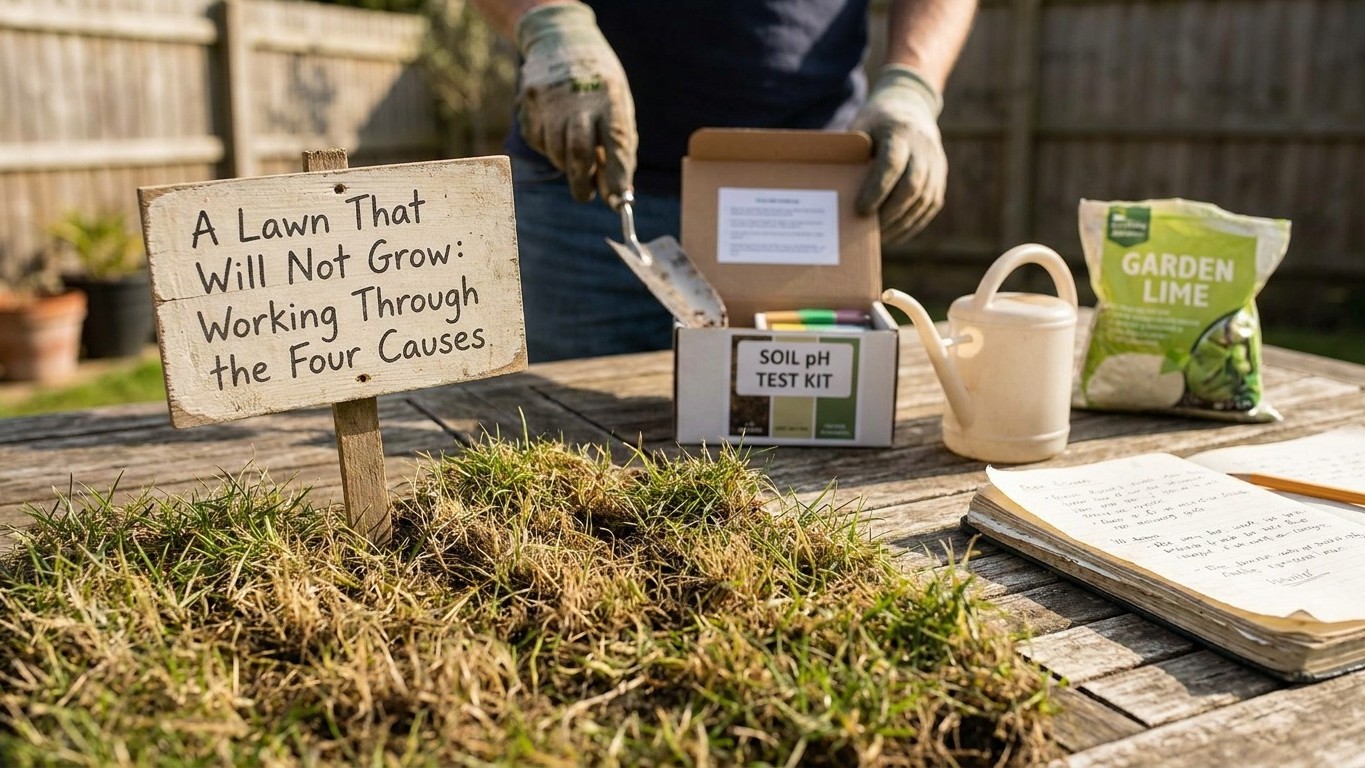

A lawn that has stopped growing almost always comes down to one of four things: the mower is set too low for that grass, the grass itself is wrong for the spot’s shade or traffic, it was fed on the wrong calendar, or it’s simply dormant and only looks dead. Check the mower deck height against your grass species before you touch anything else — that one setting causes more stalled lawns than every other reason combined, and it’s the easiest thing to rule out first.
What you are looking at

The pattern across the yard
A lawn that will not grow rarely announces itself as a bare patch. More often the grass is present but thin, pale, and slow to rebound after a mowing pass that would normally push new blades within days. Look at the pattern before anything else. A lawn stalled everywhere, evenly, points to a habit affecting the whole yard: mowing height, feeding schedule, or watering routine. A lawn that is thick and green in one part of the yard and thin in another usually means the species does not suit that particular spot’s shade, drought, or traffic.
The edges and the growth rate
Check the edges too. A gradual fade from green to pale, with no sharp line, usually tracks a change in sun exposure or soil depth across the yard. A sharp line, especially one that follows a fence, a driveway, or the path the mower takes, points to something mechanical, such as a scalped strip where the deck rode low over a dip, or a band that gets less water because a sprinkler head does not reach it. The straighter and more geometric the edge, the more likely the cause is something a person did rather than something biological.
Growth rate itself is a clue. Grass that is merely slow, still green at the crown, and pushes a little new tissue each week is under stress but alive. Grass that has stopped producing any new blade tissue at all, with old growth going from green to straw-colored over several weeks, has either gone dormant for the season or the crown has died. That difference decides everything you do next, and the next section gives a quick way to tell them apart.
What it is not
The tug test
The two most common mix-ups are calling dormancy a disease, and calling a mowing problem a pest. Seasonal dormancy can look identical to death from the porch: uniform tan-brown color, no new growth, blades that crumble dry between your fingers. Grab a small handful of the affected grass and pull. If the blades separate from the crown easily and the roots stay anchored in the soil, the plant is alive and dormant, not dead. If a whole section lifts like a loose square of carpet, roots and all, that is grub damage, not a growth problem, and belongs on a different page entirely.
Disease and compaction as look-alikes
Fungal disease is less common than most gardeners assume. Disease patches tend to have a distinct border, often a ring or a smoke-colored margin, and they show up over days rather than weeks. A lawn that is simply not growing changes slowly and evenly, and the blades look structurally normal, just pale and short, rather than spotted or slimy.
Compaction can mimic a mowing or feeding problem too. Push a screwdriver into the soil in the thin area, then again in a healthy part of the lawn. If it goes in easily in the good grass and stops short in the thin patch, the soil itself is the limiting factor, not the species or the mower, and aerating will do more than anything discussed below.
- Lifts like carpet with roots attached: grub damage, not a growth issue
- Tug test holds, blades separate cleanly at the crown: likely dormancy, not disease
- Screwdriver stops short of a healthy depth: compaction, not species or feeding
What actually causes it
Four things account for most lawns that stop growing, and each one leaves its mark weeks after it happened rather than the day it happened.
Mowing under the species’ minimum height
Cutting below the minimum for the species removes too much leaf tissue at once, and the plant spends its energy regrowing leaf instead of roots or new tillers. Damage from a low cut typically shows up one to two weeks later as pale, slow-growing turf rather than an immediate reaction, which is why the mower is so often overlooked as the cause.
The wrong species for the site
A species chosen for the wrong shade, drought, or traffic exposure will look thin no matter how well it is fed or watered, because the limitation is genetic rather than nutritional. The table below groups the twelve most common lawn species by mowing height and by shade, drought, and wear tolerance.
| Grass | Season | Mowing height | Shade | Drought | Wear |
|---|---|---|---|---|---|
| Fine Fescues | Cool-season | 2.5–3.5 in | Excellent | Good | Poor |
| Kentucky Bluegrass | Cool-season | 2–3 in | Fair | Fair | Good |
| Perennial Ryegrass | Cool-season | 2–3 in | Fair | Fair | Good |
| Rough Bluegrass | Cool-season | 2–3 in | Excellent | Poor | Poor |
| Tall Fescue | Cool-season | 2.5–3.5 in | Good | Fair | Fair |
| Bahiagrass | Warm-season | 3–4 in | Poor | Excellent | Good |
| Bermudagrass | Warm-season | 0.75–1.5 in | Very poor | Excellent | Excellent |
| Carpetgrass | Warm-season | 1–2 in | Fair | Very poor | Poor |
| Centipedegrass | Warm-season | 1.5–2 in | Fair | Fair | Poor |
| Seashore Paspalum | Warm-season | 1–1.5 in | Poor to fair | Fair to good | Good |
| St. Augustinegrass | Warm-season | 2.5–4 in | Excellent | Good | Fair |
| Zoysiagrass | Warm-season | 0.75–2 in | Excellent | Good | Very good |
The cool-season figures come from Penn State Extension’s Lawn Establishment guide. The warm-season figures, and the tall fescue entry, come from Clemson Cooperative Extension’s HGIC 1214, Selecting a Lawn Grass. A St. Augustinegrass lawn thinning under a maple, for instance, is not failing from neglect. It is planted in a spot that suits fine fescue or zoysiagrass far better.
Feeding on the wrong calendar
Cool-season grasses like Kentucky bluegrass and tall fescue put root and shoot energy into growth during a different window than warm-season grasses like bermudagrass or centipedegrass, and feeding on the wrong one wastes the application and can push weak growth right before the plant’s stress season. Clemson’s HGIC 1201, Fertilizing Lawns, and the species-specific maintenance calendars, HGIC 1215 through HGIC 1219, lay out a feeding sequence for each grass type. The exact months shift by region, so a county extension office is the right place to pin down the local window.
Normal dormancy
Sometimes the lawn has not failed at all. Cool-season grasses slow or stop growth in the heat of summer, and warm-season grasses do the same once soil temperatures drop in fall, and both patterns are seasonal dormancy rather than damage. This is the one cause on this list that resolves without any intervention.
Fixing it
Start with the mower, it costs nothing
Raise the deck to the minimum for the species before spending money on anything else. Measure from the blade tip to a flat surface on at least two sides of the deck, since decks tilt after years of use and one wheel is often lower than the rest. If the lawn was cut under the species minimum, raising the deck is often the entire fix, and new growth should show within two to three weeks.
If the site is the mismatch
Overseed with a better-suited species rather than continuing to fight the site. A shaded lawn struggling in bermudagrass gains nothing from more feeding, since Clemson rates that species’ shade tolerance as very poor. A lawn thinning under trees in fine fescue, by contrast, is planted correctly, since Penn State rates its shade tolerance as excellent, and the thinning likely has another cause entirely. Overseeding costs the price of seed and a few weekends of watering, and any bare ground left behind fills in faster once the right species is down, a process covered in more detail on the bare spots page.
If compaction or drainage is the cause
Core aerating during the grass’s active growing season loosens the root zone and lets water and fertilizer reach the roots instead of running off the surface. If poor drainage, rather than compaction, is behind the weak growth, fixing the grade or adding drainage matters more than anything above it, and that work is its own project, detailed on the standing water page.
If it is simply dormant
The correct fix for dormancy is no fix at all. Watering a dormant warm-season lawn back to green in the wrong season, or forcing a cool-season lawn to push growth through summer heat, spends money and water for a result the plant would have delivered on its own once temperatures shifted. Confirm dormancy with the tug test above before spending on seed, fertilizer, or a fungicide.
Keeping it from coming back
Mowing height
Of the three habits, mowing height causes the most repeat trouble, mostly because it is invisible day to day. A deck set half an inch low does not look wrong on any single pass, but it compounds over a season into thin, shallow-rooted turf that struggles the moment weather turns dry or hot. Check the deck against the species minimum at the start of each mowing season and again after any deck adjustment or tire pressure change.
Watering depth
Frequent, shallow watering trains roots to stay near the surface where the water is, instead of growing down into cooler, moister soil, and a shallow-rooted lawn is the one that shows stress first in a dry spell. Watering less often, but long enough to wet the root zone, does more for resilience than extra feeding ever will.
Feeding calendar
A bag of fertilizer does not say which season your particular grass wants it, and cool-season and warm-season lawns are fed on opposite calendars. Applying nitrogen at the wrong point in a warm-season grass’s year can push soft growth right before dormancy, leaving it weaker going into the following season. The species-specific maintenance calendars from Clemson, HGIC 1215 through HGIC 1219, lay out the feeding windows by grass type, and broader troubleshooting for other lawn symptoms is on the Lawn Problems hub.
Common questions
Why did my grass stop growing right after I mowed it?
Most likely the deck was set below the minimum height for that species, and the plant is spending its energy regrowing leaf tissue instead of roots or new shoots. Check the mower deck against the minimums in the table above before assuming disease or pests.
How long does it take a dormant lawn to green up again?
It depends on the species and the local season, and there is no single figure that applies to every state. A county extension office is the right place to check typical green-up timing for the grass type and region.
Will more fertilizer make a stalled lawn grow faster?
Not if the cause is mowing height, a species mismatch, or dormancy, and feeding on top of one of those problems can do more harm than good. Extra nitrogen on a dormant warm-season lawn, for instance, is simply wasted until the plant breaks dormancy on its own.
Should I overseed the whole yard or just the thin spots?
Overseed just the areas that do not match the rest of the lawn in color and density, since the rest of the yard is presumably growing fine under the current management. A lawn that is thin everywhere points to a mowing, watering, or feeding habit affecting the whole yard, not a seeding problem, and reseeding without fixing that habit tends to fail the same way again.