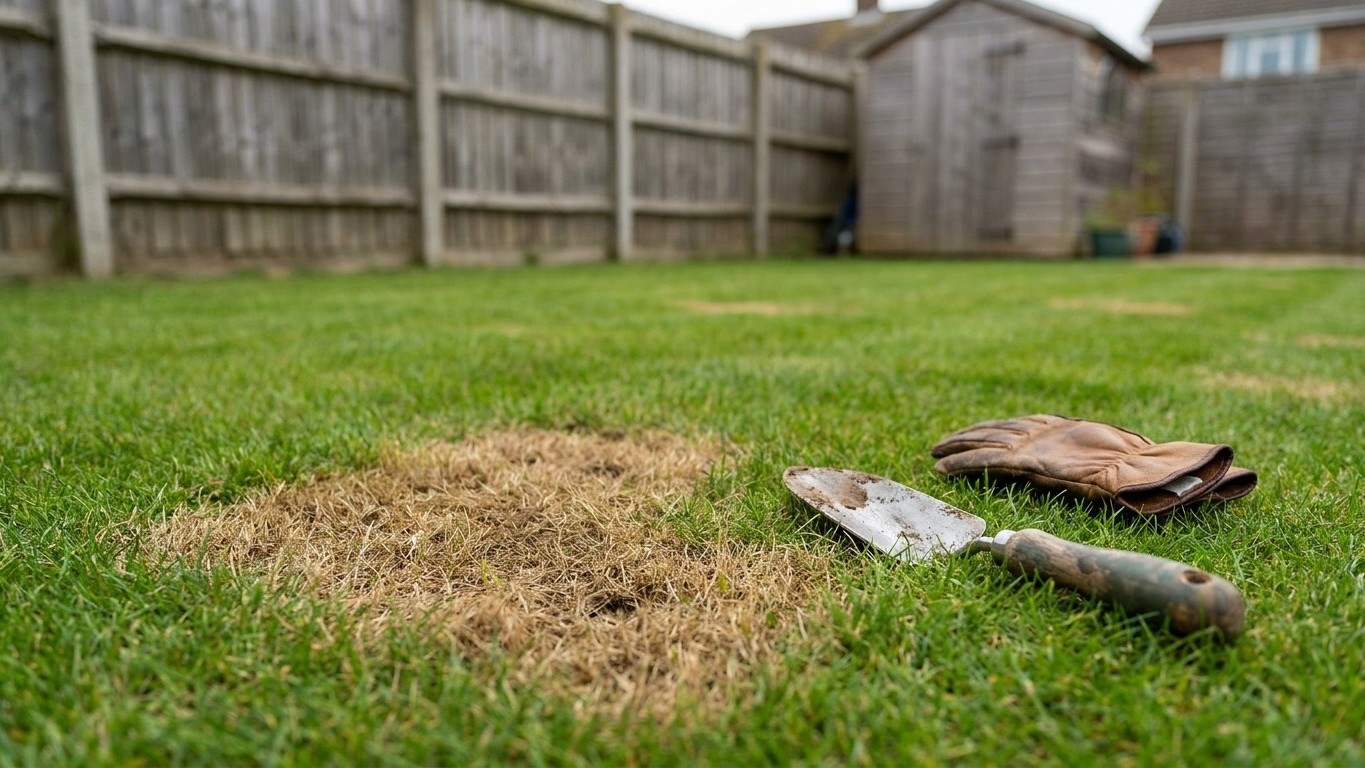

A brown patch‘s shape tells you more than its color does. A tight, near-perfect circle usually points to a fungal disease or a dog’s urine spot. A ragged patch with a soft edge that spreads across open turf points to drought stress or grub feeding. A dead-straight strip almost always traces a mower pass or a fertilizer overlap. Kneel at the edge and pull on a few blades of grass before doing anything else. Whether they resist or lift free tells you which of those three you’re dealing with.
What you are looking at

Start with the outline, not the color. A circle or ring with a sharply defined edge, anywhere from dinner-plate size to several feet across, almost always means something is working outward from a single point: a fungal pathogen, a buried root or old stump, or a concentrated dose of urine or spilled fertilizer. The center of an established ring can green back up while the advancing edge stays brown, producing the classic donut shape some turf diseases leave behind.
An irregular patch with a soft, blurred edge that fades into healthy grass rather than stopping abruptly is a different animal. That gradient usually means the whole area is under the same stress at different intensities: a dry ridge, a compacted path, a slope that sheds water before it soaks in. Drought stress reads as a fading gradient, not a hard line, because water and root depth vary gradually across a yard rather than starting from one point.
A patch with a dead-straight edge or a repeating strip is mechanical or chemical, not biological. A line that runs the width of the yard and stops exactly where a hose or spreader would have stopped is the signature of fertilizer burn or a herbicide overlap. A scalped stripe, lower and browner than the grass on either side, that follows the mower’s path means the deck was set too low for that pass.
Color matters second, after shape. Straw-yellow or tan generally means the tissue is dead or dormant. A reddish or purplish cast at the leaf tips, especially visible on a cool morning, points toward an active fungal infection rather than simple drying out. Check whether the brown area is spreading week to week or staying the same size. A fixed patch from an old event will not grow, while an active fungal or insect problem keeps enlarging.
What it is not
The most common misdiagnosis is grub damage mistaken for drought, or the reverse. Both produce spongy, irregular brown turf, but a simple tug tells them apart. Grab a handful of grass at the patch’s edge and pull. If it lifts free like loose carpet, with no resistance from the roots, suspect grubs or another root-feeding insect rather than dry soil or disease.
- Halo check: a dead center ringed by darker green grass usually means dog urine, not disease.
- Root check: roots that hold firm across a uniformly brown lawn point to dormancy, not damage.
- Blade check: torn, frayed leaf tips instead of a clean cut mean a dull mower blade, not a pathogen.
Dormancy is the look-alike that scares people into unnecessary treatment. A lawn gone uniformly straw-brown across its whole area, with no ring, no hard edge, and no spreading pattern week to week, is very likely dormant rather than dying. Cool-season lawns can go off-color in a hot, dry stretch, and warm-season lawns do it every winter as a matter of course. Neither case calls for fungicide or insecticide, since there is no pathogen or pest to kill, only a plant conserving water or waiting out the cold.
What actually causes it
Lawn damage from disease or environmental stress almost always becomes visible weeks after the event that caused it, not on the day it happened. A brown patch you see today usually reflects a stress from two to three weeks ago, since a fungus needs time to spread through leaf tissue and a drought-stressed plant burns through stored reserves before it shows color loss. Treating today’s patch as today’s problem is the most common reason home fixes miss.
Cool-season lawns
On Kentucky bluegrass, perennial ryegrass, tall fescue, and the fine fescues, most summer brown patches trace back to heat and humidity stress rather than cold. These species are mowed at ranges from 2 to 3.5 inches depending on the grass, according to Penn State Extension’s lawn establishment guidance, and cutting shorter than that range in hot weather removes leaf area the plant needs to shade its own crown and roots. Tall fescue tolerates the stress best of the cool-season group, rated fair for drought by Clemson Cooperative Extension’s HGIC 1214 fact sheet on selecting a lawn grass, while Kentucky bluegrass and perennial ryegrass are rated only fair as well but wear better, which is one reason bluegrass lawns are often the first to show ring-shaped patches in a hot, humid stretch.
Warm-season lawns
Bermudagrass, zoysiagrass, centipedegrass, St. Augustinegrass, bahiagrass, carpetgrass, and seashore paspalum fail on the opposite calendar. They green up latest in spring and go dormant first in fall, and a brown patch that shows up while a warm-season lawn is greening deserves a closer look, since cold injury and spring dead spot both appear as patches at exactly that time of year. St. Augustinegrass and centipedegrass are both rated only fair for drought by HGIC 1214, and both wear poorly, so recurring patches on those lawns more often trace to a dry spell or a worn path than to disease.
| Grass | Mowing height | Drought tolerance | Shade tolerance |
|---|---|---|---|
| Kentucky Bluegrass | 2 to 3 in | Fair | Fair |
| Tall Fescue | 2.5 to 3.5 in | Fair | Good |
| Bermudagrass | 0.75 to 1.5 in | Excellent | Very poor |
| St. Augustinegrass | 2.5 to 4 in | Good | Excellent |
| Zoysiagrass | 0.75 to 2 in | Good | Excellent |
Figures above come from Penn State Extension’s lawn establishment guidance for the cool-season species and Clemson Cooperative Extension’s HGIC 1214 for the warm-season species. A lawn mowed near the low end of its range, or growing in more shade than its rating supports, is set up to brown first when any stress arrives.
Fixing it
Match the fix to the test you already ran, not to the color of the grass. If the roots pulled free, treat for grubs following the product label’s timing and rate, since grub insecticides work only while the larvae are actively feeding near the surface. If the patch showed the fungal signature, a hard edge, a possible reddish cast, spreading week to week, a lawn fungicide labeled for that disease is the direct route. But fungicide is a maintenance cost, not a cure. It protects new growth while you correct the watering or mowing habit that let the disease take hold, and it needs repeat applications on the label’s schedule to hold.
If the pull test held firm and the whole lawn is a uniform straw color, the honest answer is to do nothing but water. A dormant lawn is not a damaged lawn, and pushing fertilizer or fungicide onto dormant turf wastes both money and product, since a plant that is not actively growing is not taking up either one. Patience costs nothing, and treating dormant grass can actually delay recovery by adding chemical or salt stress to a plant that is already conserving resources.
For a urine spot or a fertilizer burn strip, the dead tissue itself will not recover on its own. Rake out the dead grass, loosen the top inch of soil, and reseed with a grass matched to the rest of the lawn, following the timing in Clemson Cooperative Extension’s HGIC 1203 lawn establishment guidance for cool-season species or the matching species maintenance calendar for a warm-season lawn. For a mower-scalp stripe, simply raise the deck back to the species’ recommended range and let the next several mowings grow it out. If the brown area turns out to be a genuine bare spot rather than discolored live turf, Bare Spots in a Lawn: Why They Appear and How to Close Them covers the reseeding steps in more detail.
Keeping it from coming back
Most repeat brown patches trace back to one of three habits: mowing too short for the species, watering too often and too shallow, or feeding at the wrong point in the grass’s growth cycle. Of the three, mowing height is the easiest habit to fix immediately, since it costs nothing and takes effect the next time you cut. Set the deck to the top of the species’ range from HGIC 1214 or Penn State’s establishment guidance rather than the bottom, especially through the hottest weeks, since taller grass shades its own soil and crown and needs less frequent watering to stay green.
Watering habit is the second lever, and the mistake is almost always frequency, not amount. A daily five-minute sprinkle wets only the top inch of soil and trains roots to stay shallow, which is exactly the shallow root system that shows brown first in a dry spell. Watering less often but longer, so moisture reaches several inches down, builds the deeper root system that rides out a dry week without visible stress.
Feeding timing matters more than feeding amount. Clemson Cooperative Extension’s HGIC 1201 fertilizing guidance, along with the species-specific maintenance calendars, HGIC 1215 through 1219, time nitrogen applications to each grass’s active growth period. Feeding a cool-season lawn heavily in the heat of summer, or a warm-season lawn late into fall, pushes tender new growth right before the plant is least able to defend it, which is when disease and cold injury do the most damage. Check the calendar for your species rather than feeding on a fixed monthly schedule.
If the recurring patches sit consistently under a tree canopy rather than in open lawn, the underlying issue may not be a habit at all but a species mismatched to the light it is getting, and Grass That Thins Under Trees: What Will Actually Grow There covers which grasses actually hold up there. For any other recurring lawn trouble, the broader Lawn Problems hub is worth checking before assuming the worst.
Common questions
Will brown grass ever turn green again on its own?
Often, yes, if the roots are intact and the grass is dormant rather than dead. Run the pull test described above. If the roots resist and hold, give the lawn water and time before spending on any product.
How long does a fungal brown patch take to fill back in?
It depends on the disease, the grass species, and the weather, and there is no single figure that holds across every lawn. New growth generally fills a treated patch faster in a species mowed at the top of its recommended height range, since more leaf area means faster recovery.
Can I just reseed over a brown patch without figuring out the cause?
You can, but if the underlying cause is still active, whether disease, insect, or a scalping mower height, new seedlings usually fail the same way the original grass did. Fix the cause first, then reseed.
Is it worth buying a fungicide before I know what disease I have?
No. Fungicides are disease-specific, and using the wrong one wastes money and delays proper treatment. If the shape, edge, and color point toward a specific disease, check with your state extension service before buying anything, since several fungicide products are restricted for home use in some states.