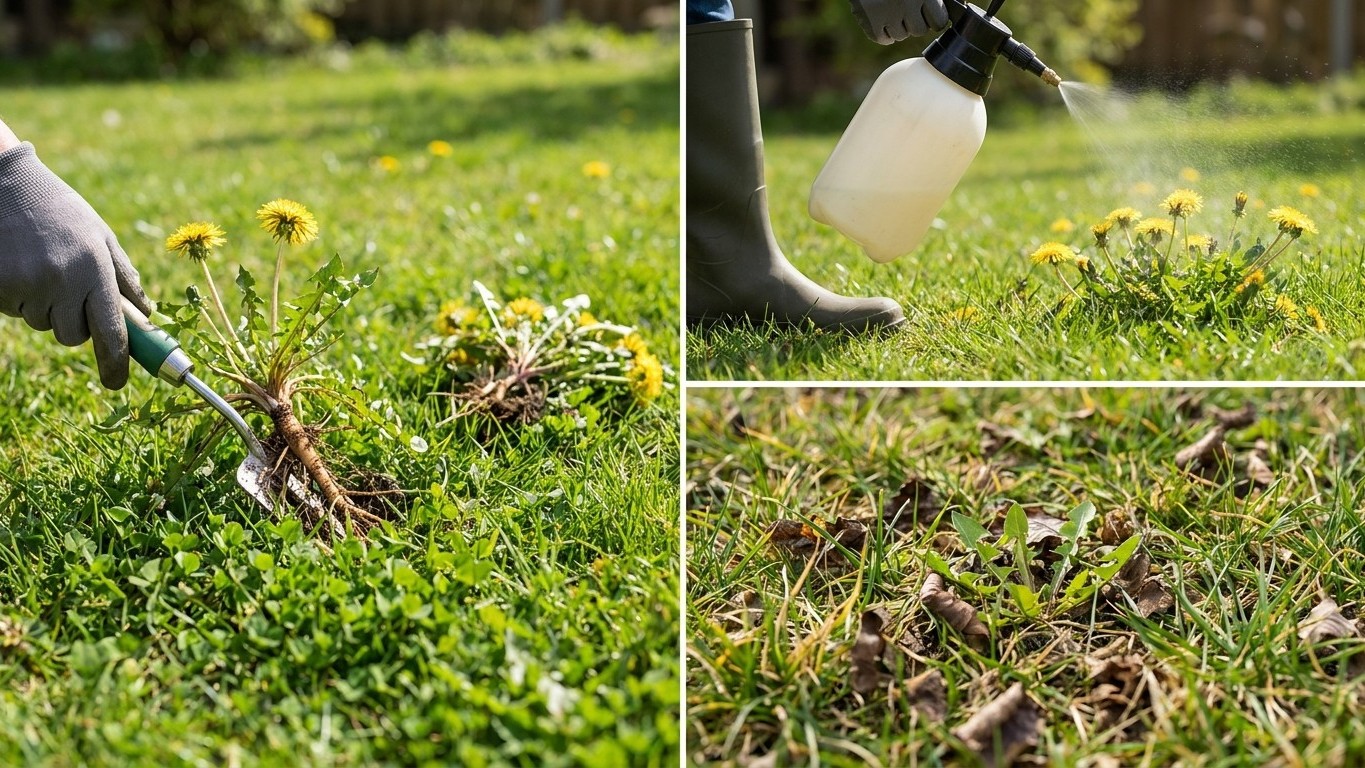

A dandelion is the low rosette of jagged, deeply toothed leaves that sends up a single hollow stalk topped by one bright yellow flower head, later turning into the familiar white puffball of seed. It is a perennial that comes back from a deep taproot even after the leaves and flower are mowed off flush with the soil. If you are not sure what you are looking at, snap a leaf: dandelion sap runs milky white right away, a detail its lookalikes do not share. Check that before you spend money on a herbicide you may not need.
How to be sure that is what you have

The leaves grow flat in a rosette, pressed against the ground rather than standing up, and each leaf is deeply lobed with the points usually angled back toward the base, which is where the plant gets its common comparison to a lion’s tooth. No leaf grows on the flower stalk itself. The stalk is hollow, smooth, and carries exactly one flower head, never a branched cluster of several. Break that stalk or a leaf and the sap that beads up is milky white, a reaction you can check in seconds and one the two plants people confuse it with do not produce the same way.
Dandelion is most often mistaken for cat’s ear (Hypochaeris radicata) and for one of the hawkweeds or hawksbeards. Cat’s ear has the same rosette habit but its leaves and stem are covered in short, coarse hairs, and its flower stalk usually branches to carry two or three heads instead of one. Hawksbeard behaves the same way: a branched, hairy stem with multiple smaller flower heads rather than dandelion’s single bloom on bare, hollow stalk. If the stalk branches or feels hairy, it is not a dandelion, whatever the flower looks like from a distance.
What it looks like through the seasons
The rosette persists through winter close to the ground and often stays green under snow cover in mild spells. Growth resumes as soon as the soil warms, and the first flush of yellow flowers usually appears before the surrounding lawn has fully greened up, which is why dandelion looks so conspicuous in early spring. A second, smaller bloom often follows during the cooler weeks of fall. Between bloom periods the plant is easy to miss: just a rosette of leaves, no stalk, no flower, quietly rebuilding its taproot.
Why it is in your lawn
A dandelion seed needs open soil and light to germinate, and it gets both wherever turf has thinned out. Thin turf is the single condition that invites it in: mowing too short, mowing on a dull blade that shreds rather than cuts, drought stress, or a bare patch left by foot traffic or a dead patch of disease all open the same gap. Once the canopy above the soil is gone, a wind-blown dandelion seed has exactly the bright, undefended ground it needs.
Compacted soil compounds the problem because it slows the grass roots that would otherwise crowd a seedling out before it establishes a taproot. Dandelion’s taproot handles hard, dry ground better than fine turfgrass roots do, so a lawn with compaction from equipment traffic, foot traffic, or heavy clay ends up favoring the weed over the grass every time conditions turn dry. Compacted soil invites the same weeds that show up in thin turf generally: clover where nitrogen is running low, and broadleaf plantain where the ground has been packed hard by repeated traffic. Dandelion tends to be the third member of that group, and it shows up in the same bare, bright soil the other two prefer.
None of this means the lawn is dying. A patchy stand of dandelion is a sign the turf underneath it is thin, not that the grass itself is diseased or doomed. Fix the thinning and the weed loses its opening.
The window that decides everything
Pre-emergent herbicide works on seeds as they germinate. It does nothing for a dandelion that is already established with a taproot in the ground, so its only real job here is stopping the next generation of seedlings before they take hold. Clemson Cooperative Extension’s HGIC 1219 Tall Fescue Maintenance Calendar times spring pre-emergent applications to forsythia and dogwood bloom, because the same soil temperature that pushes those shrubs into flower is what triggers weed seed germination. That bloom signal is a useful stand-in for a soil thermometer, and it moves with the calendar year to year rather than sitting on a fixed date.
Post-emergent herbicide is the tool for dandelions already growing, and it works by being absorbed through the leaf and carried down into the root, which is the only way to affect a taproot without digging. That means timing follows the plant’s growth, not the calendar: a dandelion actively pushing new leaf growth takes up and translocates the herbicide far better than one sitting dormant through summer heat or winter cold.
The forsythia-and-dogwood signal arrives weeks apart from one part of the country to another, so treat it as a trigger to watch for locally rather than a date to circle in advance. Once you have confirmed this is a broadleaf problem rather than one of the other common lawn weeds competing for the same bare ground, check your own state extension’s spring maintenance calendar for the equivalent bloom cue in your area before you buy anything.
Getting rid of it
Pulling by hand
Hand-pulling works, but only if the taproot comes with it. A dandelion taproot can run a foot or more into loose soil, and if it snaps off below the crown, the remaining piece usually resprouts within a few weeks. A weeding tool with a forked or serrated head that gets several inches down the side of the root before you pull gives a far better chance of taking the whole thing, especially right after rain or watering when the soil is soft. Check back on any spot you pulled; a rosette regrowing from a broken root looks smaller and more crowded than the original.
Chemical control
The broadleaf herbicides used against dandelion are auxin-type actives: 2,4-D, mecoprop (MCPP), dicamba, and triclopyr are the names to look for on a label, sometimes combined in a single product. These work because grass is a monocot and mostly tolerates them, while a broadleaf plant like dandelion absorbs and overdoses on them. That selectivity is also the risk: drift or overspray onto garden beds, vegetables, or ornamental trees can injure or kill them, and some warm-season lawn grasses are more herbicide-sensitive than others, so read the label against your specific turf species before spraying.
Several of these actives are restricted for homeowner use in some states, and the list changes. Check your own state’s current restrictions through your state extension service before buying a product, rather than assuming what is sold on a shelf is legal to apply everywhere.
- 2,4-D: broadleaf-selective, one of the oldest and most common actives
- Mecoprop (MCPP): often paired with 2,4-D for broader broadleaf control
- Dicamba: effective on tougher perennial broadleaf weeds, more prone to root uptake and drift injury
- Triclopyr: strong on woody and broadleaf weeds, frequently used where dicamba is restricted
Keeping it out
Turf density is the real control
No herbicide schedule outperforms a lawn thick enough that dandelion seed never reaches bare soil. Mowing height is the cheapest lever: cutting at the top of the recommended range for your species shades the soil surface and keeps a stand of turf dense enough to out-compete seedlings, while cutting short does the opposite and opens the same gaps that invited the weed in the first place. Clemson Cooperative Extension’s HGIC 1205 Mowing Lawns and HGIC 1201 Fertilizing Lawns both tie mowing height and feeding timing to the density that keeps weeds out, and matching the grass species to the site matters as much as either practice.
| Species | Season | Mowing height | Shade tolerance | Drought tolerance |
|---|---|---|---|---|
| Fine Fescues | Cool | 2.5–3.5 in | Excellent | Good |
| Kentucky Bluegrass | Cool | 2–3 in | Fair | Fair |
| Perennial Ryegrass | Cool | 2–3 in | Fair | Fair |
| Tall Fescue | Cool | 2.5–3.5 in | Good | Fair |
| Zoysiagrass | Warm | 0.75–2 in | Excellent | Good |
| St. Augustinegrass | Warm | 2.5–4 in | Excellent | Good |
| Bermudagrass | Warm | 0.75–1.5 in | Very poor | Excellent |
| Centipedegrass | Warm | 1.5–2 in | Fair | Fair |
Source: Penn State Extension Lawn Establishment for the cool-season rows; Clemson Cooperative Extension HGIC 1214 Selecting a Lawn Grass for the warm-season rows.
Overseeding a thin cool-season lawn on schedule, and topdressing bare warm-season patches so runners can fill in, closes the gaps a dandelion seed would otherwise land in. Feeding on the timing your species-specific Clemson maintenance calendar recommends (HGIC 1215 for centipedegrass, 1216 for bermudagrass, 1217 for zoysiagrass, 1218 for St. Augustinegrass, 1219 for tall fescue) builds the root density that crowds weeds out without relying on a spray program at all.
Common questions
Do I need to kill every dandelion or just the flowering ones?
Treat any rosette you can identify, not just the ones in bloom. A rosette without a flower stalk is still building up its taproot and will flower on its own schedule, so waiting for yellow blooms just gives it more time underground.
Will vinegar or boiling water actually kill the root?
Both scorch the leaves you pour them on, but neither reliably reaches a taproot a foot or more down, so most rosettes resprout from the crown within a few weeks. They work better as a spot treatment on driveway cracks than inside a lawn you want to keep.
My lawn is brown after I sprayed, did I kill the grass?
Probably not. Grass can go off-color for a week or two after a broadleaf herbicide application without being dead, and a cool-season lawn under heat stress at the same time can look far worse than it is. Water normally and check for new green growth before assuming the turf itself was injured.
Why did dandelions come back the same week I mowed them off?
Mowing removes the flower and leaves but leaves the taproot untouched, and that root can push up a new rosette within days. Mowing controls seed spread if you do it before the flowers turn to a white puffball, but it is not a control for the plant itself.