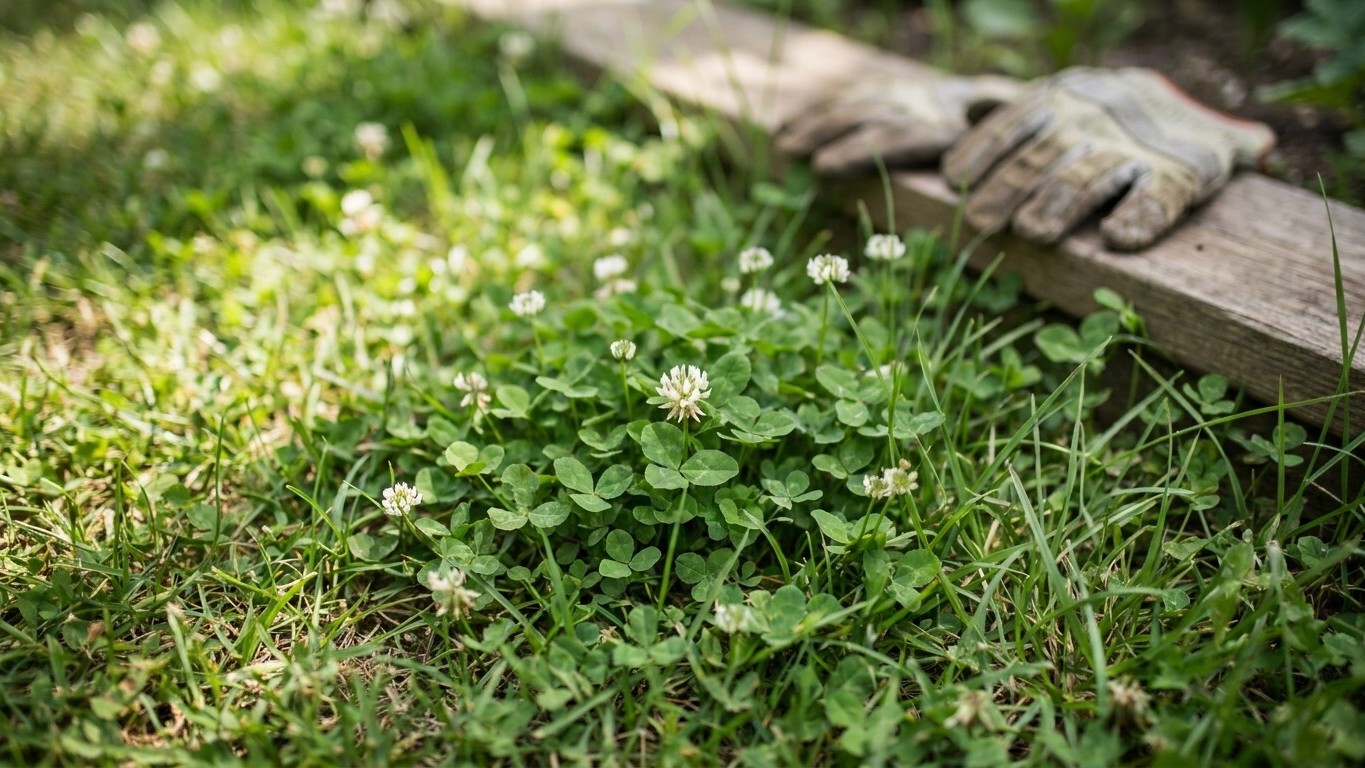

That patchy green low spot in your lawn isn’t a random invader — it’s clover moving in because the grass there got too thin or too hungry to hold its own ground. It shows up where the turf already lost a step: worn paths, compacted edges, a spot that missed a feeding. So before you buy anything to kill it, go check your mower height against what your grass actually needs, because cutting too low is very often the crack clover walked through in the first place.
How to be sure that is what you have

White clover (Trifolium repens) is easy to identify once you know the leaf. Each leaflet comes in a set of three, oval and slightly notched at the tip, with a pale crescent or V-shaped mark near the base. The plant grows flat against the ground on trailing stems called stolons that root wherever a node touches soil, which is how a single plant becomes a spreading patch within one season. Flower heads are round, white to pale pink, held on their own short stalks just above the leaves, opening through the warm months wherever the mower leaves them tall enough to bloom.
Two look-alikes
Black medic also carries three small oval leaflets, but they lack clover’s pale marking, and its flowers are tiny, tight, yellow clusters rather than white puffballs. It favors the same compacted, low-fertility ground clover prefers, so the two often turn up side by side in the same bare patch. Yellow woodsorrel, a wood sorrel and not a true clover at all, folds its three leaflets into a heart shape at the midrib, closer to a shamrock than an oval, and its small bright yellow flowers are followed by narrow upright seed pods that snap open and fling seed when brushed. Neither look-alike fixes nitrogen the way clover does, which matters once you start asking why the plant showed up at all.
Clover shows up first at a lawn’s thin spots: along paths worn by foot traffic, at the base of downspouts where soil stays wet, and in any patch where the grass canopy has opened enough to let light reach bare ground. It holds its color through a stretch of dry weather that would brown out the grass around it, because its own root system and its partnership with nitrogen-fixing soil bacteria let it get by on less. That contrast is usually the first thing a homeowner notices, often described as the only green patch left in a dry August lawn.
Why it is in your lawn
Clover is one entry on a long list of lawn weeds, and most of them arrive by the same route: a gap opens in the grass, and something faster or hungrier fills it before the turf can. Clover’s advantage is nitrogen. As a legume, it partners with soil bacteria that pull nitrogen straight from the air, so it thrives in exactly the low-fertility ground where turfgrass, which cannot do that trick, struggles and thins out. A lawn that has gone a season or two without feeding is prime ground for it.
Compaction adds to the invitation. Foot traffic, driveway edges, and soil that never gets aerated pack the ground tight, squeezing out the air pockets grass roots need while clover’s shallower, more opportunistic roots tolerate the squeeze better. Poor drainage works the same way from the other direction: a low spot that stays wet drowns grass roots before it bothers clover at all.
Mowing height is the variable most homeowners control without realizing it. Cutting a Kentucky bluegrass or perennial ryegrass lawn below the 2 to 3 inch range Penn State Extension recommends, or a fine fescue or tall fescue lawn below the 2.5 to 3.5 inch range that same source and Clemson Cooperative Extension’s HGIC 1214 both give, opens the canopy and lets light reach the soil surface where clover seed is waiting.
The short version: clover rarely takes over a thick, well-fed lawn. It takes over the parts of a lawn that were already struggling for another reason, which usually include:
- Compacted soil along paths, driveways and play areas
- Low nitrogen from a lawn that missed a feeding cycle
- Mowing height set below what the grass species needs
- Poor drainage in low spots or heavy clay soil
- Thin or bare patches left by shade, wear, or disease
The window that decides everything
Clover is a perennial, so the plants already established in a lawn will not be timed out by a pre-emergent application. Pre-emergent herbicides work on germinating seed, and most of the clover a homeowner is fighting is already growing from a crown or a rooted stolon, not a fresh seedling. That makes clover control mostly a post-emergent job: a broadleaf herbicide applied while the plant is actively growing.
Timing still matters, just measured differently than a pre-emergent calendar date. Clemson Cooperative Extension’s HGIC 1219 Tall Fescue Maintenance Calendar times pre-emergent crabgrass control to forsythia and dogwood bloom rather than a fixed date, because soil temperature, not the calendar, triggers weed seed germination. The same bloom-stage logic is worth borrowing for clover: treat it while it is putting on new growth in spring or fall, not while it is heat-stressed in midsummer or dormant in winter, when a broadleaf herbicide has far less living leaf tissue to move through.
Why a date will mislead you
Forsythia and dogwood do not bloom on the same week in a northern state and a southern one, and they will not bloom on the same week in two counties of the same state in a cool spring versus a warm one. That is the entire point of using a bloom stage instead of a date: it tracks soil temperature instead of a page on the calendar. Check your own state extension’s lawn calendar for the local equivalent before buying a product, because the window can land weeks apart between a northern and a southern county even within a single region.
Fall tends to be the more forgiving season to treat established clover, since the plant is pulling energy down into its roots ahead of winter and carries a systemic herbicide with it, but a spring application while clover is flowering and growing fast also works well. What does not work is spraying a plant that is drought-stressed, freshly mowed with little leaf left to absorb the product, or already easing into dormancy.
Getting rid of it
Hand-pulling works better on clover than on most lawn weeds, because its stolons root shallowly and pull free with light tension in loose or moist soil. Unlike nutsedge, where pulling the top growth actually multiplies the problem (see Nutsedge: Why Pulling It Makes It Worse), a stray clover fragment left behind after a careless pull is unlikely to reestablish the way an intact rooted stem would. Get the crown and most of the stolon out, and pull with a hand fork rather than fingers alone once the patch gets thick, since a fork lifts more of the root system per pass.
Chemical options, and their limits
Where clover covers too much ground to pull, a post-emergent broadleaf herbicide is the practical choice, but the active ingredient matters more than the brand on the shelf. 2,4-D used alone often struggles against established clover, which tolerates it better than most broadleaf weeds do. Combination products carrying dicamba or triclopyr alongside 2,4-D, sold as three-way broadleaf mixes, are more consistent against clover specifically. None of them touch a grassy weed such as quackgrass, which needs an entirely different approach since it is a grass itself sharing clover’s cool-season lawn but none of its broadleaf chemistry.
Read the label before you buy, not after. Broadleaf mixes that are safe on Kentucky bluegrass or tall fescue can injure or kill warm-season lawns such as St. Augustinegrass and centipedegrass, especially applied at the wrong temperature or rate, and several active ingredients including dicamba carry state-specific restrictions or require a licensed applicator in parts of the country. Check with your state department of agriculture or your extension office before buying, rather than assume the shelf label covers your state’s rules.
A single pass rarely finishes an established patch. Clover’s stolons often root ahead of where the spray reached, and a stand that took a couple of seasons to spread that far usually needs a second treatment three to four weeks later to catch the regrowth the first pass missed. Spot-treating the patches rather than blanket-spraying the whole yard saves product and keeps a broadleaf herbicide off grass that never needed it.
Keeping it out
Thick turf is the only control that lasts, because clover needs an opening to establish and a dense stand of grass never gives it one. Getting there starts with matching mowing height and feeding timing to the grass species actually growing in the lawn, not a generic close-cut habit.
Match the grass to the height it needs
| Grass | Mowing height | Shade tolerance | Drought tolerance | Wear tolerance |
|---|---|---|---|---|
| Fine Fescues | 2.5 to 3.5 in | Excellent | Good | Poor |
| Kentucky Bluegrass | 2 to 3 in | Fair | Fair | Good |
| Perennial Ryegrass | 2 to 3 in | Fair | Fair | Good |
| Rough Bluegrass | 2 to 3 in | Excellent | Poor | Poor |
| Tall Fescue | 2.5 to 3.5 in | Good | Fair | Fair |
| Bahiagrass | 3 to 4 in | Poor | Excellent | Good |
| Bermudagrass | 0.75 to 1.5 in | Very poor | Excellent | Excellent |
| Carpetgrass | 1 to 2 in | Fair | Very poor | Poor |
| Centipedegrass | 1.5 to 2 in | Fair | Fair | Poor |
| Seashore Paspalum | 1 to 1.5 in | Poor to fair | Fair to good | Good |
| St. Augustinegrass | 2.5 to 4 in | Excellent | Good | Fair |
| Zoysiagrass | 0.75 to 2 in | Excellent | Good | Very good |
Cool-season figures come from Penn State Extension’s lawn establishment guidance. Warm-season figures come from Clemson Cooperative Extension’s HGIC 1214. Mow toward the top of the range through summer stress and the bottom of it only when the grass is growing fast, since a taller canopy shades the soil surface clover seed needs to germinate.
Feeding on the schedule your grass type calls for closes the other opening. A lawn fed on the timing Clemson Cooperative Extension’s HGIC 1201 sets out for its cool- or warm-season species keeps a canopy dense enough that clover has nowhere to root even where a stray seed lands. Overseeding thin or bare patches each fall on a cool-season lawn, or plugging and sodding bare spots on a warm-season lawn, closes the gaps clover would otherwise fill on its own.
Common questions
Will clover kill my grass if I leave it alone?
No, clover does not kill grass the way a disease or a grub infestation does. It simply occupies the space already opened up by thin turf, so leaving it alone mostly means that patch stays clover instead of filling back in with grass on its own.
Is clover actually good for my lawn?
It fixes nitrogen in the soil around its own roots, which is a real benefit to the ground it occupies, though the effect stays local to that patch rather than feeding the whole lawn. Some homeowners now overseed clover into a lawn deliberately for that reason and to cut back on mowing and fertilizing.
Why did clover come back after I sprayed it last year?
Most likely the underlying thin spot, compacted soil, low fertility, or a mowing height that opens the canopy, never got fixed, so the same opening simply reseeded or regrew from a surviving root. Herbicide clears the plant standing there, not the condition that let it establish in the first place.
Can I just mow clover shorter to get rid of it?
Mowing short does the opposite: it thins the grass around the clover and opens more room for it to spread, since clover grows low enough to keep flowering and spreading under a close cut that would stress the turf competing with it.