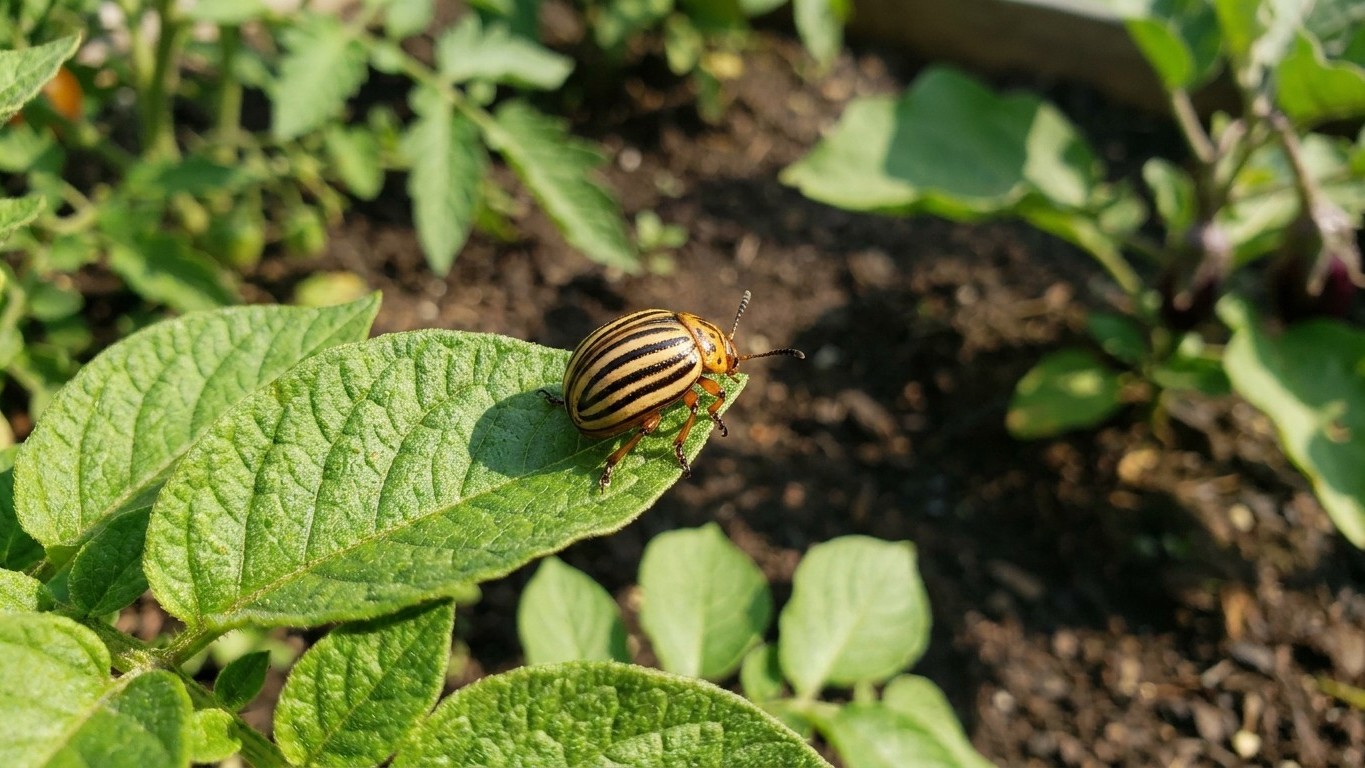

Colorado potato beetle turns up in Georgia mostly in home gardens and small farm plots growing potatoes, eggplant, or tomatoes, typically from late April through early July, with a second wave possible in late summer in the northern part of the state. It’s not the year-round menace it is in the Northeast or Midwest, but Georgia gardeners who plant nightshade-family crops still need to watch for it, especially in the Piedmont and mountain counties where cooler spring soil delays and then concentrates its emergence.
Where and When It Shows Up in Georgia

Georgia sits near the southern edge of this beetle’s comfort zone. Leptinotarsa decemlineata is originally a Rocky Mountain species that expanded east with potato farming in the 1800s, and it thrives best where winters are cold enough to force a true dormancy but summers aren’t brutally humid for months on end. Georgia’s mild winters mean adults overwintering in garden soil or field edges can wake up early, sometimes as soon as soil temperatures hit the low 50s, which in much of the state happens by mid-to-late March.
That early wake-up call doesn’t necessarily mean bigger populations. Extension entomologists across the Southeast have consistently reported lower Colorado potato beetle pressure in Georgia compared to states like Virginia, Pennsylvania, or Michigan. Part of the reason is host availability: Georgia isn’t a major commercial potato state, so the beetle doesn’t have the same wall-to-wall food supply that keeps populations exploding season after season in potato belt regions. Most Georgia sightings come from backyard vegetable patches and small diversified farms growing potatoes alongside eggplant or heirloom tomatoes.
Elevation matters too. Gardeners in north Georgia, around Rabun, Union, or Habersham counties, tend to see beetle activity stretch a bit later into the season because cooler nights slow the insect’s development. In the Coastal Plain, where soil warms faster and stays warmer, beetles can complete a generation in as little as three to four weeks under good conditions, meaning a garden could theoretically host two full generations before the July heat dome settles in and knocks populations back.
Why Summer Heat Actually Works Against the Beetle
Here’s the twist that surprises a lot of Georgia gardeners: extreme heat isn’t the beetle’s friend. Research on Colorado potato beetle physiology shows adult activity and egg-laying drop sharply once daytime temperatures push past the mid-90s for extended stretches, which happens routinely across Georgia by July. That’s one reason the pest rarely becomes the season-long nightmare here that it is farther north. The real window of concern is that six-to-eight week stretch from beetle emergence to the arrival of true Georgia summer heat.
How to Recognize It Before It Strips Your Plants
Misidentification wastes time, and time matters with this insect because a small population can defoliate a young potato or eggplant plant in days. The adult is unmistakable once you know the pattern: a rounded, hard-shelled beetle about 3/8 inch long, tan to yellowish-orange with ten black stripes running the length of its wing covers. No other common Georgia garden beetle wears that exact black-and-cream racing-stripe look.
Eggs are laid in tight clusters of 10 to 30, bright orange-yellow, standing on end on the underside of leaves. The larvae are the stage that does the real damage, plump and reddish-orange with two rows of black spots along each side, growing from the size of a pinhead to nearly half an inch before pupating in the soil. A field or garden bed with heavy feeding will show skeletonized leaves, just veins left standing, usually starting on lower foliage and working upward.
- Adults overwinter in soil and garden debris, emerging in Georgia as early as March in warm springs
- Egg clusters appear within a week or two of emergence, always on leaf undersides
- Larvae cause the most damage and molt through four growth stages over two to three weeks
- A full generation, egg to adult, can complete in under a month during warm Georgia spring weather
What Actually Stops Colorado Potato Beetle in Georgia Gardens
Control works best when it starts before the population builds, because this beetle reproduces fast enough to outrun reactive spraying once larvae are established. The most reliable Georgia-specific approach layers several tactics rather than leaning on one product.
Hand-picking still works surprisingly well in small gardens. Adults are slow-moving and easy to knock into a jar of soapy water in the cool morning hours when they’re least active. Crushing egg clusters on the underside of leaves before they hatch eliminates an entire generation with zero chemical input, and it’s the single most effective ten-minutes-a-week habit a Georgia gardener can adopt in April and May.
Crop rotation matters more than most gardeners realize. Because adults overwinter in soil near where they fed the previous season, moving potatoes, eggplant, and tomatoes to a different section of the garden each year, ideally at least 30 feet away, forces emerging beetles to travel farther to find food, and many simply don’t make it. Rotating with unrelated crops like beans, squash, or greens for at least one season breaks the cycle without any product cost.
Row covers put down at planting and left on until flowering block adults from ever reaching young plants during that vulnerable early window. Since Colorado potato beetle in Georgia often arrives before pollination is needed, covers can stay sealed longer here than in regions where beetles show up mid-season.
Biological and Chemical Options That Hold Up
Bacillus thuringiensis var. tenebrionis (sold as Bt-tenebrionis or Bt “san diego” strain) targets young larvae specifically and spares most beneficial insects, making it a solid first chemical step for home gardens. Spinosad-based products offer another option with lower toxicity to pollinators when applied in the evening after bees have left the flowers.
The bigger issue nationally, and one Georgia growers shouldn’t ignore, is resistance. Colorado potato beetle populations across the U.S. have developed resistance to multiple insecticide classes over the decades, including certain pyrethroids and neonicotinoids, largely from repeated use of the same active ingredient. Rotating between different modes of action, rather than reaching for the same spray bottle every time, slows that resistance buildup and keeps existing tools effective longer.
Natural predators help too, even if they rarely provide complete control on their own. Ground beetles, spined soldier bugs, and lady beetle larvae all feed on Colorado potato beetle eggs and young larvae. Gardens that avoid broad-spectrum insecticide use tend to build up these predator populations over a season or two, which is one more argument for reaching for Bt or hand-picking before jumping to synthetic sprays.
Monitoring Timing for Georgia Gardeners
Checking plants twice a week starting in early spring, rather than waiting for visible damage, catches the problem at the egg stage when control is cheapest and easiest. Marking a calendar reminder for late March in south Georgia and mid-April in the mountains lines up with typical overwintering adult emergence based on soil temperature patterns.
Gardeners who lost plants to this beetle the previous year should pay closer attention the following spring in that same bed, since local overwintering adults will emerge nearby unless the planting location changes. A single missed generation in June can still produce enough new adults to overwinter and restart the cycle the following March, which is why the small early-season efforts, egg-crushing, rotation, row covers, tend to pay off far more than late-season rescue spraying once larvae have already stripped a plant to bare stems.