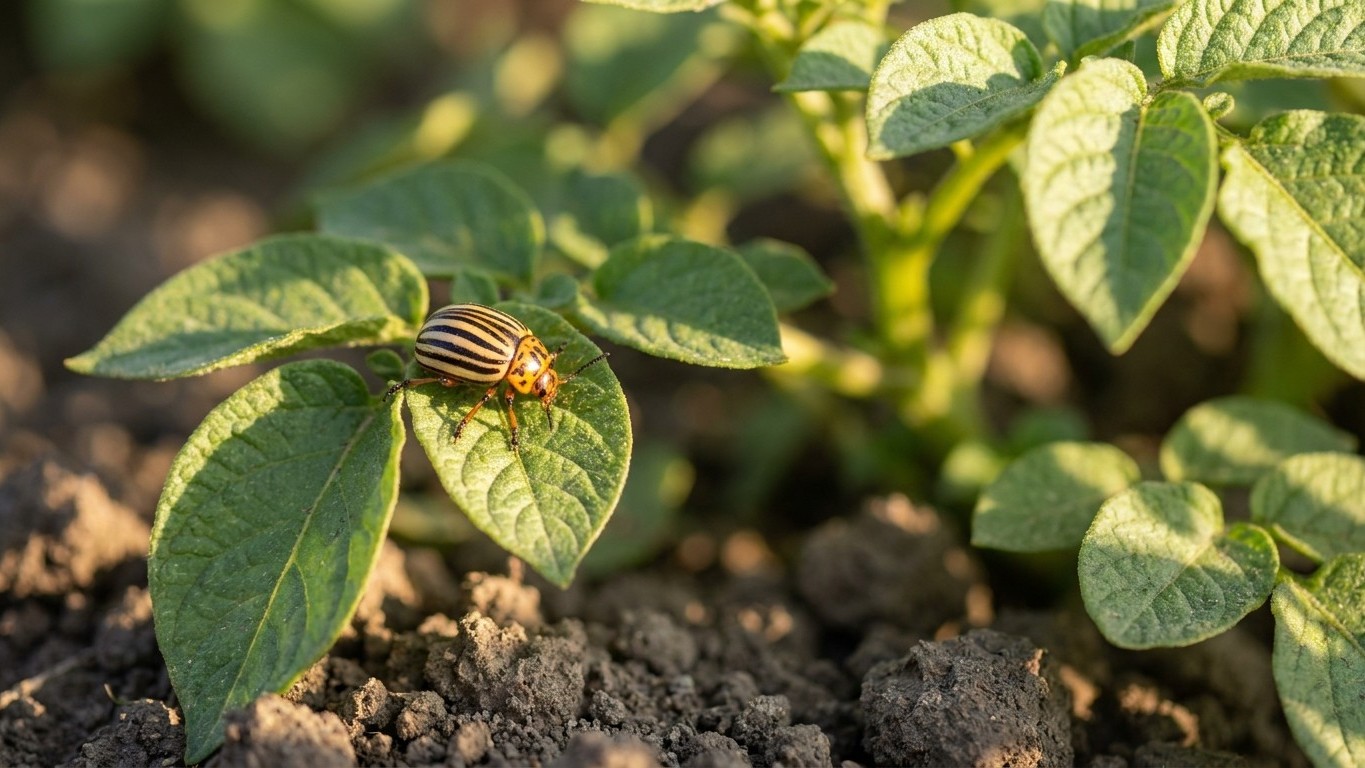

Colorado potato beetles show up in Idaho fields and gardens in late spring, usually between mid-May and early June, once soil temperatures climb past 50°F. They stick around through September, cycling through one to three generations depending on how warm the season runs. Nothing stops them cold except a combination of tactics: crop rotation, physical barriers like straw mulch or row covers, targeted insecticides rotated to avoid resistance, and consistent scouting before larvae strip a plant bare.
That’s the short version. Idaho grows roughly a third of the nation’s potatoes, concentrated across the Snake River Plain, the Magic Valley around Twin Falls, and the eastern counties near Idaho Falls and Rexburg. Wherever there’s a potato crop, this beetle eventually finds it. The insect doesn’t discriminate between a 3,000-acre commercial field and a raised bed behind a house in Meridian.
When the Beetle Actually Shows Up

Adult Colorado potato beetles overwinter buried a few inches deep in soil, often at field edges or in windbreaks. They wait out Idaho’s winter in a dormant state and re-emerge once the ground warms, typically triggered by soil temperatures hitting the low 50s Fahrenheit. In the warmer, lower-elevation ground around Nampa and Caldwell, that can happen in early May. Up in the higher elevations near Rexburg or Idaho Falls, where frost lingers longer, emergence often waits until late May or the first week of June.
Once they’re out, adults fly or walk toward the nearest host plant, usually a volunteer potato from last year’s crop or an early-planted field. They feed for a week or two before mating, then females start laying eggs on the undersides of leaves in tight clusters of 20 to 40, colored bright orange-yellow so they’re actually easy to spot if you know to check the leaf undersides.
A single female can lay up to 800 eggs over her lifetime. That’s the number that makes this pest genuinely dangerous to a crop: a handful of overwintering adults in April can produce a leaf-stripping population by July if nobody intervenes.
How Many Generations Idaho Sees Each Year
Southern Idaho’s growing season is long enough to support two generations most years, and in unusually warm stretches, a partial third generation can develop before fall frost shuts things down. Each generation from egg to adult takes roughly three to four weeks in warm conditions, faster than that when temperatures push into the 80s. That compressed timeline is why an infestation that looks minor in June can look catastrophic by mid-July if it’s ignored.
Spotting the Damage Before It Spreads
The adults are hard to miss once you know the pattern: about 3/8 inch long, yellowish-orange, with ten black stripes running down the wing covers, which is where the species name decemlineata comes from. But adults do relatively modest feeding damage compared to what comes next.
Larvae are the real threat. They start as tiny reddish grubs and grow into plump, humpbacked orange-red larvae with two rows of black spots along each side. Four larval stages happen over about two to three weeks, and each stage eats considerably more than the last. A field of larvae in their final instar can defoliate a potato plant in days.
Watch for these signs during a walk through the rows:
- Ragged, chewed leaf edges starting at the plant’s lower canopy
- Clusters of orange-yellow eggs on leaf undersides
- Orange-red humpbacked larvae clustered near the eggs
- Skeletonized leaves, just veins left, on heavily infested plants
- Adult beetles mating or feeding on top leaves in early summer
Defoliation matters most during tuber bulking, the stretch in mid to late summer when the plant is converting leaf energy into potato growth underground. Losing 30% or more of leaf area during that window can cut yield noticeably, which is exactly why commercial growers scout weekly rather than waiting for obvious damage.
Why This Pest Is Hard to Kill With Chemicals Alone
Colorado potato beetle has a reputation among entomologists for adapting faster than almost any other agricultural pest. It’s developed resistance to nearly every major insecticide class used against it at some point, going back to DDT in the 1950s and continuing through organophosphates, carbamates, pyrethroids, and more recently some neonicotinoid products in certain regions. That track record is the reason blanket spraying with a single product year after year tends to fail within a few seasons.
The practical response, both for large growers and home gardeners, is rotation and restraint. Using a product only when populations cross an actual damage threshold, alternating between different modes of action from one application to the next, and mixing in non-chemical tactics all slow down how fast the beetle population adapts. Products based on Bacillus thuringiensis subspecies tenebrionis (often labeled Btt) target the larval stage specifically and have a lower resistance risk than broad-spectrum sprays. Spinosad-based products are another option many home gardeners reach for because they’re effective against larvae with fewer non-target effects than older chemistries.
Biological and Cultural Controls That Actually Help
Idaho gardeners and small-scale growers have a few reliable, low-cost tools that don’t rely on chemicals at all:
- Crop rotation: moving potatoes, tomatoes, or eggplant to a different part of the garden each year forces overwintering beetles to travel farther to find food, and many simply don’t make it
- Deep straw mulch: a thick layer around plants makes it physically harder for emerging adults to reach the surface and locate host plants
- Hand-picking eggs and larvae: checking leaf undersides every few days during peak season and crushing egg clusters is tedious but genuinely effective on a garden scale
- Row covers: lightweight fabric over young plants blocks adults from landing and laying eggs, though covers need to come off once plants flower if pollination matters
- Natural predators: ground beetles, lady beetles, and certain stink bug species prey on eggs and young larvae, so avoiding broad-spectrum insecticides that kill beneficial insects pays off over a season
None of these alone stops a heavy infestation. Combined, they cut population growth enough that any chemical treatment needed becomes a mop-up operation rather than the main defense.
What Idaho Growers and Gardeners Watch For Each Season
Timing scouting to the beetle’s biology matters more than spraying on a calendar. University extension programs across potato-growing states generally recommend starting field checks as soon as soil temperatures hit the 50-degree mark in spring, then continuing weekly checks through the season, focusing extra attention on field edges where overwintering adults tend to concentrate first.
Destroying volunteer potato plants left over from the previous season removes an early food source that lets beetle populations build before the new crop is even up. Tilling field edges in fall, where many adults burrow in to overwinter, is another tactic commercial operations use to reduce the population that survives to spring. Home gardeners can do a version of this by clearing old potato and tomato debris at season’s end rather than leaving it to rot in place.
One detail that surprises a lot of first-time potato growers in Idaho: the beetle isn’t picky about which Solanaceae crop it eats. Tomatoes, eggplant, and peppers in a backyard garden can all host it, meaning a beetle problem in the potato patch this year can easily become a tomato problem next year if the garden layout doesn’t change. Rotating where nightshade-family crops go, even in a small suburban plot, breaks that cycle more effectively than any single spray application.
Related guides
- Colorado potato beetle in Washington: When It Shows Up and What Stops It
- Colorado potato beetle in Wyoming: When It Shows Up and What Stops It
- Colorado potato beetle in Illinois: When It Shows Up and What Stops It
- Colorado potato beetle in Indiana: When It Shows Up and What Stops It
- Colorado potato beetle in South Dakota: When It Shows Up and What Stops It
- Colorado potato beetle in Ontario: When It Shows Up and What Stops It