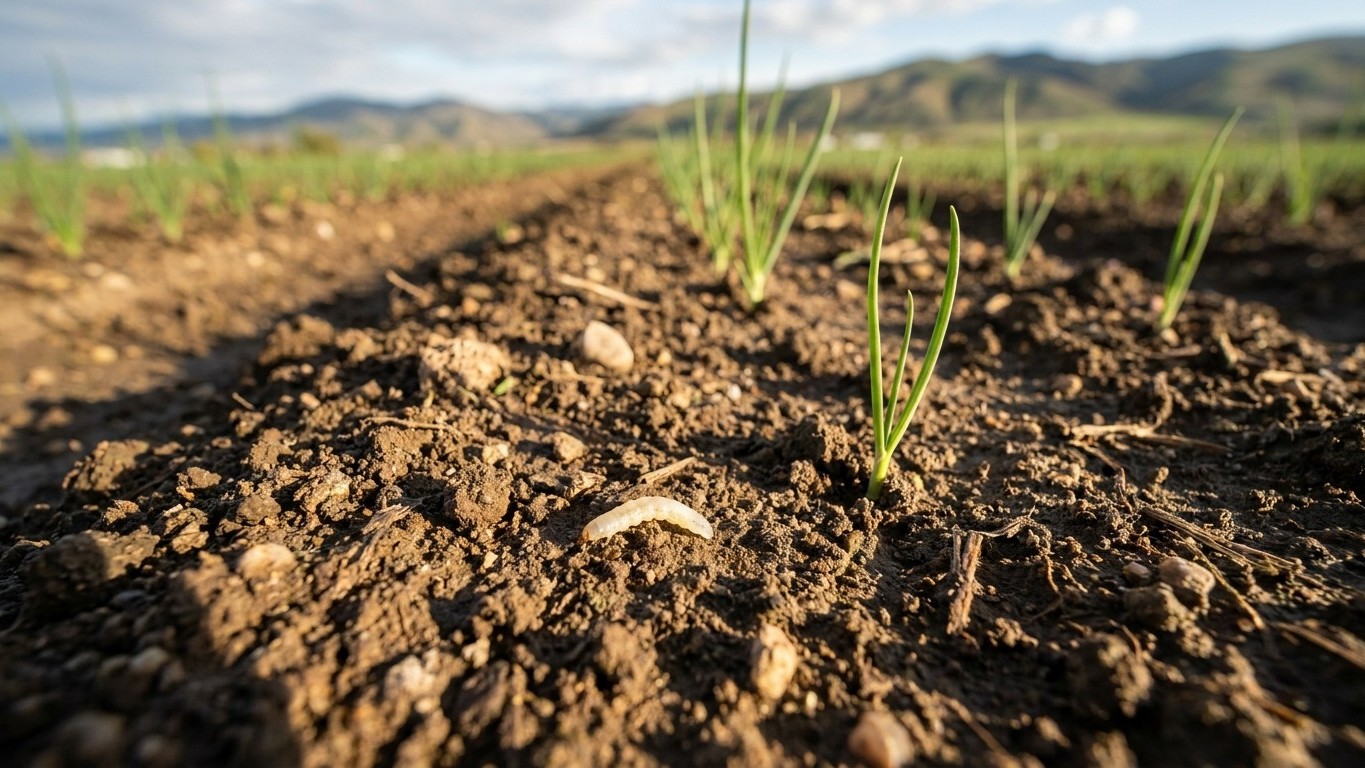

Onion maggot activity in Idaho typically begins in mid to late April, once soil temperatures climb into the 50s Fahrenheit, and the pest can produce two to three generations before frost shuts things down in September or October. The Treasure Valley around Parma, Fruitland, and Payette, along with the Magic Valley near Twin Falls, carry the heaviest pressure because both regions concentrate the state’s commercial onion acreage. For home gardeners and small growers, the takeaway is simple: watch the ground, not just the plant, and time any protective steps to soil warm-up rather than the calendar date.
The weeks to watch

Onion maggot (Delia antiqua) overwinters as pupae buried a few inches into the soil, usually in the same beds where onions grew the season before. Adult flies, which look like smaller, grayer houseflies, emerge once accumulated soil warmth crosses a threshold that Idaho and Pacific Northwest extension programs track using degree-day models built around a 40°F base temperature starting March 1. That first flight is the one growers fear most, because it lands right when young onion or seed-started transplants are at their most vulnerable.
A second generation follows roughly six to eight weeks later, often in late June or July, and a partial third generation can show up in warmer years by late August or September in the lower-elevation valleys. Higher-elevation growing areas in eastern Idaho, where soils warm more slowly, tend to see a compressed schedule with fewer generations overall. That’s one reason pest pressure varies so much between a backyard plot in Idaho Falls and a commercial field outside Parma.
The fly is drawn to freshly cultivated, moist soil and to decaying organic material, including onion cull piles, rotting bulbs left in the field, and even compost with onion scraps. Females seek out that environment to lay eggs at the base of onion stems, right at the soil line, which is why sanitation around planting beds matters as much as anything sprayed on the plant itself.
How to Spot the Damage Before It Spreads
Larvae, not adult flies, do the actual damage. After hatching, the small white maggots tunnel down into the bulb or into the base of a seedling stem, feeding on root tissue and the developing bulb. On young transplants, this shows up fast: seedlings wilt, turn yellow, and collapse within days, often in patches rather than evenly across a row. Pull one up and you’ll typically find soft, discolored tissue at the base, sometimes with visible larvae still inside.
On established bulbs, the injury is subtler at first. Onions may look fine above ground while maggots hollow out the interior, and the real evidence doesn’t surface until harvest or storage, when affected bulbs turn soft, slimy, and prone to secondary bacterial rot. Idaho’s onion storage sheds see this secondary rot as one of the costliest downstream effects, since a bulb that looked marketable in the field can break down within weeks in storage.
Because the fly targets the entire allium family, damage isn’t limited to onions. Garlic, shallots, and leeks planted nearby can show the same wilting and rot, which matters for gardeners who rotate a mixed allium bed rather than a single crop.
What Actually Stops Onion Maggot
No single tactic handles onion maggot on its own. University extension programs across the Pacific Northwest, including University of Idaho’s, consistently recommend layering cultural practices with targeted chemical or treated-seed options, because the fly’s biology gives it multiple points of vulnerability across a season.
Cultural controls that reduce risk before planting
Crop rotation is the first line of defense, and it needs to be a real rotation, not a token gesture. Moving onions or other alliums at least a quarter mile from the previous year’s planting site, when space allows, cuts down on adult flies emerging directly into a fresh crop. Home gardeners with smaller plots won’t always have that kind of room, but even rotating to the opposite end of a yard from last year’s onion bed helps.
Sanitation matters just as much. Cull piles, rotting bulbs, and onion debris left in or near a field act as an open invitation for egg-laying adults, so clearing that material away from planting areas before the spring flight begins removes a major attractant. The same goes for tilling under crop residue promptly after harvest rather than letting it sit through fall and winter.
Timing planting to avoid the peak of the first fly generation also helps, particularly for gardeners using seed rather than transplants. Direct-seeded onions planted slightly later, once soil has warmed past the fly’s preferred cool, moist window, tend to establish stronger root systems before the first generation peaks. That’s a tradeoff against yield potential, so it works better for home gardens than for commercial operations locked into a planting schedule.
Chemical and treated-seed options
Commercial growers in Idaho’s onion regions rely heavily on insecticide seed treatments applied before planting, which protect seedlings during the vulnerable early-season window when the first generation of flies is active. These treatments target the larvae as they attempt to feed near the germinating seed, before damage reaches the bulb.
For established plantings, soil-applied insecticides timed to egg-laying periods, rather than to adult fly presence alone, tend to perform better, since spraying adult flies directly has limited lasting effect once they’ve already dispersed across a field. Extension recommendations generally point growers toward degree-day-based timing for any soil treatment, applying protection just ahead of predicted egg-laying peaks rather than on a fixed calendar date.
Home gardeners without access to commercial seed treatments have fewer chemical options, which puts more weight on the cultural side, particularly sanitation and rotation, along with physical barriers like floating row covers placed over seedlings during the first-generation flight window in April and May. Row covers work well precisely because the adult fly needs direct access to soil at the base of the plant to lay eggs; block that access and the female has nowhere to lay.
Monitoring Through the Growing Season
Yellow sticky traps placed at ground level near onion beds give a low-cost way to track adult fly activity and confirm when a flight is underway, rather than guessing from the calendar. Checking traps twice a week starting in early April, before soil temperatures hit that 50°F mark, catches the leading edge of the first generation and gives a few days’ warning before eggs start showing up at the base of plants.
Because Idaho’s growing regions span a fairly wide range of elevations and microclimates, from the warmer Treasure Valley floor to cooler benches and higher terrain elsewhere in the state, local soil temperature is a far better guide than a statewide average. A grower near Nampa might see first emergence a full two to three weeks ahead of someone gardening at higher elevation near Idaho Falls, even in the same calendar year.
Second-generation flights in late June and July tend to be less destructive to bulb crops already past the seedling stage, but they still matter for late-planted onions, garlic set out for fall harvest, or any allium still establishing roots. Continuing trap checks through midsummer, rather than stopping after the spring scare passes, catches that second wave before it does damage that only becomes visible in storage months later.
Storage losses tend to be the most underestimated part of the problem. A field that looked clean at harvest can still carry low-level larval damage that turns into soft rot weeks into storage, which is why growers who had visible maggot pressure earlier in the season often inspect stored bulbs more frequently through fall rather than assuming the threat ended at harvest.