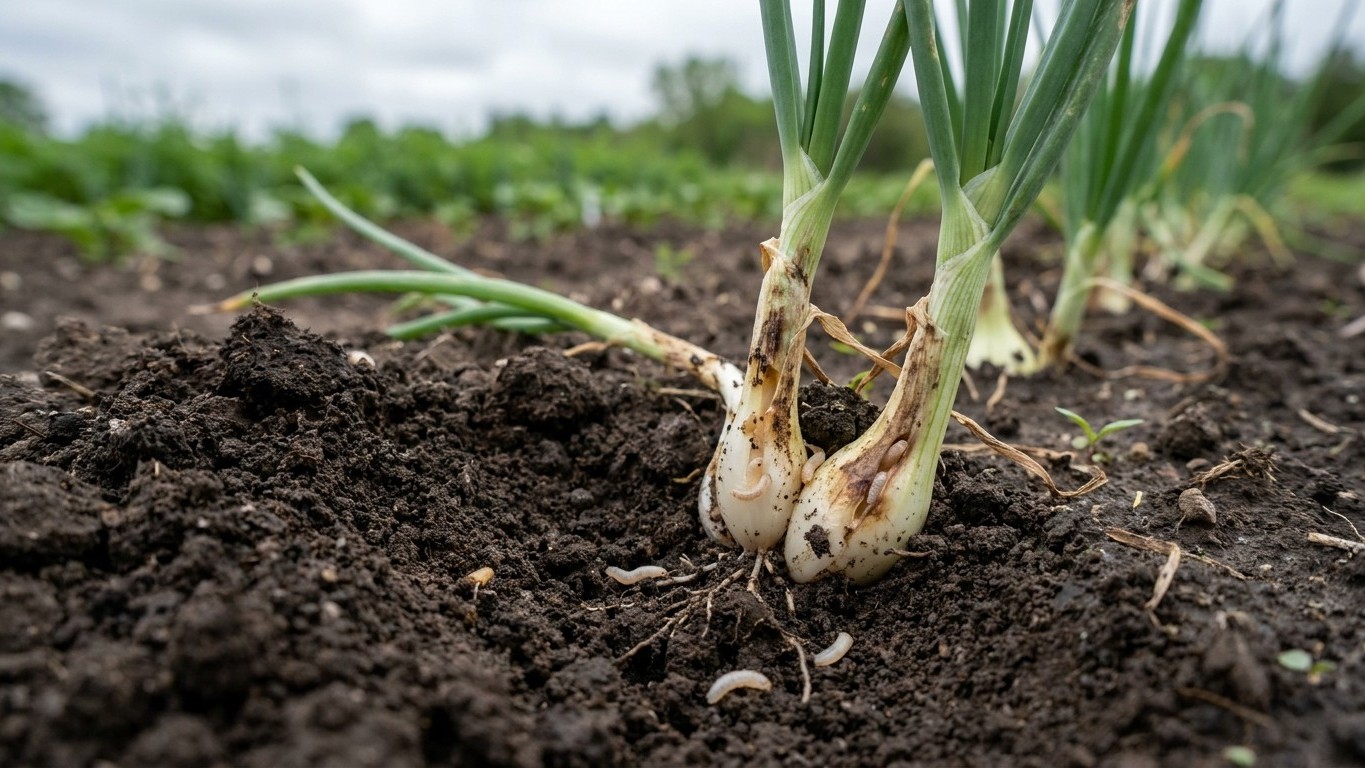

Onion maggot flies start laying eggs in Minnesota soil as soon as it warms past roughly 40°F for several consecutive days, which usually means late April in the southern part of the state and into May farther north. The larvae that hatch from those eggs are what actually destroy onion seedlings and bulbs, tunneling into the base of the plant within days. Stopping them comes down to three things: timing your planting to dodge the worst egg-laying window, rotating onion-family crops far from last year’s plot, and cleaning up cull piles that give overwintering pupae a head start.
The Minnesota Timeline: Three Generations, One Big Threat

Onion maggot (Delia antiqua) survives Minnesota winters as a pupa buried a few inches into the soil, close to where onions grew the previous season. When soil temperatures climb into the 40s and stay there, adult flies emerge, mate, and start hunting for onion-scented soil to lay eggs. Entomologists track this with a degree-day model based on a 40°F threshold, and first emergence typically lands somewhere between 250 and 350 accumulated degree days. In practical terms, that’s right around when lilacs start to bud in much of the state, a phenological cue that gardeners have used for decades before degree-day calculators existed.
Minnesota sees three generations of onion maggot in a typical year. The first is by far the most destructive because it targets seedlings and freshly set transplants that have almost no defense against maggot feeding at the base of the stem. A single larva can kill a young onion plant outright. The second and third generations, arriving in July and again in late August or September, go after bulbs that are already sizing up. Those attacks rarely kill the plant, but the wounds they leave behind become entry points for bacterial soft rot, which is often the reason a seemingly healthy onion turns to mush in storage a few weeks after harvest.
Growing conditions matter as much as the calendar. Cool, wet springs extend the window when soil stays attractive to egg-laying females and give larvae a better survival rate once they hatch. Fields with heavy manure applications or a lot of decomposing organic matter from the previous crop also draw more egg-laying activity, since the flies are drawn to sulfur compounds that onions and decaying plant material both release.
Why the Red River Valley Sees Extra Pressure
The Red River Valley, straddling the Minnesota and North Dakota border, is one of the country’s significant onion-growing regions, and that concentration of acreage creates a bigger reservoir of overwintering pupae than a typical home garden would ever face. Large commercial fields planted year after year in roughly the same rotation give the fly population a stable, predictable food source, which is part of why growers there lean heavily on scouting and degree-day forecasts rather than guessing at spray timing.
Spotting the Damage Before It’s Too Late
The first sign most home gardeners notice is a seedling that looks fine one day and collapsed the next. The outer leaves yellow from the tip down, the whole plant wilts even with adequate soil moisture, and when you tug gently at the base, it comes free from the soil with little resistance because the roots and lower stem have already been chewed through. Pulling the plant and slicing open the bulb base usually reveals a small, tapered white maggot, about a quarter inch long, feeding right at the point where roots meet stem.
On bulbs that survive the seedling stage but get hit by later generations, the damage looks different. You’ll see brown, water-soaked streaks running through the outer scales, sometimes with a foul smell if secondary rot has set in. These bulbs often look normal from the outside at harvest and then break down in storage within a few weeks, which is why growers who lost bulbs to onion maggot in July or August don’t always connect the dots until winter.
Sticky traps (yellow or white, about the size of an index card) placed at plant height near the onion rows are the simplest way to confirm adult flies are active before you see any plant damage. Checking traps twice a week starting in mid-April gives you a real-time read on when the first flight is underway, which is far more useful than relying on a calendar date that shifts from year to year depending on the spring weather.
What Actually Stops Onion Maggot in Minnesota Gardens
Cultural controls do most of the heavy lifting for home gardeners, and they work because they interrupt the fly’s ability to find a host plant in the first place. Crop rotation is the foundation: move onions, garlic, leeks, and chives to a spot at least an eighth of a mile from where any allium grew the year before, and don’t repeat that spot for three to four years. Adult flies don’t range far on their own, so distance alone can cut egg-laying pressure significantly.
Floating row cover, installed the same day you plant and sealed tight at the edges with soil or landscape staples, physically blocks female flies from reaching the seedbed. This matters most during the first-generation flight window in late April and May, since that’s the flight responsible for the highest seedling mortality. The cover needs to stay sealed continuously, because flies will exploit even a small gap, and it can come off once plants are established enough to withstand later, less severe generations.
Sanitation closes another door. Onion maggot pupae overwinter in soil close to cull piles, discarded bulbs, and volunteer plants left from the previous season. Clearing that debris in fall, rather than leaving it to break down over winter, removes a concentrated food source that draws egg-laying females straight to your garden the following spring. Some Minnesota growers also till soil shallowly in late fall specifically to expose pupae to freezing temperatures and to ground beetles and other predators that feed on them once uncovered.
Delayed planting is a trade-off worth knowing about. Pushing transplant dates back by a week or two, once the first-generation flight has peaked and started to decline, can meaningfully reduce the number of eggs laid near your seedlings. The cost is a shorter growing season for bulb sizing, so it works better for gardeners who aren’t chasing the largest possible onions and are more focused on getting a crop through undamaged.
For situations where cultural controls aren’t enough, particularly on a scale where hand-checking every plant isn’t realistic, insecticide options exist. Seed treatments applied before planting protect the earliest and most vulnerable growth stage, while at-plant granular insecticides worked into the soil at seeding time target larvae before they reach the bulb. Timing any foliar application to coincide with the degree-day-predicted egg-laying peak, rather than spraying reactively after damage appears, makes a real difference in effectiveness, since sprays applied after larvae have already tunneled into the stem do very little good.
What Doesn’t Work as Well as People Think
Companion planting with strong-smelling herbs gets recommended constantly online, but there’s no solid research backing it as a standalone defense against onion maggot in Minnesota conditions. It may offer marginal benefit at best. Relying on it alone, instead of rotation and row cover, is a common reason gardeners keep losing the same bed year after year.
One detail that surprises a lot of home growers: onion sets (the small bulbs sold for planting rather than seed or transplants) are actually more attractive to egg-laying females than seed-grown plants, because the cut or bruised surface on a set releases more of the sulfur compounds that draw flies in. If you’ve had repeated maggot trouble and have been planting sets every spring, switching to transplants or direct-seeded onions for a season or two, combined with a real rotation away from that bed, is one of the more effective adjustments a Minnesota gardener can make without reaching for a sprayer.