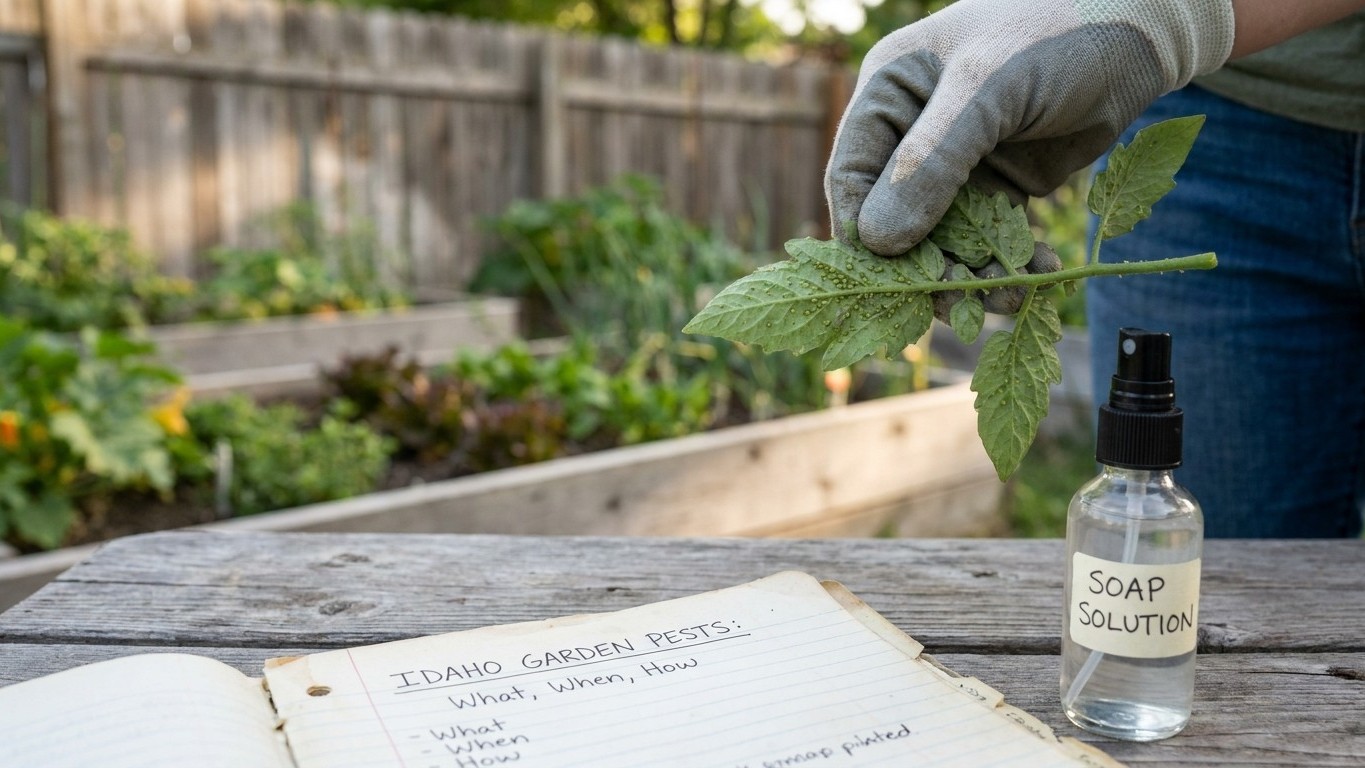

Idaho vegetable gardens face a fairly short, well-documented list of repeat offenders. University of Idaho Extension flags eleven insects as the ones doing most of the damage in home plots: Colorado potato beetle, cutworms, tomato hornworm, aphids, imported cabbageworm and cabbage looper, wireworms, onion thrips and Onion maggot Idaho, squash bug, grasshoppers, carrot rust fly, and Pea leaf weevil Idaho. Walk your rows every few days once seedlings go in, and check leaf undersides first, since that’s where most of this group starts feeding.
What Idaho gardens actually deal with

What’s actually eating your garden usually comes down to eleven insects, and which one it is depends on what you’re growing and what you’re seeing. Colorado potato beetle in Idaho strips potatoes, cutworms sever seedlings at the soil line overnight, Aphids in Idaho cause curl and yellow leaves, squash bugs wilt whole vines, Tomato hornworm in Idaho is known for stripping tomato foliage bare while staying nearly invisible, ragged holes chewed through cabbage and broccoli leaves point growers to Imported cabbageworm in Idaho, and growers watch for Carrot rust fly in Idaho tunneling through their carrot roots. Idaho’s hot days, cold nights, and irrigated ground sitting next to dry rangeland keep this same short list coming back every year. Start by walking your rows every few days and turning leaves over, since that’s where most of this damage begins before you’d ever notice it from a distance.
Cutworms

Cutworms in Idaho feed at night as larvae and cut young seedlings off right at the soil line, leaving a bare stem stub with no plant attached by morning. A collar made from cardboard or a cut can, pushed an inch into the soil around each transplant, stops them cold.
Wireworms

Wireworms in Idaho live in the soil and feed on seed pieces and roots before seedlings even emerge, so damage shows up as poor germination and stunted plants rather than anything visible above ground. Rotating out of grass or sod ground for a season before planting root crops cuts populations down over time.
Pea leaf weevil

Adults notch pea and bean leaf edges in scallop-shaped bites, but the real damage happens underground, where the white, legless larvae feed on the root nodules that fix nitrogen. UIDAHO Extension notes this pest only in northern Idaho and the Magic Valley, so gardeners elsewhere in the state can rule it out first.
Colorado potato beetle

It’s the larvae that do the worst work, stripping a potato plant down to bare stems in a matter of days once a population takes hold. Handpicking adults early in the season, before egg masses hatch on leaf undersides, is the single most effective non-chemical step.
Imported cabbageworm and cabbage looper

Both chew ragged holes through cabbage, broccoli and kale leaves and leave behind wet, greenish frass pellets, a good tell that separates them from slug damage. The looper lacks a full set of middle legs, which is why it arches into a loop as it crawls.
Aphids

Green peach, cabbage and pea aphids pierce tissue and drink sap rather than chew, leaving behind curled, yellowing leaves and a sticky honeydew that often grows sooty black mold. A strong water spray knocks small colonies down before they need anything stronger.
Onion thrips and onion maggot
Thrips feeding leaves silvery-white streaks on onion leaves that can be mistaken for drought stress, while maggot larvae tunnel into the bulb itself, so by the time you see wilting tops the damage below ground is already done. Neither responds well to spraying once maggots are inside the bulb, which makes prevention the only real option.
Squash bug
Both the adult and nymph stages suck sap and cause leaves to wilt, blacken and collapse, often before the fruit is even set. Checking leaf undersides weekly and crushing egg clusters is the most reliable control available to a home gardener.
Tomato hornworm
The larva hides well against tomato foliage and does its damage overnight, stripping whole branches of leaves and sometimes chewing into green fruit. The adult is a heavy gray-brown sphinx moth that’s rarely seen in daylight.
Carrot rust fly
The damage comes entirely from the larvae, which tunnel through carrot, parsnip and celery roots while the adult fly does no feeding damage of its own. UIDAHO Extension notes that in northern Idaho, larvae keep feeding on roots left in the ground after late September, so pulling root crops before then limits the damage.
Grasshoppers
UIDAHO Extension notes that in the Boise area, grasshoppers move into gardens from dry pasture and rangeland in late summer, once vegetation out there has dried down and garden greens are the closest food left. Gardeners in Montana deal with a similar late-season influx, covered in Garden Pests in Montana: What Shows Up, When, and How to Stop It.
Telling damage apart

Before treating anything, figure out whether you’re looking at an insect, a disease, or a watering problem, because the fixes don’t overlap. Ragged holes and chewed leaf edges point to a chewing insect, whether that’s a beetle, a caterpillar, or a grasshopper working through the tissue. Clean, round holes usually mean something with an evenly biting mouthpart, while irregular tears with leftover veins are more typical of larger larvae, like hornworms, that eat around the tougher ribs.
- Chewed edges or holes: a chewing insect, check leaf undersides for larvae
- Fine pale stippling: a sap-feeding insect like aphids or thrips
- Wilting with moist soil: a root-feeding pest or a vascular disease
- Sticky leaves with a black film: aphid honeydew and sooty mold
- Distinct brown or yellow rings: fungal or bacterial disease, not a pest
Stippling, wilting and sticky residue
Stippling, a fine pale speckling across the leaf surface, comes from insects that pierce and suck rather than chew. Aphids and thrips both leave this pattern. Wilting is trickier: a plant that wilts despite moist soil usually has a root or vascular problem, either a soil pest such as wireworms feeding below ground or a disease affecting the vascular tissue. A plant that wilts because the soil itself is dry is an easy check. Push a finger into the top couple inches of soil before assuming pest damage.
Sticky residue on leaves or on the ground underneath a plant is almost always honeydew from aphids or another sap-feeding insect, and it often comes with a black sooty mold growing on top of it. That combination, sticky leaves plus a black film, is a fairly reliable signature that rules out fungal leaf spot diseases, which tend to show up as discrete brown or yellow rings rather than an even black coating.
Idaho’s dry summer air works in a gardener’s favor here, since many of the leaf-spot and blight diseases that plague vegetable gardens in wetter climates need extended stretches of leaf wetness to take hold. Gardeners in a state like Vermont deal with a very different balance of insect versus disease pressure, as covered in Garden Pests in Vermont: What Shows Up, When, and How to Stop It, where humidity keeps fungal problems in play for much longer stretches of the season. In Idaho, if you see spotting or lesions rather than chewing, feeding trails, or sticky residue, disease is the more likely cause and a pest spray won’t help at all.
When each one shows up
Pest pressure in an Idaho garden follows the plant’s growth stage more than the calendar. The first two to three weeks after seedlings emerge are the highest-risk window, since cutworms and wireworms both target that tender, low-to-the-ground stage. UIDAHO Extension notes slugs typically appear on seedlings in early spring too, often before most gardeners are checking for insects at all.
As potato and pea plants get their first true leaves, watch for Colorado potato beetle adults and, in northern Idaho and the Magic Valley specifically, pea leaf weevils working the leaf edges. UIDAHO Extension pins the pea leaf weevil to those two regions only, so a gardener around Boise or in southern Idaho outside the Magic Valley is far less likely to see it. Around Boise, UIDAHO Extension also flags Mexican bean beetle as a mid-June arrival, specific enough to that area that gardeners elsewhere shouldn’t assume it applies to them.
Midsummer through harvest
Once squash vines are running and tomatoes are setting fruit, squash bugs, aphids and tomato hornworms move to the front of the list, feeding on the lush new growth that midsummer heat produces fastest. Onion thrips build steadily through the same stretch, since dry, hot weather favors their reproduction more than the cooler snap of early spring.
Late summer brings grasshoppers in from drying rangeland and pasture edges, a shift UIDAHO Extension ties directly to the dry-down of wild vegetation near Boise. Carrot rust fly larvae become a late-season concern specifically in northern Idaho, where UIDAHO Extension warns that roots left in the ground after late September keep feeding damage going even as top growth slows down. Pulling root crops before then, rather than leaving them for a late fall harvest, avoids that window entirely. These windows are measured at or near Boise, and higher-elevation or northern gardens should expect the same insects on a different clock, running behind the stages described here rather than skipping them.
What actually works
Prevention beats intervention for nearly every pest on this list, because most of the damage happens fast and out of sight. Larvae inside a stem or a bulb aren’t reachable by anything you spray after the fact.
Prevention
Crop rotation breaks the cycle for soil-dwelling pests like wireworms and onion maggot, since both overwinter in the ground near where they fed the previous year. Moving alliums and root crops to a different bed each season denies them an easy return. Row cover installed at planting and sealed at the edges keeps cabbageworms, cabbage loopers, onion thrips and carrot rust fly adults from ever reaching the plant to lay eggs, though it has to come off before flowering on crops that need pollination.
Timing your planting to avoid a pest’s peak window matters more than most gardeners give it credit for. Getting onions in early enough to bulb before onion maggot populations build, or getting potatoes past their most vulnerable stage before Colorado potato beetle adults emerge in numbers, avoids problems that no spray fixes cleanly later. Encouraging predators, ladybugs and lacewings for aphids, ground beetles for cutworm larvae, also matters, since spraying broadly for one pest often wipes out the insects handling another for free.
Targeted intervention
Handpicking works well for anything large enough to see and slow enough to catch: Colorado potato beetle adults, tomato hornworms, and squash bug egg clusters are all realistic to remove by hand on a small planting. Insecticidal soap and horticultural oil knock back aphid and thrips colonies without harming most beneficial insects, provided you cover the leaf undersides where they cluster. Bacillus thuringiensis, sold as Bt, targets caterpillar pests like cabbageworm, cabbage looper and hornworm specifically, leaving bees and other non-caterpillar insects unaffected.
Some popular home remedies do nothing measurable against this list of pests: ultrasonic pest repellers, garlic or hot pepper sprays used alone, and companion planting for repellency rather than habitat value are all weak at best. Marigolds are often planted as an insect deterrent, but there’s little evidence they reduce feeding damage on nearby vegetables. They’re better thought of as a flower that draws in pollinators and predatory insects than as a repellent.
What control costs
Cost here isn’t mostly about money. It’s about which resource you’re spending, cash or attention, and how often you have to spend it again.
| Method | Upfront cost | Time investment | How often it repeats |
|---|---|---|---|
| Handpicking | Free, or the cost of a bucket of soapy water | A few minutes, several times a week | Continuously through the pest’s active window |
| Row cover and barriers | One-time purchase of fabric and hoops, reused for years | Low, mostly install and removal | Once per season per bed, replace fabric as it wears out |
| Biological controls | Moderate, a Bt product or purchased beneficial insects | Low, timed to hatch or feeding stage | Reapplied after rain, or whenever a new generation hatches |
| Sprays (soap, oil, broader insecticides) | Low to moderate per bottle | Quick per application, but frequent | Repeated through the infestation and after every rain |
For most home gardens, handpicking and barriers cost the least in dollars but the most in attention, while sprays cost more in product over a season but less in standing time. For most home gardeners, a combination of row cover early and handpicking through the season is the cheapest path that still works, since it avoids repeat purchases and doesn’t risk killing off the predator insects that would otherwise handle aphids for free.
Sprays make the most sense once a population has already gotten ahead of hand control, squash bugs that have gone from a few adults to dozens of nymphs, for instance, since removing that many by hand across a full planting isn’t realistic in the time most gardeners actually have.
Local help
When you can’t tell one pest from another, or the damage doesn’t match anything above, UIDAHO Extension takes specimen and photo submissions through county offices and can identify what’s actually in the garden. That identification step matters, since treating the wrong pest wastes both time and product. The University of Idaho Extension service also tracks pest outbreaks as they develop through the season, useful since pressure in the Panhandle, the Magic Valley and the Treasure Valley around Boise doesn’t move in lockstep. Our Idaho guides cover the rest of the season beyond pest control.
Four More Pests Worth Watching
The pests above don’t cover everything Idaho gardeners run into over a season. If your yard has a history of crop damage in dry, open ground, keep an eye out for grasshoppers, which move in once soil temperatures warm into the low 60s and can be active from April clear through June depending on elevation. Onion growers should track onion maggot, a pest that gets going in mid to late April and can push out two to three generations before the first fall frost. Pea growers, especially in the north and the Magic Valley, need to know about the pea leaf weevil, since University of Idaho Extension marks it as a regional problem rather than one found statewide — gardeners around Boise and the eastern valleys largely get a pass. And anyone growing squash or pumpkins should watch for the squash bug, which shows up in late June as vines start putting on real growth, after overwintering as adults in leaf litter and garden debris.
Common questions
Do I need to spray for grasshoppers every year in Idaho?
Not necessarily. Grasshopper pressure depends on how dry the surrounding rangeland gets, and UIDAHO Extension notes they move into gardens from dry pasture mainly in late summer once that vegetation has already dried down. A wetter year with more forage nearby usually means fewer grasshoppers show up in the garden at all.
Are ladybugs actually going to eat my aphids or is that just something people say?
They will, and lacewing larvae are even more effective, but neither shows up in useful numbers if you’ve already sprayed a broad insecticide that killed them off along with the aphids. Buying a bag of ladybugs and releasing them onto a plant with no aphids on it usually just sends them flying off somewhere else within a day.
My carrots look fine on top but the roots are tunneled. What did that?
That’s the classic sign of carrot rust fly larvae, which feed inside the root while the top growth looks completely normal. UIDAHO Extension flags this as a particular risk in northern Idaho for roots left in the ground after late September, so pulling carrots before then is the main way to avoid it.
Can I use the same pest schedule my neighbor in Boise uses if I garden at higher elevation?
Not exactly. The seasonal windows UIDAHO Extension documents are measured at or near Boise, and higher-elevation gardens and those farther north typically see the same pests on a delayed schedule tied to when their soil warms and plants reach the same growth stage. Watch the plant’s stage rather than the date on the calendar as your cue to start checking.