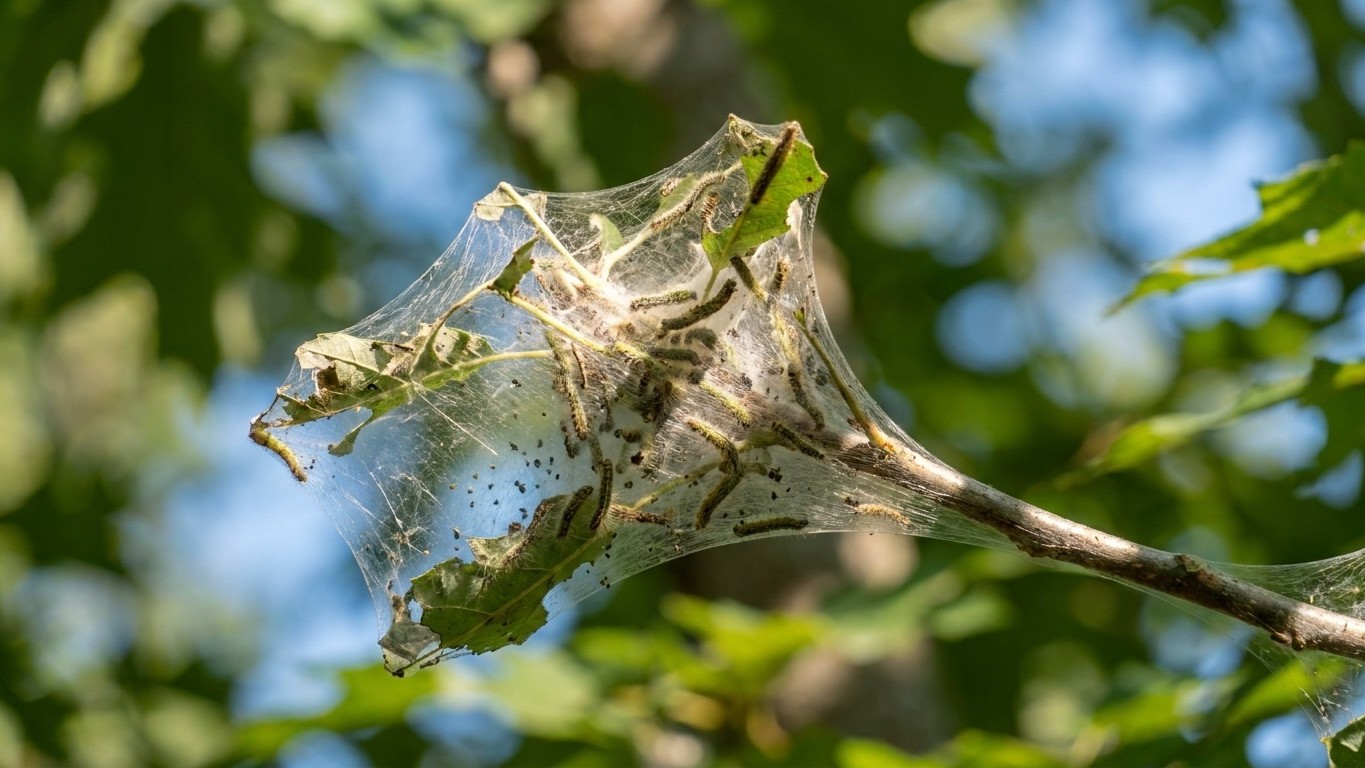

Fall webworm shows up in North Carolina from mid to late summer into fall, when silky, tent-like nests appear at the tips of hardwood branches. The insect responsible is a caterpillar, not the moth that comes later, and the damage it causes is almost always cosmetic. NC State Extension is the local authority referenced throughout this guide, though its published pest calendar for the season doesn’t single out this particular species.
When Fall webworm turns up in North Carolina

Here’s the honest answer first: the seasonal notes published by NC State Extension’s Extension Gardener Handbook, in the chapter covering insects on fruiting vegetables, don’t name fall webworm at all. That chapter tracks tobacco thrips in early spring, western flower thrips as a vector through June and July, tomato fruitworm from fruit set through harvest, aphids and spider mites and stink bugs building through mid to late season, cabbage looper turning up in August and September, and flea beetles arriving right after transplanting. None of that is fall webworm. It’s a different insect targeting a different set of plants, and the local extension service simply doesn’t publish a dated window for it in that document.
What fills the gap is the general pattern known for the species across the Southeast. Fall webworm gets its name honestly: nests become visible as summer stretches toward fall, and in warmer parts of the region overlapping generations can keep new webs appearing well into October. The visible sign isn’t the insect itself but the enclosure it builds, a loose, grayish-white silk tent wrapped around leaves and small twigs near the ends of branches. Those nests grow larger as the season goes on, because the caterpillars inside keep feeding and keep expanding the web to reach fresh foliage.
None of this comes with a fixed calendar date the way, say, flea beetle arrival does for tomato transplants. It’s a range tied to temperature and to how much leaf growth a host tree has put on, which is exactly why the next section ties it back to the one date most North Carolina gardeners already track.
Reading the calendar from your last frost
The last spring frost for the Charlotte area falls between March 23 and April 5, based on NOAA’s 1991-2020 climate normals. That’s a normal, not a promise, built from a 30 to 70 percent freeze-probability band, so treat it as a planning window rather than a hard line on the calendar. The Blue Ridge mountains to the west run several weeks behind that window in spring; the coastal plain tends to warm up ahead of it.
Fall webworm doesn’t answer to a printed date any more than a tomato plant does. It answers to soil and air warmth, which sets when host trees leaf out and how much food is available once the caterpillars hatch. Trees typically push new leaves within a couple of weeks of the last frost passing, and that leaf-out is what feeds the season’s first generation. An early spring pulls the whole chain forward: earlier leaves, earlier feeding, nests noticeable earlier in summer. A late, cold spring pushes everything back and compresses the window before fall arrives.
For a gardener, the practical takeaway isn’t a row cover going on and off a vegetable bed, since this pest lives in tree canopies rather than garden rows. It’s a pruning window instead. Once the last frost has passed and new growth is out on hardwood trees, that’s the point to start watching branch tips for the first small webs, because catching them early, while the nest is still the size of a fist, is what makes removal effective later on.
What it attacks, and what the damage looks like
Fall webworm feeds on a long list of hardwood trees rather than on garden vegetables, which sets it apart from most of the pests tracked in a typical vegetable pest calendar. Persimmon, pecan, black walnut, wild cherry, sourwood, mulberry, and sweetgum are common hosts, along with many other ornamental and shade trees planted in yards across the state.
The symptom shows up before the insect does. A homeowner usually notices a loose, dirty-looking web caught at the end of a branch, almost like a wisp of cotton candy snagged in the leaves. Inside that enclosure the foliage looks skeletonized: brown, papery, with the leaf veins left behind after the softer tissue has been eaten away. As the web grows, it can eventually cover several feet of branch tip, though it rarely spreads to the whole tree.
The caterpillar stage is the one doing all the damage. The larvae live and feed inside the protective silk, which is exactly why the nest keeps expanding as they grow, they’re extending their own shelter to reach fresh leaves rather than leaving it exposed. The adult moth that emerges later doesn’t feed on the tree at all. That distinction matters for anyone deciding whether to act: once caterpillars are several weeks into feeding and the web is already large, any intervention needs to deal with a mass of larvae wrapped in thick silk, not a handful of newly hatched insects on open leaves.
How North Carolina sits in this pest’s range

Fall webworm is native across most of North America and shows up in nearly every state with hardwood trees, so its presence in North Carolina isn’t unusual or edge-of-range in any biological sense. Within this site’s series of territory guides, though, the species is currently documented in two territories, and that count describes how many local guides exist right now rather than how far the insect actually travels. Readers in states outside that pair shouldn’t assume the pest skips them; it almost certainly doesn’t.
Because the species is genuinely widespread, the difference between one territory and the next comes down to timing rather than presence. A state with a longer warm season sees nests start earlier and keep appearing later into fall. A state where cold arrives sooner sees a shorter, more compressed window. North Carolina’s own spread from coastal plain to Blue Ridge mountains works the same way in miniature: warmer eastern counties likely see activity start earlier than the cooler mountain counties, following the same frost-date gap already noted for spring.
None of the sources referenced here rank North Carolina’s fall webworm pressure against other states, and none describe it as more or less severe locally. The honest statement is simpler: it’s a widely distributed species, this state falls inside that broad range, and what varies by location is when the webs appear, not whether they do.
What actually works against it
The cheapest and most effective response starts with watching, not spraying.
- Check branch tips on host trees from midsummer onward, so a new web is caught while it’s still small enough to prune out with hand shears, cutting a few inches below where the silk attaches; this physically removes the larvae along with their shelter before the colony has grown large enough to strip a significant section of foliage.
- Remove pruned nests from the property rather than leaving them on the ground nearby, since larvae can crawl out of cut branches and relocate; bagging the trimmed material or disposing of it away from other host trees closes that loophole.
- Clear fallen leaves and bark debris in late fall, which helps modestly since some individuals overwinter in leaf litter and loose bark near the base of host trees, though it won’t stop moths flying in from a neighbor’s yard the following year.
- Wrap vulnerable branch tips on young, newly planted ornamental or fruit trees, offering some physical protection before nests ever form, though once larvae are already established inside a web, no amount of covering the outside reaches them.
Timing is what decides whether pruning still works. Once a web has grown to cover several feet of branch and dozens of leaves, cutting it out means sacrificing a large chunk of healthy canopy along with the pest, which is rarely worth it on an established shade tree.
At that stage, the more realistic path is patience: healthy trees tolerate fall webworm without lasting harm, natural predators like paper wasps, birds, and parasitic wasps and flies typically keep populations in check over a season or two, and the cosmetic damage disappears with leaf drop anyway.
Common questions
Does fall webworm kill trees?
Rarely, if ever, on an otherwise healthy tree. Damage happens late in the growing season after most of the tree’s yearly photosynthesis work is already done, so the loss of a few branch tips is cosmetic rather than structural.
Can I just leave the webs alone?
On a large, established tree, yes, that’s often the simplest and least destructive option. On a young or newly planted tree with limited canopy, removing small nests early is worth the effort since it has less foliage to spare.
Is fall webworm the same as eastern tent caterpillar?
No. Eastern tent caterpillar builds webs in branch forks in spring, while fall webworm builds its nest at the tips of branches later in the season, enclosing the leaves themselves rather than just using them as a base.