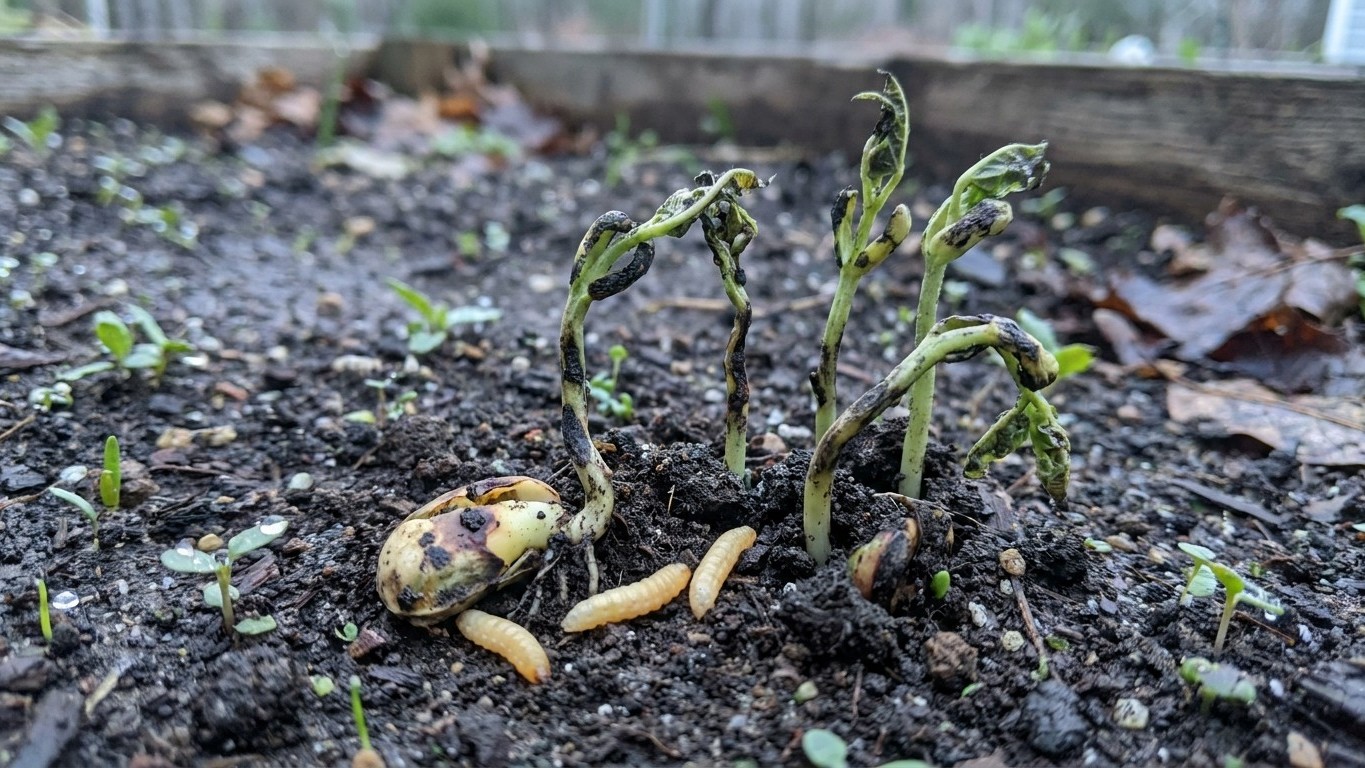

Seedcorn maggot shows up in Maine soil every spring, usually before most gardeners have even planted their first row of beans. The larvae attack seeds and seedlings during cool, wet weather in April and May, then fade in importance once summer soil warms up. Stopping it means timing your planting around soil temperature, not fighting the pest after damage appears, because once seeds are hollowed out there’s no rescue treatment that brings a stand back.
What Seedcorn Maggot Damage Actually Looks Like

The culprit is a small fly, Delia platura, that looks a lot like a shrunken housefly, barely a fifth of an inch long. Nobody notices the adult much. What gardeners and market farmers notice is the aftermath: seeds that never come up, or seedlings that emerge weak, twisted, and stunted with dark scarring near the base.
The larvae do the real damage. They’re yellowish-white, legless, tapered maggots about a quarter-inch long that tunnel directly into germinating seeds. In corn, that means a hollowed-out kernel that never sends up a shoot. In beans and peas, the larvae often leave the classic “snake-eyes” symptom, small dark pits on the cotyledons of a seedling that manages to limp above ground. Cole crops like cabbage and broccoli show similar stem tunneling near the soil line, sometimes killing transplants outright.
Here’s the part that surprises a lot of home gardeners in Maine: this isn’t a pest that chews leaves you can spot and spray. By the time you notice a gap in the row, the maggot has already finished its work and moved on to pupate in the soil. Scouting for adults or larvae after the fact doesn’t help much, which is why timing and prevention carry almost all the weight in managing this insect.
When Seedcorn Maggot Shows Up in Maine
Maine’s cool springs are exactly the conditions this pest favors. Seedcorn maggot activity is tracked using soil degree days, not the calendar, because a warm April in Aroostook County behaves nothing like a warm April in York County. The first generation typically flies and lays eggs once accumulated degree days (base 39°F) reach somewhere in the range of 200 to 360, which in most of Maine lines up with mid to late April through mid-May, right when early peas, spinach, and the first corn plantings go in the ground.
That first generation is the one that causes almost all the economic and garden damage. Seeds planted into cold, slow-draining soil sit there for two or three weeks before they germinate, giving the maggots plenty of time to find and destroy them. Plant the same seed into soil that’s 65°F and draining well, and it might be up and growing within five or six days, well before a female fly has laid eggs nearby or before eggs have hatched into feeding larvae.
Maine sees two to three generations of seedcorn maggot per year, but the second and third generations, arriving through June and into July, cause far less trouble. Summer soil warms fast, seeds germinate quickly, and adult flies have less bare, moist, organic-rich soil to lay eggs in once a garden fills in with foliage. This is a spring pest first and a summer afterthought second.
Why Wet Springs Make It Worse
Female seedcorn maggot flies are drawn to soil that’s been recently disturbed and is rich in decaying organic matter, cover crop residue, manure, or a plowed-under weedy field are all magnets. Add a wet, cold spring on top of that, the kind Maine growers deal with most years, and you get the worst possible combination: slow seed germination plus an attractive egg-laying site. Growers in the Midwest and mid-Atlantic states deal with this insect too, but Maine’s shorter, cooler spring window means the vulnerable period stretches out longer relative to the rest of the growing season.
Which Maine Crops Take the Hit
Not every crop is equally at risk, and knowing where to focus attention saves a lot of unnecessary worry.
- Sweet corn and field corn planted early, especially into cool, heavy soils
- Snap beans, lima beans, and peas, where cotyledon damage is most visible
- Cabbage family transplants and direct-seeded crops like broccoli and cauliflower
- Cucumbers, squash, and other cucurbits seeded directly rather than transplanted
- Seed potato pieces, which can rot or fail to sprout after maggot tunneling
Crops started as transplants and set out after they already have true leaves generally dodge the worst of it, since the vulnerable germination window has already passed indoors. That’s one reason plenty of Maine gardeners start cole crops and even some cucurbits in trays rather than direct-seeding them into cold April soil.
What Actually Stops Seedcorn Maggot in Maine
Prevention beats reaction with this pest, full stop. There’s no foliar spray that fixes a stand of corn once the maggots have already hollowed out the seed underground.
Plant Into Warm, Fast-Draining Soil
The single biggest lever growers have is delaying planting until soil temperature climbs. Corn and beans that germinate in five to seven days spend far less vulnerable time underground than seed sitting in 50°F mud for two or three weeks. Raised beds, tile-drained fields, and simply waiting an extra week or two in a cold spring all shrink the window of exposure. In a state where frost risk lingers into late May in northern counties, this sometimes means accepting a slightly later harvest in exchange for a stand that actually comes up.
Watch What You Till In Right Before Planting
Freshly incorporated manure, a lush cover crop turned under the week before planting, or a field full of decomposing weeds all attract egg-laying females at the worst possible moment. Extension guidance from land-grant universities across the Northeast generally recommends terminating cover crops or applying manure two to three weeks ahead of planting rather than right before, giving the organic matter time to break down and become less attractive as an egg-laying site by the time seeds go in.
Use Treated Seed Where It Makes Sense
Commercial insecticidal seed treatments, often applied to corn, bean, and pea seed by the supplier, give a level of protection during that vulnerable germination window that home gardeners rarely have access to on untreated seed. Market growers and larger operations in Maine lean on treated seed for early plantings specifically because it lines up with peak seedcorn maggot flight. Home gardeners without access to treated seed lean more heavily on timing and soil conditions instead.
Track Degree Days Instead of Guessing
Soil temperature and accumulated degree days predict fly activity far better than the date on the calendar. A grower checking soil temperature at planting depth, rather than just eyeballing whether the ground looks dry, gets a much clearer read on whether seed will sit vulnerable for days or weeks. Some Cooperative Extension programs in the Northeast publish degree-day tracking tools during spring specifically for this pest, and checking one before an early planting decision is worth the five minutes it takes.
Give Seedlings Every Advantage
Anything that speeds up germination shrinks the maggot’s window of opportunity. That means planting at the recommended depth rather than too deep, avoiding overly wet or compacted soil, and in some cases pre-sprouting seed indoors before transplanting outdoors as small seedlings rather than direct-seeding into cold ground. None of these tactics eliminate risk entirely, but stacked together they cut it substantially.
One detail that catches people off guard: seedcorn maggot pressure tends to be worse in a field or garden bed the year immediately following heavy manure application or a thick cover crop, even if that amendment was applied the previous fall. The organic matter doesn’t need to be fresh at planting time to have shaped a soil environment flies find attractive earlier in the season, so growers rotating through amended beds should factor that history into which plot gets the earliest, most vulnerable plantings.