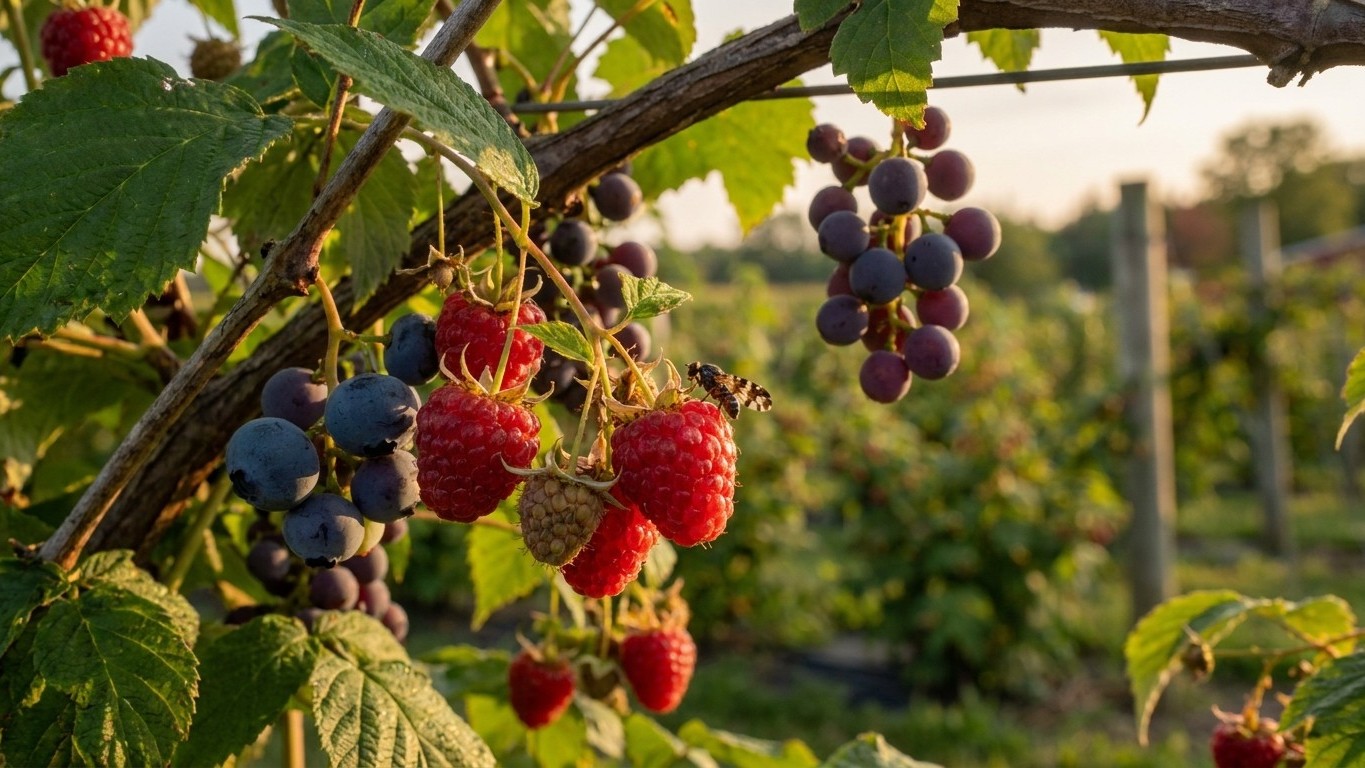

Spotted wing drosophila shows up in Ontario as early as June, but the real trouble starts in late July and runs through October, right when raspberries, blueberries, and grapes are ripening on the vine. Cold sanitation practices, frequent harvesting, and targeted insecticide timing are what actually keep populations from wrecking a fruit crop or a backyard bramble patch. Trapping and fruit checks starting in early summer give growers and gardeners the lead time they need before female flies start laying eggs inside intact, ripening fruit.
This isn’t your average fruit fly. Drosophila suzukii, the species behind the damage, arrived in North America around 2008 and was confirmed in Ontario by 2010. Unlike native vinegar flies that only bother overripe or rotting produce, the female spotted wing drosophila carries a serrated, saw-like ovipositor. That lets her cut into firm, still-ripening skin and deposit eggs where common fruit flies simply can’t reach. The result: fruit that looks fine on the outside can already be compromised on the inside, and growers across Niagara, Simcoe County, and the Georgian Bay fruit belt have learned to treat this insect differently from anything else in the orchard.
The weeks to watch

Adults overwinter in leaf litter and wooded edges bordering fields, tucked into a slightly darker, more reddish-brown form than the summer generation. As soon as daytime temperatures climb into the 50s Fahrenheit for a stretch of days, usually by mid-to-late spring, those overwintered flies become active and start feeding on early-season wild hosts like wild blackberry and honeysuckle before cultivated fruit is even available.
Trap catches in Ontario monitoring networks typically stay low through May and early June, then climb sharply once berry crops start coloring up. Peak pressure lands between late July and mid-September, matching the ripening windows for raspberries, blackberries, blueberries, and early wine grape varieties. Populations can build fast during this stretch because the insect completes a generation in as little as one to two weeks under warm, humid conditions. That’s not one wave of flies to manage. It’s several overlapping generations compounding on top of each other within a single growing season.
Activity tapers as temperatures drop in October, but a mild fall extends the risk window for late-season raspberries and fall-bearing varieties. First hard frost effectively ends active feeding and egg-laying for the year, though it doesn’t eliminate the population; enough adults survive in sheltered leaf litter to restart the cycle the following spring.
Why a Single Cold Snap Doesn’t Solve the Problem
A lot of Ontario gardeners assume a hard winter will wipe the pest out. It doesn’t work that way. Studies on the species’ cold tolerance show that while extended deep freezes do kill a portion of the overwintering population, enough insects find protected microhabitats (leaf piles, brush piles, dense hedgerows) to survive typical Ontario winters. Mild winters, which have become more common in southern Ontario over the past decade, tend to produce noticeably higher spring populations than a winter with sustained sub-zero stretches.
Which Fruits Are Actually at Risk
Soft-skinned fruit is the target. Raspberries and blackberries top the list because their exposed drupelets offer almost no resistance to that serrated ovipositor. Blueberries, cherries, strawberries, and thin-skinned grape varieties follow close behind. Peaches and plums can get hit too, particularly once the skin starts to soften near full ripeness.
Thick-skinned or firm produce, think apples, pears, and most vegetables, stays largely off the menu. That’s a useful distinction for home gardeners trying to figure out where to focus monitoring effort: a mixed backyard planting with apple trees and a raspberry patch only needs intensive scouting on the raspberries.
Damage shows up as a small, soft depression on the fruit surface, sometimes with a faint puncture mark. Cut the fruit open and you may find tiny white larvae, rarely longer than an eighth of an inch, feeding inside the flesh. Left unchecked, infested fruit collapses and turns mushy within a day or two of the eggs hatching, well before it would naturally overripen. For commercial growers, that translates directly into rejected loads and lost revenue; for home gardeners, it means berries that look pickable on Monday and are inedible by Wednesday.
How to Detect It Before Damage Shows
Waiting until fruit looks bad means acting too late. Trapping is the standard early-warning method, and it’s simple enough to set up in a backyard patch or a five-acre planting alike.
A basic trap can be made from a clear plastic cup or deli container with several 3/16-inch holes drilled around the upper sides, baited with a mix of apple cider vinegar or a yeast-sugar-water solution, and hung in partial shade near the fruit canopy. Checking traps twice a week from early June through harvest gives a running count of adult activity. Commercial growers in Ontario often supplement this with lures specifically formulated to attract D. suzukii over other vinegar fly species, since apple cider vinegar alone also pulls in non-target flies and can muddy the count.
Beyond trapping, a salt-water float test on sample fruit confirms whether larvae are already present. Crush a handful of ripe berries into a solution of roughly one part salt to twelve parts water, let it sit for fifteen minutes, and larvae will float to the surface if the fruit is infested. This test is cheap, takes almost no equipment, and tells growers within the hour whether they’re dealing with an active infestation or a false alarm from trap counts alone.
What Actually Stops Spotted Wing Drosophila
No single tactic handles this pest on its own. Effective control in Ontario relies on layering sanitation, harvest timing, exclusion, and, when needed, insecticide applications timed to the insect’s short generation cycle.
Sanitation and Harvest Timing
Removing overripe, dropped, or damaged fruit from the planting is the single most effective non-chemical step. Every piece of fruit left on the ground or hanging past its prime is a potential egg-laying site and a source for the next generation. Growers who harvest every two to three days during peak season, rather than stretching to weekly picks, consistently see lower infestation rates because there’s less overripe fruit sitting around as bait.
Fallen and cull fruit should go into sealed bags in the regular trash or be buried at least a foot deep, not tossed into a compost pile at the edge of the field. Backyard compost bins sitting near a raspberry patch are a surprisingly common, and avoidable, source of reinfestation.
Exclusion and Physical Barriers
Fine-mesh insect netting, with holes small enough to block adult flies (generally under 0.98 mm), draped over susceptible plantings before fruit starts to color has shown strong results in small-scale trials and is increasingly used on high-value berry plantings in Ontario. It’s labor-intensive to install and requires monitoring for tears, but it sidesteps the insecticide question entirely for gardeners who’d rather not spray food crops.
Insecticide Timing
When chemical control is warranted, timing matters more than product choice. Because the insect’s life cycle moves so fast in warm weather, sprays need to start at first detection in traps, not after fruit shows damage. Products containing spinosad are commonly used in both conventional and organic production and are generally considered less disruptive to pollinators when applied according to label directions, ideally in early morning or evening when bees aren’t actively foraging. Malathion and pyrethroid-based products are also labeled for spotted wing drosophila on various fruit crops in Canada, though rotating active ingredients helps slow resistance development, a real concern given how many generations this insect can push through in a single season.
Home gardeners should check current provincial guidance before applying anything, since labeled products and application intervals shift from year to year and vary by fruit type. A product cleared for raspberries isn’t automatically cleared for blueberries or grapes.
Post-Harvest Cooling
One control point that gets overlooked outside commercial operations: cooling harvested fruit quickly. Refrigerating berries at or below 39°F within a few hours of picking slows larval development significantly, which matters if fruit sits before it’s eaten, sold, or processed. It won’t kill existing eggs or larvae, but it buys time before infested fruit visibly breaks down, which is useful for anyone selling at a farmers market or holding fruit for a jam batch later in the week.
Ontario’s fruit-growing regions, from the Niagara Peninsula’s vineyards to the u-pick berry farms scattered through central Ontario, deal with this insect every season now. It’s not going away, and it’s not something a single spray or a lucky cold winter fixes on its own. The growers and gardeners managing it best are the ones treating trap counts as a weekly task from June onward, not an afterthought once the berries start turning soft.
Related guides
- Spotted wing drosophila in Manitoba: When It Shows Up and What Stops It
- Spotted wing drosophila in Quebec: When It Shows Up and What Stops It
- Spotted wing drosophila in Prince Edward Island: When It Shows Up and What Stops It
- Spotted wing drosophila in Vermont: When It Shows Up and What Stops It
- Spotted wing drosophila in Maine: When It Shows Up and What Stops It