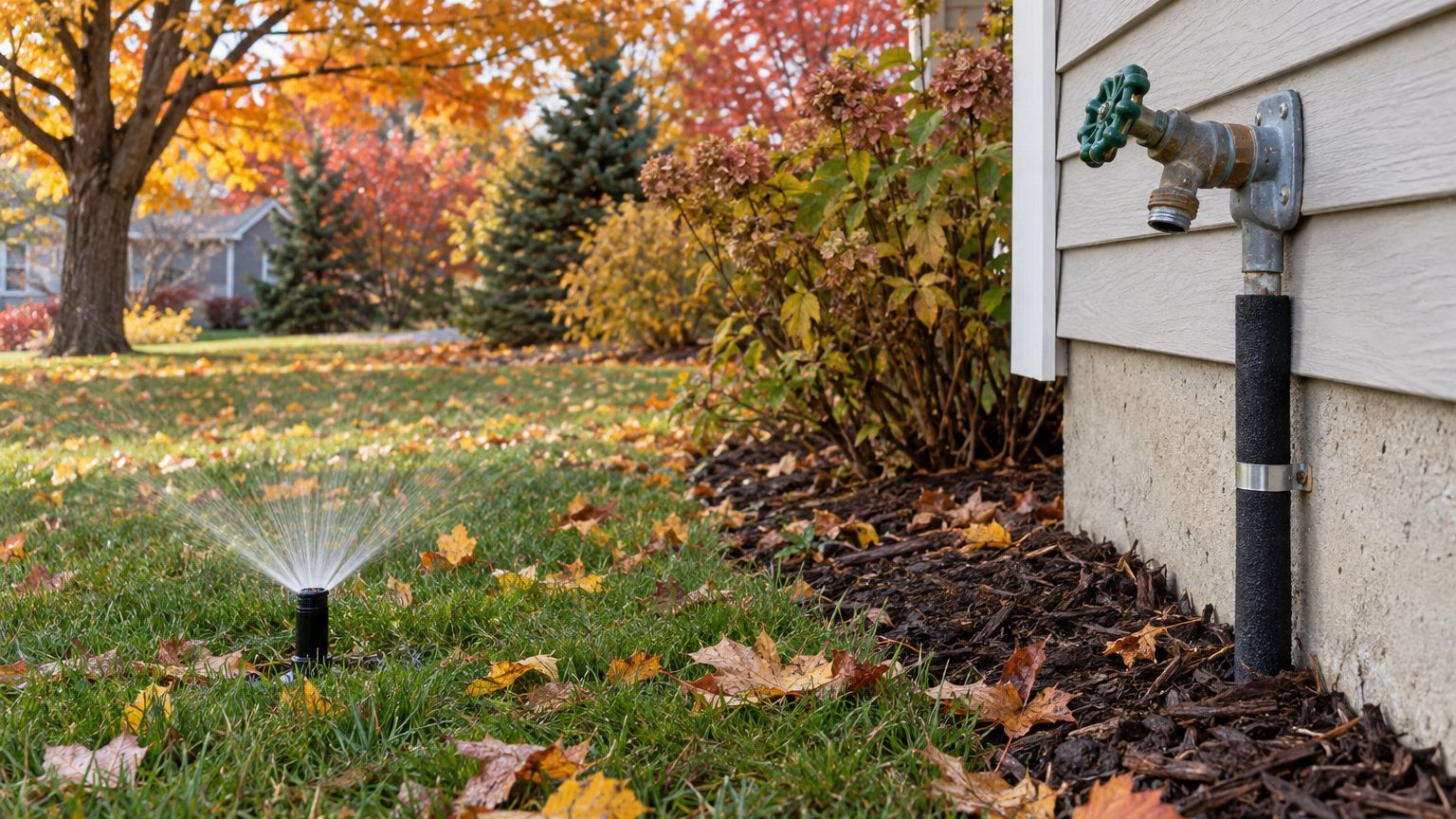

North Dakota doesn’t leave much margin. The mean daily minimum in the coldest month is 0.2°F at the Fargo reference station, according to NOAA’s 1991-2020 climate normals. Any water left in a sprinkler line or an outdoor tap has a long, brutal winter to find its weak spot. The calendar helps, but the weather makes the call. Here is how the timing works, which method suits each part of the system, and where homeowners here tend to get caught.
When to do it in North Dakota
Winterize before the first hard freeze, not after the first light one. NOAA NCEI’s U.S. Climate Normals for 1991-2020 put the first fall 32°F freeze at the Fargo airport station in a band running from September 25 to October 5 (the 30-70% probability band), so finish the work before the September 25 to October 5 window opens.
That window is not a distant target this year. Today is October 1, which puts the reference city squarely inside it. If the sprinklers are still charged and the hoses are still on the spigots, this week is the week.
Why the date is a range, not a day
A probability band is not a promise. Some years the first 32°F reading shows up before the band starts, and some years it holds off past the end. A light frost, the kind that blackens basil on a clear, calm night, usually passes without harming anything underground. A hard freeze is different: temperatures sit below freezing for hours and then repeat the next night. Buried sprinkler lines get a little protection from the soil, but the exposed parts, like an aboveground backflow preventer or a spigot on a north-facing wall, give out first.
The airport figures also come with a caveat. Suburban and rural properties typically see the first fall frost earlier than the airport does, often by one to two weeks, and more at higher elevation. The same direction holds across the state: the farther north you go, the earlier the first frost, which means fall chores like this one move earlier, never later. Check your own county’s frost dates before you settle on a weekend, and the North Dakota guides are a good place to start.
What the hardiness zone does and doesn’t tell you
The USDA Plant Hardiness Zone Map 2023, built on 1991-2020 normals, places North Dakota in zones 3a to 4b. That system rests on one variable, the average annual extreme minimum temperature, and it varies across the state. It confirms that pipes here face real freezing, but it says nothing about timing. Use the frost probabilities for the date and the zone only as a reminder of the stakes.
There is no mild-winter shortcut in this state. In places where winter lows stay above freezing, a full blowout is often unnecessary and a few simple precautions will do. With a coldest-month minimum near 0°F, that logic does not apply here. Everything that holds water gets drained or blown out, and the whole job gets done ahead of the cold.
Sprinkler lines: drain or blow out
Water expands as it turns to ice, and a closed pipe has nowhere to let that pressure go. The ice plug itself is rarely what breaks things. The pressure squeezed between the plug and a closed valve cracks the weakest point, which on a sprinkler system means fittings, valve bodies, sprinkler heads, and the backflow preventer. PVC and poly pipe tolerate a little, but threaded plastic fittings and brass components do not. The damage stays hidden under the lawn all winter and shows up when you pressurize the system in spring.
Three ways to clear the lines
A manual drain relies on valves at the low points of the system. You shut off the water supply, open those valves, and let gravity empty the pipes. It works only if the system was installed with sloped lines and drain valves in the right spots, and even then, water can linger in sections that sag or sit flat.
Automatic drain valves open on their own when line pressure falls and let water out at low points. They save a step, but they share the manual method’s weakness: they drain whatever sits above them and nothing else. Heads, valve manifolds, and any dip in the line can hold water that never reaches the valve.
A compressed-air blowout pushes water out of every zone, one at a time, through the heads. It reaches the places gravity misses, which is why it is the standard approach for harsh winters. The air pressure has to stay within what your system’s components are rated for, because too much can damage heads and fittings. The air volume matters more than most people expect, and a small hobby compressor is rarely enough for a full system.
What this climate calls for
With a coldest-month mean minimum of 0.2°F at the Fargo reference station (NOAA NCEI Climate Normals, 1991-2020), draining alone leaves too much to chance. Plan on a compressed-air blowout, completed before the September 25 to October 5 frost window opens, and treat drain valves as a supplement. Shut off the water to the system first, set the controller to its off or rain mode so it doesn’t try to run, and drain the backflow preventer too, since it sits aboveground and is exposed.
Hiring a professional makes sense in several situations. Large systems with many zones need more air volume than a typical homeowner owns. A blowout done wrong can split a line or blast a head, and you won’t know until spring. If you can’t tell where the low points are or whether your system has a mainline drain, an irrigation contractor can sort that out in one visit. Book early, because the weeks around the first frost are when every contractor in town is slammed. Once the system is dry, the lawn’s fall routine comes next, and winterizing a lawn covers that.
Outdoor faucets and hoses
The hose bibs are the part of the house plumbing most exposed to a North Dakota winter, and the fix takes about ten minutes per spigot. Start by disconnecting every hose, splitters and spray nozzles included. Drain them, coil them, and store them in a garage or shed. A hose left screwed on holds water in the faucet and the pipe behind it.
Next, find the interior shutoff valve that feeds each outdoor tap. It is usually in a basement, crawlspace, or utility area, on the pipe that runs to the exterior wall. Close it. Then go outside, open the tap, and let the remaining water run out. Leave the outside tap open through winter so any trace of water has room to expand. Some homes have no interior shutoff for the outdoor tap at all, and adding one is a plumber’s job, not a weekend project. Turning valves is as far as a homeowner should go here.
Why a frost-free faucet still fails with a hose attached
A frost-free faucet puts the valve seat well inside the heated part of the wall, at the end of a long stem. When the handle is off, the water stops inside the house, and the pipe barrel in front of it is supposed to drain out through the spout. That only happens if the barrel can empty. With a hose attached, even a hose that looks empty, water stays trapped in the barrel. It freezes, the pipe splits, and you find out in spring when you turn the tap on and water floods the wall cavity. That is why frost-free outdoor taps still need to be cleared of hoses. They are forgiving, not freeze-proof.
Disconnect every hose before the September 25 to October 5 frost window opens, because the first hard freeze won’t wait for the weekend. The fuller sequence, including what to check on older sillcocks, is laid out in Winterizing Outdoor Faucets Before the First Freeze. If a tap drips after the interior valve is closed, or the handle feels loose or stuck, call a plumber rather than forcing anything.
What goes wrong here
The most common failure is the early cold snap. The NOAA band of September 25 to October 5 describes the airport. Rural and suburban properties often freeze one to two weeks earlier, and anyone farther north freezes earlier still. A homeowner who waits for the airport’s date can lose the race by a week or more. What spring looks like afterward: a sprinkler zone that never builds pressure, a head that geysers, or a backflow preventer that drips steadily. The prevention is to schedule the blowout for the days leading up to the window, not inside it.
The forgotten hose is the second. One hose left on a back-yard spigot can burn a frost-free faucet, and the symptom is usually invisible until you open the tap. Water runs inside the wall instead of out the spout, and you may notice a stain on drywall or a drip from a basement ceiling. Walk the whole property, including the spigot behind the shrubs and the one on the garage, before you call the job done. Burst pipes inside walls are a bigger conversation, and frozen pipes covers what to do if one happens.
The third is the flooded valve box. In-ground boxes hold the sprinkler valves, and they collect runoff and meltwater all fall. If a box is full of water when the hard freeze arrives, the valves inside can crack even on a system that was blown out, because the valve bodies still hold residual water. In spring, you see a zone that won’t shut off or a wet patch around the box lid. Pop the lids in the fall, check for standing water, and make sure the box drains. Do that check in the days before the frost window opens, not after the first freeze.
Common questions
Is it too late if the first frost has already happened?
Not necessarily. A light frost often does no harm to buried lines, and what matters is whether a hard freeze has arrived. If the forecast shows nights staying below freezing, do the blowout and the faucet work immediately. If the system has already frozen hard, leave it off until spring and have it inspected before you turn the water back on.
Do I need a professional for the blowout?
Not always, but it is the sensible choice for large or multi-zone systems, and for anyone without a compressor that can supply enough air volume. A mistake can crack a head or a line, and the damage stays hidden until spring. A contractor can also check for low-point drains and the backflow preventer at the same visit.
Can I leave a hose on a frost-free faucet?
No. The faucet only drains if the barrel is open to the air. A hose, even an empty one, traps water inside the pipe, and that water can freeze and split the pipe within the wall. Take every hose off before the hard freeze, and let the tap drain.
Does the hardiness zone tell me when to winterize?
It doesn’t. The USDA Plant Hardiness Zone Map 2023 lists North Dakota as 3a to 4b and measures only the average annual extreme minimum temperature. For timing, use the first fall frost probabilities from NOAA, shift them earlier if you live in a colder part of the state, and finish before the first hard freeze arrives.