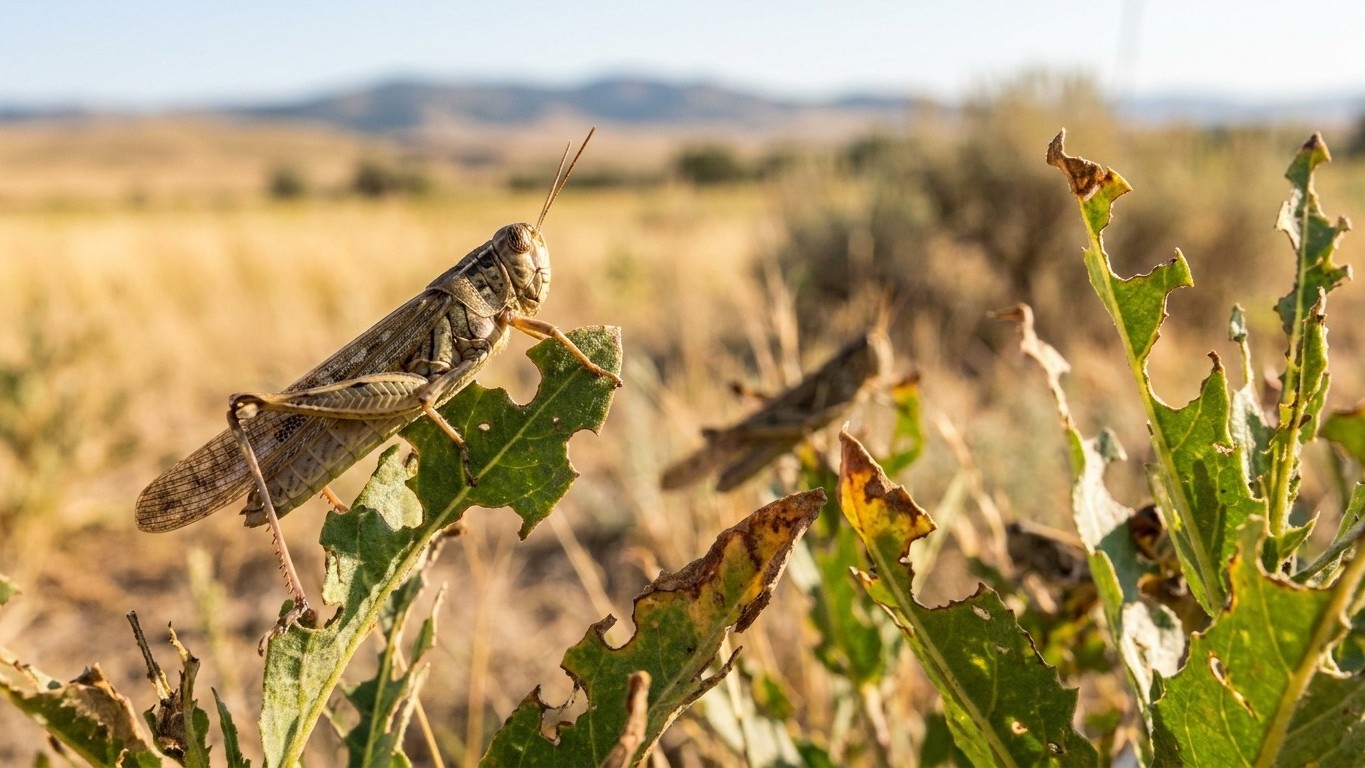

Grasshoppers become a real problem across Montana from late June through August, when nymphs finish molting into winged adults and start moving through rangeland, hay fields, and backyard gardens in numbers that can strip vegetation in days. The state sits inside one of the most active grasshopper zones in the country, and outbreak years tend to follow a predictable rhythm tied to soil temperature, rainfall, and how many eggs survived the previous winter.
The Grasshopper Calendar: What Happens and When

Eggs laid the previous August and September sit in the top few inches of soil all winter, packed into small pods that look like grains of rice. Warming soil in April and May triggers hatching, and that timing shifts by two or three weeks depending on elevation. Eastern Montana counties, lower and drier, often see hatch start in late April. Higher valleys in the western part of the state can lag until late May.
Newly hatched nymphs are wingless and stay close to where they emerged, feeding on grasses and low weeds. Over the next five to six weeks they molt through several stages, and by late June the first adults appear with functional wings. This is the point where a backyard problem turns into a mobile one. Adult grasshoppers can travel long distances on wind currents, which is why a field that looked fine in June can be overrun by mid-July when a swarm drifts in from a neighboring property or even the next county.
Peak feeding pressure runs from July through mid-August, right when Montana’s hay crops, wheat, and garden vegetables need the most protection. Females start laying eggs again in August, favoring undisturbed soil along field edges, fence lines, and roadsides, resetting the cycle for next year.
Which Species Actually Cause Trouble
Montana State University Extension entomologists track three species as the main economic threats: the migratory grasshopper, the twostriped grasshopper, and the redlegged grasshopper. Each behaves a little differently.
The migratory grasshopper is the one most likely to form large, mobile bands. It prefers grasses, which makes rangeland and hay ground its main target. The twostriped grasshopper has a broader appetite that includes broadleaf crops and garden vegetables, so it shows up more often in complaints from homeowners with vegetable beds. The redlegged grasshopper tends to build up in weedy, unmanaged areas before spreading into adjacent cropland once its preferred food runs short.
Knowing which species dominates matters for timing control. Migratory and twostriped grasshoppers hatch a bit earlier than redlegged populations in most Montana counties, so an early-season scouting trip can tell you which threat you’re actually managing before you decide on a treatment window.
Why Some Years Are Brutal and Others Are Quiet
Grasshopper populations in Montana run in multi-year cycles, and drought is the single biggest driver. Dry, warm springs improve egg survival and nymph development, while wet, cool springs cause fungal disease and higher nymph mortality. A string of dry years, the kind Montana has seen repeatedly over the past two decades, can push local populations from background levels to outbreak densities within two or three seasons.
Rangeland condition plays a role too. Overgrazed pasture with sparse vegetation actually favors grasshopper survival, because thin plant cover means more bare soil that warms faster and speeds up egg development. Ironically, some of the same conditions that stress cattle operations during drought also give grasshoppers an advantage, which is part of why bad drought years and bad grasshopper years tend to overlap in eastern Montana.
Natural predators and pathogens act as a brake most years. Birds, particularly meadowlarks and other grassland species, eat large numbers of nymphs. A naturally occurring fungus, Entomophaga grylli, can wipe out significant portions of a population during cool, humid stretches, though Montana’s dry summers often don’t give that fungus the conditions it needs to spread.
What Actually Stops Grasshoppers
Timing Beats Everything
The single most effective control window is early, when nymphs are still small and wingless. Once grasshoppers reach adult stage and can fly, treatment options shrink and effectiveness drops. Extension agents in Montana consistently recommend scouting field margins in May, since that’s typically where hatching concentrates first, and treating while nymphs are concentrated rather than waiting for a visible outbreak across an entire field.
A simple density check works well for deciding whether action is worth it: counting grasshoppers per square yard along several spots in a field gives a rough population estimate. Numbers above eight to ten per square yard in rangeland, or lower thresholds in high-value crops and gardens, generally justify treatment.
Chemical and Bait Options
Insecticidal baits remain popular for larger acreages because they target grasshoppers specifically and reduce exposure to non-target insects like pollinators. Baits work best applied early morning or evening when grasshoppers are most active on the soil surface feeding.
Broader-spectrum insecticides are used on cropland and pasture when infestations are severe, but timing against nymph stages produces far better results than spraying adults after they’ve already caused most of the season’s damage. Applications during peak midday heat tend to be less effective since grasshoppers are less active on exposed vegetation during the hottest hours.
Biological and Cultural Controls
A naturally occurring protozoan, Nosema locustae, is sold as a bait-based biological control. It doesn’t kill grasshoppers quickly, but infected insects feed less, reproduce less, and can pass the pathogen to others, which reduces populations over a season or two rather than overnight. This option appeals to landowners managing large rangeland acreages who want a lower-impact approach and are willing to accept slower results.
Cultural practices help too. Reducing weedy, undisturbed field margins limits egg-laying habitat. Rotational grazing that maintains denser plant cover keeps soil temperatures lower, which slows nymph development. Tilling field edges in early spring can physically disrupt egg pods before hatch, though this only works where tillage fits the existing farming system.
Protecting Home Gardens Specifically
Backyard gardens face a different challenge than open rangeland, since grasshoppers moving in from adjacent fields or vacant lots can overwhelm a small growing space fast, even if the homeowner did nothing wrong. Physical barriers work well at this scale. Floating row covers over young vegetable plants block feeding without chemicals, and they’re especially useful for leafy greens and seedlings that show damage quickly.
Garlic and hot pepper sprays offer mild deterrent effects but won’t stop a serious influx once grasshoppers are hungry and numerous. For gardens bordering open land or pasture, a mowed buffer strip several feet wide reduces the cover grasshoppers use to approach garden beds, since they tend to avoid crossing bare, exposed ground where predators can spot them easily.
Chickens and guinea fowl, where local zoning allows them, do a surprisingly efficient job of thinning grasshopper numbers in a yard. It’s not a complete solution for a serious outbreak, but as part of an integrated approach alongside row covers and buffer strips, it adds another layer of pressure that reduces how many grasshoppers make it to your tomatoes.
Montana’s grasshopper pressure isn’t uniform across the state, and a county extension office can usually tell you whether local trapping counts from the previous fall point toward a heavier or lighter season ahead, information that’s far more useful for planning than waiting to see what shows up in your yard come July.