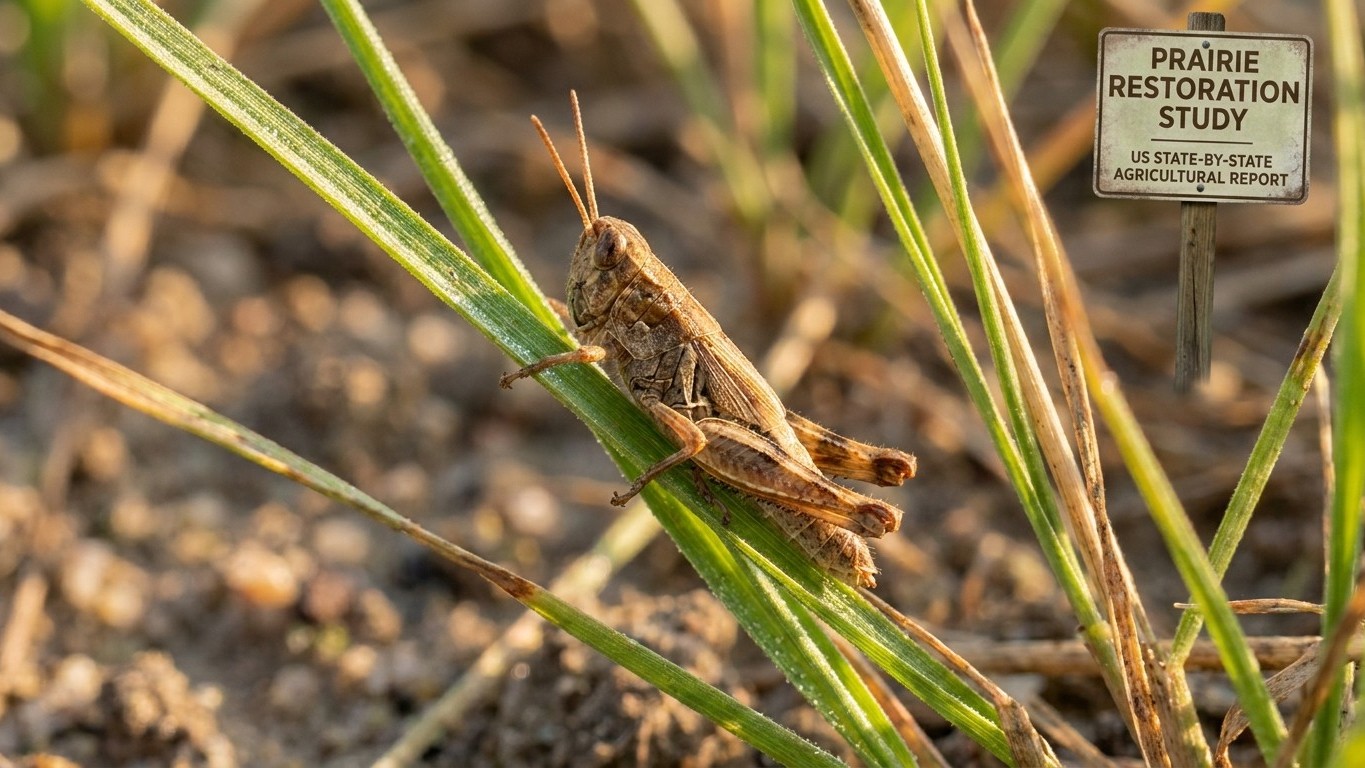

Grasshoppers become a problem in South Dakota from late May through early July, when overwintered eggs hatch into nymphs, and again in August when adult populations peak and start moving into gardens, shelterbelts, and hay fields. The window to act runs earlier than most homeowners think, since young nymphs are far easier to kill than winged adults that can hop a quarter mile between meals.
The South Dakota Grasshopper Calendar

Eggs laid the previous fall sit in the top two inches of undisturbed soil all winter. Roadside ditches, fence lines, pasture edges, and no-till fields make ideal nurseries because the ground stays firm and isn’t disturbed by plows. Once soil temperatures climb into the 60s, usually mid-to-late May in the eastern part of the state and a bit later on the western prairie, those eggs hatch in waves rather than all at once.
South Dakota State University Extension entomologists track this hatch closely because timing sprays around it makes or breaks control. Nymphs go through five or six growth stages before becoming winged adults, a process that takes roughly five to six weeks. During that stretch they can’t fly far, which is the narrow opportunity homeowners and ranchers get before the insects mature and spread across property lines.
By late July, adults are mating and females are already scouting soil for egg-laying sites, often the same undisturbed patches where they themselves hatched. August tends to bring the heaviest visible pressure on lawns, gardens, and shelterbelts as adult grasshoppers, now strong fliers, move out of drying rangeland in search of green, irrigated vegetation. That’s often when a homeowner in Rapid City or Aberdeen suddenly notices dozens of grasshoppers stripping leaves off tomato plants that looked fine a week earlier.
Drought Years Change the Math
Dry conditions favor grasshoppers in two ways. Females lay more eggs when they’re not competing with lush vegetation, and fungal diseases that normally kill nymphs struggle to spread in low humidity. South Dakota has seen this play out during multiple drought cycles over the past two decades, with rangeland surveys from USDA’s Animal and Plant Health Inspection Service showing population spikes across the western half of the state following consecutive dry summers. A wet spring, by contrast, can knock hatch rates down significantly because saturated soil damages eggs and young nymphs are more vulnerable to fungal pathogens like Entomophaga grylli.
Which Species Show Up Most in South Dakota
Not every grasshopper species causes economic damage, but a handful dominate the state’s outbreaks. The migratory grasshopper and the differential grasshopper are the two most commonly blamed for stripped crops and defoliated gardens, both favoring broadleaf plants over grasses, which is exactly why vegetable gardens and young trees take such visible hits. The two-striped grasshopper follows close behind, often found in denser, moister vegetation along creek bottoms and irrigated fields.
These three species share a habit that matters for control: they prefer laying eggs in firm, unplowed soil rather than loosely tilled ground. That preference is why grasshopper pressure tends to concentrate along field borders, CRP acres, and untended lots before spreading inward, and it’s a detail that shapes where treatment should start.
What Actually Stops Grasshoppers in South Dakota
Control works best when it targets the nymph stage, roughly early June through mid-June depending on the year’s hatch timing, before insects gain flight range. Waiting until adults are airborne in late summer means dealing with a mobile population that simply relocates rather than dying off, which is a large part of why late-season treatments often disappoint homeowners.
Cultural and Mechanical Controls
Tillage remains one of the most effective tools against overwintering eggs. Turning soil in known egg-laying zones, field edges, ditches, and fallow ground, physically destroys egg pods before they hatch. This works well on private land but is obviously not practical along public roadsides or CRP acreage, which is why those areas often become the source population for surrounding farms and yards year after year.
Mowing tall grass and weeds along property borders removes both food and shelter, forcing young nymphs to travel farther and face more predation. Birds, spiders, and predatory ground beetles account for a meaningful share of natural nymph mortality, so keeping some diverse vegetation around (rather than a single monoculture lawn) actually supports the predators doing free pest control.
Biological and Chemical Options
For larger acreages, bait formulations containing Nosema locustae, a naturally occurring protozoan pathogen specific to grasshoppers and crickets, offer a slower but more targeted approach. It doesn’t kill instantly; infected grasshoppers weaken over one to three weeks and spread the pathogen to others through cannibalism and contaminated droppings. It’s most useful as a preventive measure applied early, not a rescue treatment for an active outbreak already stripping a garden bare.
Insecticides remain the fastest option when nymph populations are dense. Products containing carbaryl, malathion, or pyrethroid compounds are labeled for grasshopper control on lawns and non-crop areas, and timing them to the third-instar nymph stage (roughly two to three weeks after hatch) maximizes effectiveness while minimizing the number of applications needed. Homeowners should always check current product labels for South Dakota-specific application rates, since formulations and restrictions change and label instructions take precedence over any general guidance.
Reduced Agent Area Treatments, a strip-spraying technique developed through USDA APHIS rangeland programs, apply insecticide in alternating swaths rather than blanket coverage. This cuts chemical use by roughly a third to a half while still achieving effective control, because grasshoppers moving across the field encounter treated strips regardless of the gaps. Several South Dakota counties have used this method on rangeland during heavy outbreak years, coordinated through Extension offices and USDA staff rather than individual landowners acting alone.
Protecting Gardens and Yards Specifically
Row covers made of fine mesh keep adult grasshoppers off vegetable plants during the peak August migration, though they need to go on before insects arrive since grasshoppers already inside a covered bed simply feed undisturbed and multiply the problem. Physical barriers work particularly well for smaller raised beds where full insecticide coverage isn’t practical or desired near food crops close to harvest.
Trap crops, sacrificial plantings of something grasshoppers prefer (sorghum and certain millets work well) planted along a garden’s outer edge, can pull feeding pressure away from tomatoes, peppers, and other high-value plants. It’s not a complete solution, but combined with mowed borders and early-season monitoring, it reduces the odds of waking up to a garden stripped down to stems.
Homeowners dealing with a heavy grasshopper year should scout weekly starting in late May, checking field edges and untended grass first since that’s where nymphs concentrate before spreading. Counting five or more nymphs per square yard along a border typically signals a population worth treating before it matures and disperses across the property.
Related guides
- Grasshoppers in Iowa: When It Shows Up and What Stops It
- Grasshoppers in Wyoming: When It Shows Up and What Stops It
- Grasshoppers in Texas: When It Shows Up and What Stops It
- Grasshoppers in Utah: When It Shows Up and What Stops It
- Squash vine borer in South Dakota
- Cabbage looper in South Dakota
- Asparagus beetles in South Dakota
- Grasshoppers in Idaho: When It Shows Up and What Stops It
- Grasshoppers in Colorado: When It Shows Up and What Stops It