
Tomato hornworms show up in Nevada gardens from late June through September, with the heaviest activity hitting in July and August once daytime temperatures consistently top 85°F. In the Las Vegas valley, that window opens earlier and stretches longer than in Reno or Carson City, where cooler nights delay the pest by several weeks. Two overlapping generations are common in southern Nevada; northern gardeners usually deal with just one.
What’s Actually Eating Your Tomatoes

The culprit is either the tomato hornworm (Manduca quinquemaculata) or its close cousin, the tobacco hornworm (Manduca sexta). Both species turn up on Nevada tomato plants, and honestly, telling them apart doesn’t matter much for control purposes. What matters is recognizing the caterpillar before it strips a plant bare overnight.
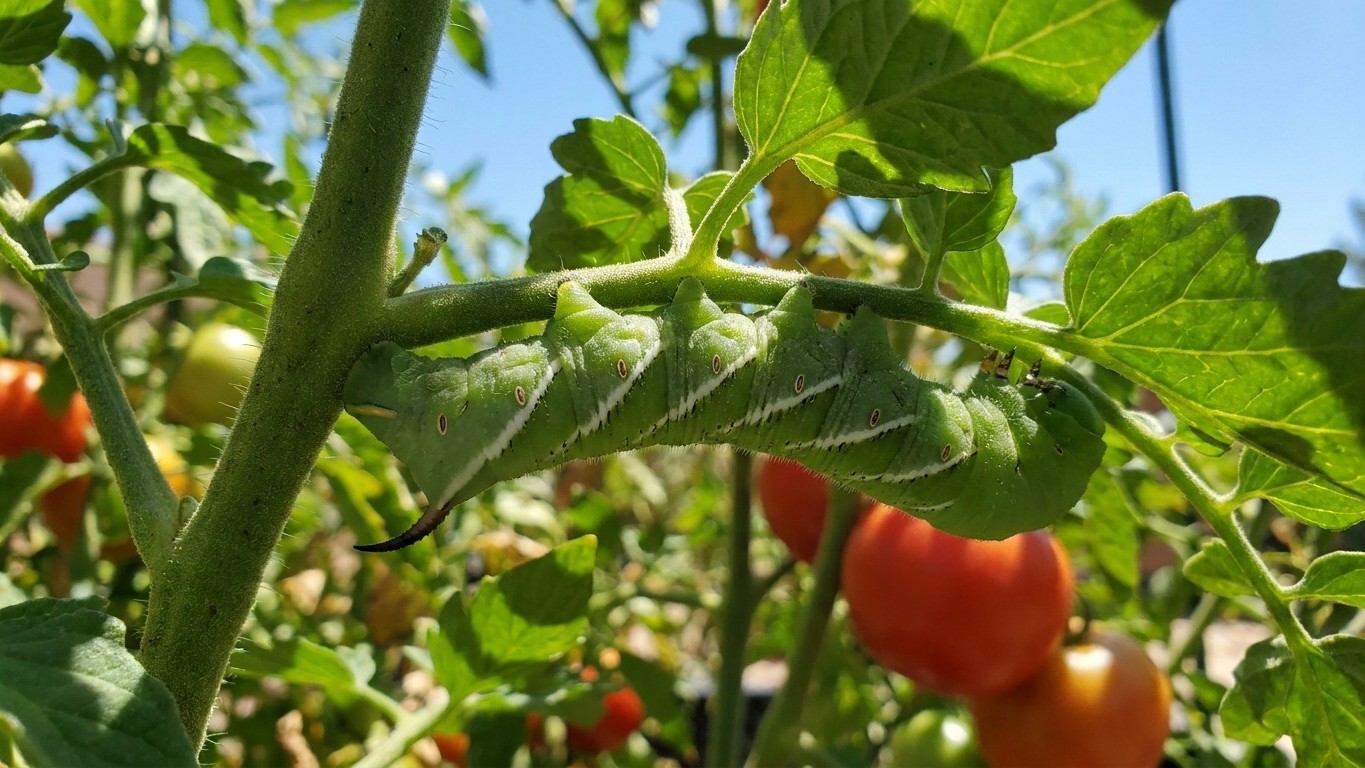
These are big, green caterpillars, sometimes reaching four inches long, with a curved horn on their rear end (harmless despite the intimidating look). Diagonal white stripes run down each side of the body. The tomato hornworm has V-shaped markings and a black or dark blue horn. The tobacco hornworm shows straighter diagonal lines and a red horn. Adults are large gray-brown moths, sometimes called hawk moths or sphinx moths, with a wingspan that can hit five inches, and they’re often mistaken for hummingbirds when they hover at dusk feeding on flower nectar.
Spotting the Damage Before You Spot the Bug
Hornworms are masters of camouflage. Their green coloring blends almost perfectly with tomato foliage, so most gardeners notice the wreckage before they find the worm responsible. Look for stripped stems where leaves have vanished entirely, dark green or black droppings (called frass) about the size of a pencil eraser scattered on leaves below the feeding site, and chewed marks on green fruit. A single mature hornworm can consume an entire tomato plant branch in a couple of days.
Why Nevada’s Climate Sets the Schedule
Nevada’s dry heat plays a bigger role in hornworm timing than most gardeners realize. Moth activity and egg-laying depend on accumulated warmth, technically called degree-day accumulation, and Nevada’s intense summer sun pushes that total up fast in the Mojave Desert region. Southern Nevada counties, including Clark County, often see moths active by late May, with caterpillars feeding heavily through June and a second wave in August as the moths complete another cycle before fall.
Northern Nevada’s high desert climate, around Reno, Sparks, and the Carson Valley, runs on a slower clock. Cooler spring temperatures and shorter frost-free seasons compress hornworm activity into a single generation, typically peaking from mid-July through early September. Elevation matters here too: gardens above 5,000 feet in places like Douglas County or the Tahoe basin’s edge tend to see lighter pressure overall, simply because the growing season is shorter and nighttime temperatures dip enough to slow larval development.
Irrigation habits also factor in. Nevada’s arid conditions mean tomato plants rely almost entirely on supplemental watering, and stressed, drought-strained plants can actually become more attractive to egg-laying moths searching for softer foliage. Consistent, deep watering keeps plants vigorous enough to tolerate some feeding damage and recover faster if a hornworm does move in.
Scouting: The Single Most Effective Habit
Nightly or early-morning inspections beat every other control method combined, because hornworms are most visible feeding at dawn, dusk, or under artificial light with a UV flashlight (their body actually fluoresces green under blacklight, which sounds strange but works remarkably well for night patrols). Run your hands along stems and check the undersides of leaves, especially near stripped branches. Twice-weekly checks during peak season, late June through August in the south, mid-July through September in the north, catch infestations before they cause serious damage.
Hand-picking remains the gold standard for home gardens of typical backyard size. Drop captured caterpillars into a bucket of soapy water, or relocate them far from your garden if you’d rather not kill them directly. This sounds tedious, but a five-minute daily walk-through during peak weeks prevents the kind of overnight defoliation that ruins a season’s tomato crop.
Natural Predators Already Working in Your Favor
Before reaching for any spray, check for small white cocoons attached to a hornworm’s back. Those are the pupal cases of parasitic braconid wasps, and a hornworm carrying them is already doomed, working as an unpaid pest-control agent for the rest of its life. Leave parasitized hornworms in place; killing them wastes a natural biological control that will release dozens of new wasps to attack future hornworms. Nevada gardens with diverse plantings, particularly those including dill, fennel, or other umbel-flowered herbs that attract adult braconid wasps, tend to see this natural suppression more consistently.
Other natural predators active in Nevada include lady beetles and lacewings, which target hornworm eggs, along with birds that pick off smaller larvae. Reducing broad-spectrum insecticide use protects these allies and often does more for long-term control than any single treatment.
Treatment Options That Actually Work
Bacillus thuringiensis (commonly sold as Bt or Bt kurstaki) remains the most reliable low-toxicity option for Nevada gardeners dealing with an active infestation beyond what hand-picking can manage. It targets caterpillars specifically, sparing bees, beneficial wasps, and other pollinators that are already under enough pressure in the desert Southwest. Apply it in the early evening, since UV breakdown from Nevada’s intense summer sun degrades the product fast, sometimes within a day, cutting its effectiveness if sprayed at midday.
Insecticidal soap and neem oil offer additional options for smaller larvae, though they’re less effective once a hornworm reaches full size. Spinosad-based products provide another targeted alternative with lower impact on beneficial insects compared to broad-spectrum synthetic pesticides. Whatever product you choose, spray in the cooler parts of the day, both to protect pollinators actively foraging and to reduce rapid evaporation in Nevada’s low humidity.
Broad-spectrum insecticides do kill hornworms, but they also wipe out the braconid wasps and other predators keeping populations in check naturally. In a state where beneficial insect populations already face pressure from heat and limited water sources, that tradeoff rarely makes sense for a home garden.
Prevention Steps for Next Season
Tilling soil in fall or early spring disrupts overwintering pupae, which burrow a few inches underground to survive winter before emerging as moths. Nevada’s sandy, well-draining desert soils actually make this tilling step easier than in heavier clay soils found elsewhere, and it’s one of the more effective long-term reductions in hornworm pressure available to home gardeners.
Crop rotation helps too, though in small residential gardens with limited space it’s often impractical. Where possible, avoid planting tomatoes, peppers, eggplant, or potatoes (all host plants) in the same bed year after year. Companion planting with marigolds, basil, or borage doesn’t eliminate hornworms outright, but it does support the pollinators and predatory insects that make natural control more effective.
Row covers offer physical protection for young transplants, though they need to come off once flowers appear so pollinators can reach the blooms. This works especially well in northern Nevada, where the single-generation pattern means covering plants through the peak early-summer moth flight can meaningfully cut down on eggs laid before the covers are removed for pollination.
Regional Timing at a Glance
Southern Nevada gardeners in the Las Vegas valley and Clark County should start scouting by late May and expect activity clear through September, with two overlapping generations creating near-continuous pressure. Northern Nevada gardeners around Reno, Carson City, and the Truckee Meadows can focus their scouting from mid-July through early September, when the single annual generation does its damage. Higher-elevation gardens statewide tend to see lighter, later, shorter windows of activity, simply due to compressed growing seasons and cooler nights that slow larval development.
One overlooked detail: hornworm moths are strong fliers and can travel considerable distances between wild host plants (like desert nightshade species common throughout the Mojave and Great Basin) and cultivated gardens. That means even isolated Nevada properties with no neighboring tomato patches aren’t immune, since a wandering moth from native vegetation can find a backyard tomato bed just as easily as one surrounded by other gardens.
Related guides
- Tomato hornworm in Idaho: When It Shows Up and What Stops It
- Tomato hornworm in Utah: When It Shows Up and What Stops It
- Tomato hornworm in New Jersey: When It Shows Up and What Stops It
- Tomato hornworm in Pennsylvania: When It Shows Up and What Stops It
- Tomato hornworm in Virginia: When It Shows Up and What Stops It
- Tomato hornworm in British Columbia: When It Shows Up and What Stops It