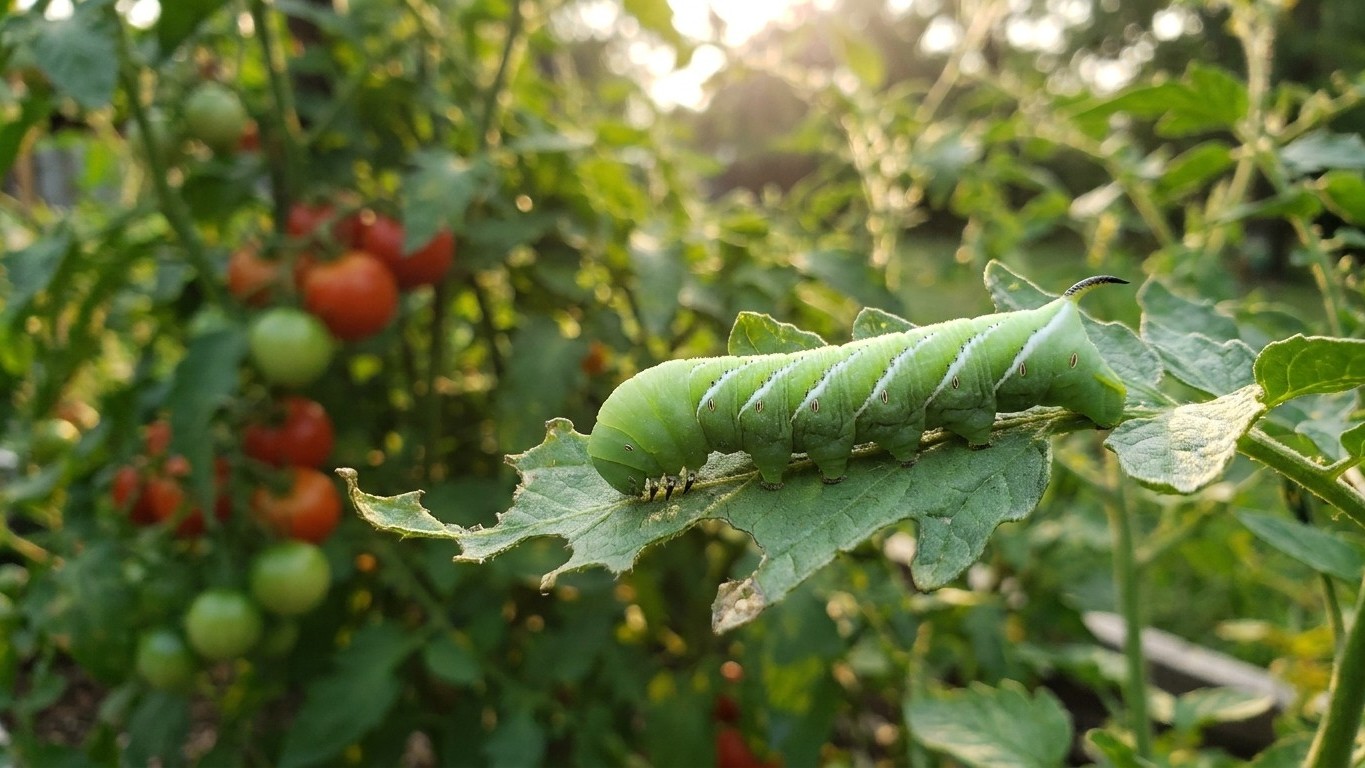

Tomato hornworms typically show up in British Columbia gardens from mid-July through September, with the heaviest feeding damage usually happening in August when the caterpillars reach full size. They’re most active in the province’s warmer tomato-growing regions, the Okanagan Valley, the Fraser Valley, Greater Vancouver, and the southern tip of Vancouver Island. Handpicking is still the most reliable fix for a backyard garden. Bt sprays help when the population gets heavier than a few caterpillars, and turning over garden soil in fall destroys the pupae hiding underground before they get a chance to become next year’s moths.
When Tomato Hornworms Show Up in BC

The life cycle starts with an overwintering pupa buried a few inches into the soil. Once the ground warms in late spring, the pupa transforms into a large gray-brown moth that emerges at dusk. These moths, sometimes called five-spotted hawk moths, hover over flowers the way hummingbirds do, feeding on nectar through a long proboscis. Females lay pale green eggs on the underside of tomato leaves, and those eggs hatch within about a week.
Young larvae start small and easy to miss, but they grow fast. Within three to four weeks of steady feeding, a tomato hornworm can reach nearly 4 inches long, thick as a finger, before dropping to the soil to pupate again. BC’s shorter, cooler growing season generally limits the insect to one generation per year, unlike parts of the southern United States where warmer, longer summers allow for two generations and a second wave of caterpillars in early fall.
That single-generation pattern matters for timing your garden checks. If you spot moths flying around porch lights or garden beds in June, expect caterpillars to appear on your plants roughly three to five weeks later. Most BC home gardeners report their first hornworm sightings in July, with numbers building through August before tapering off as nights cool in September.
Identifying a Tomato Hornworm (and What It’s Not)
A full-grown tomato hornworm is bright green with eight diagonal white markings shaped like a series of V’s along its sides, and a curved black or dark blue horn near the tail end. That horn looks alarming but it’s harmless, it can’t sting or bite. The caterpillar’s coloring blends almost perfectly with tomato foliage, which is part of why an infestation can go unnoticed until the damage is already extensive.
There’s a close relative worth knowing about: the tobacco hornworm (Manduca sexta). It has straight diagonal white stripes without the V shape, plus a red horn instead of a black one. Tobacco hornworms favor warmer climates and are far more common in the southeastern US than in Canada. In British Columbia, nearly every hornworm you find on tomatoes, peppers, or eggplant is the tomato hornworm species rather than its tobacco-loving cousin.
The adult moth is easy to identify too. It has a wingspan up to 5 inches, mottled gray and brown forewings, and five pairs of orange-yellow spots running down the sides of its abdomen, which is where the “five-spotted” name comes from. If you’ve ever seen a large moth hovering at dusk near petunias or evening-scented flowers and mistaken it for a small hummingbird, there’s a decent chance that was the adult stage of this same pest.
Where in BC They Cause the Most Trouble
Climate drives where hornworms cause real damage. The Okanagan’s hot, dry summers create ideal conditions for both the moth’s flight period and the caterpillar’s growth rate, so gardeners in Kelowna, Penticton, and Osoyoos often deal with a longer active window than coastal growers. The Fraser Valley and Greater Vancouver see steady hornworm activity too, since the region grows a large share of BC’s commercial and home garden tomatoes.
Coastal areas like Victoria and the Gulf Islands tend to have slightly cooler nights, which can push egg-laying and larval development back by a week or two compared to the interior. Higher-elevation interior regions, including parts of the Thompson-Nicola and the Kootenays, report fewer hornworm problems overall simply because the growing season for warm-weather nightshades is shorter there.
Signs Your Tomato Plants Have Hornworms
Hornworms are surprisingly good at hiding. They rest along stems during the hottest part of the day and feed mostly in early morning or evening, so the first clue is usually the damage rather than the caterpillar itself. Look for these signs:
- Stripped stems with entire leaf sections missing, sometimes overnight
- Dark green or black pellet-shaped droppings (frass) scattered on leaves or the soil below the plant
- Gouged or partially eaten green tomatoes, especially near the top of the fruit
- A general thinning of the upper canopy where a plant was previously full
If you notice frass but can’t find the caterpillar right away, check the stems and undersides of nearby leaves carefully. A flashlight scan at dusk works better than a daytime search, since that’s when the caterpillars are actively feeding and easier to spot moving.
What Actually Stops Tomato Hornworms
Handpicking remains the most practical control for backyard gardens, and it’s genuinely effective because hornworm populations on a single tomato plant rarely number more than a handful at a time. Once removed, caterpillars can be dropped into soapy water or relocated well away from the garden. Wearing gloves isn’t necessary since the caterpillar has no sting, but some gardeners prefer it simply because of the size and squirming grip.
For gardens with a heavier infestation, Bacillus thuringiensis var. kurstaki, commonly sold as Bt, offers a targeted organic option. It’s a naturally occurring soil bacterium that disrupts a caterpillar’s digestive system after ingestion, and it has little to no effect on beneficial insects like bees when applied according to label directions. Bt works best on younger, smaller larvae, so early detection through regular plant checks makes it more effective.
Natural predators deserve credit too. Braconid wasps are parasitic insects that lay their eggs directly on a hornworm’s back. If you spot a caterpillar covered in small white, rice-grain-shaped cocoons, leave it in the garden rather than removing it. The hornworm is already doomed, and letting the wasp larvae complete their development helps build a population of natural predators that will keep future hornworm numbers down. Birds, particularly robins and other insect-eating species, also pick off hornworms when given the chance, which is one more reason to avoid broad-spectrum insecticides that could reduce bird activity in the yard.
Fall and spring soil cultivation breaks the cycle at its source. Tilling or turning over the top several inches of soil around former tomato beds exposes overwintering pupae to cold temperatures and predators, both of which reduce the number of moths that emerge the following season. This step is easy to skip but makes a measurable difference for gardens that had a rough hornworm year.
Companion planting with dill, basil, or marigolds gets mentioned often as a deterrent, though the evidence for it is mostly anecdotal rather than backed by controlled studies. It’s a low-risk addition to a garden plan, just not something to rely on as a sole line of defense. Row covers placed over young plants in late spring, before moths are actively laying eggs, can physically block egg-laying and are worth considering for anyone who’s had repeat problems in the same garden bed year after year.
Rotating where tomatoes, peppers, and eggplant are planted each season also helps, since all three belong to the nightshade family that hornworms rely on. Moving those crops to a different section of the yard, even a modest distance, can reduce the odds that emerging moths find host plants right where last year’s pupae were buried.
Related guides
- Tomato hornworm in California: When It Shows Up and What Stops It
- Tomato hornworm in Delaware: When It Shows Up and What Stops It
- Imported cabbageworm in British Columbia
- Earwigs in British Columbia
- Armyworms in British Columbia
- Tomato hornworm in Idaho: When It Shows Up and What Stops It
- Tomato hornworm in Nevada: When It Shows Up and What Stops It