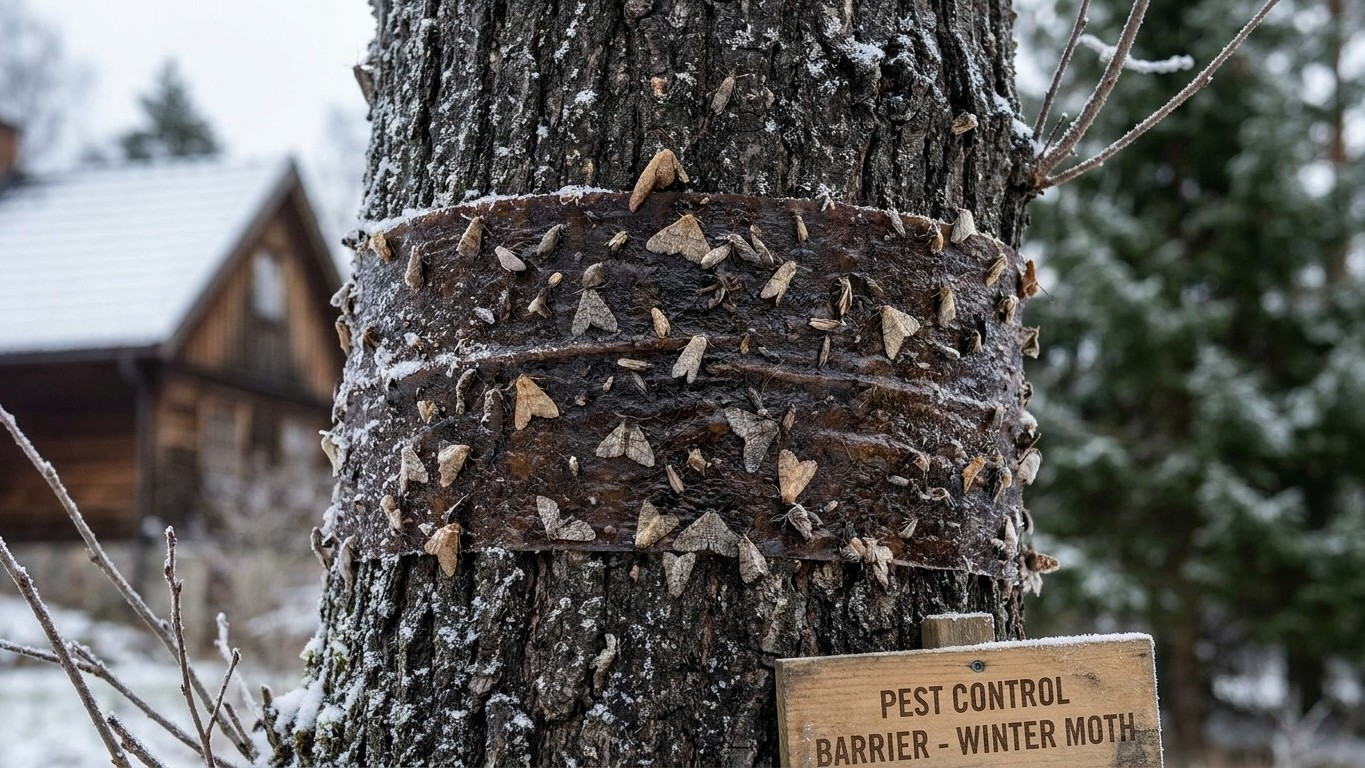

Winter moth adults take to the air in New Brunswick from late October through December, with wingless females climbing tree trunks, fence posts, and even house siding to lay their eggs in bark crevices before the first hard freeze locks everything down. The real trouble starts months later, in early to mid-April, when those eggs hatch into tiny inchworm-like larvae that bore straight into swelling buds before a single leaf has unfurled. What actually stops the insect isn’t a single spray but a combination: a parasitic fly introduced decades ago, precisely timed dormant oil applications, and sticky trunk bands that intercept the flightless females before they lay eggs at all.
A European Insect With a Foothold in Atlantic Canada

Winter moth (Operophtera brumata) isn’t native to North America. It arrived from Europe, and its first well-documented foothold on this continent was Nova Scotia back in the 1930s, likely hitching a ride on nursery stock or firewood. From there it spread slowly along the Atlantic coast for decades before entomologists noticed a separate outbreak in eastern Massachusetts during the 1990s. That second introduction crept north through coastal Maine and eventually crossed the border into New Brunswick’s milder southern pockets, particularly around the Bay of Fundy shoreline and parts of the lower Saint John River valley, where winters run a bit less brutal than the province’s interior.
It’s easy to mistake winter moth for other late-fall flying geometrid moths, like fall cankerworm, since both have males that swarm porch lights on cool November nights while females stay grounded. The distinction matters for control decisions, because the two species respond differently to the biological and chemical tools available. A close look at egg placement and larval feeding pattern, or a consult with a provincial extension office, settles the identification question fast.
The New Brunswick Timeline: Egg to Moth
The insect’s entire life cycle hinges on one narrow window each spring, and understanding that window is the key to any control plan.
Fall Flight and Egg-Laying
Male moths fly at night from late October into December, drawn to porch lights and streetlamps in a pattern homeowners in affected counties describe as a sudden, dense flurry on the first cold, clear evenings. Females can’t fly at all, their wings reduced to stubs, so they crawl up whatever vertical surface is nearest, a maple trunk, a fence post, a foundation wall, and release a scent that pulls males in. After mating, each female lays a batch of eggs tucked into bark crevices, under loose lichen, or in cracks around windowsills, where they sit dormant through the coldest months.
Spring Hatch and Feeding
Eggs shift color from orange to a pale blue just before hatching, a visual cue growers use to gauge timing. Hatch typically lines up with budbreak in early to mid-April, and the tiny green larvae wriggle straight into swelling buds within hours, feeding from the inside before the tree even has visible foliage. Through May and into early June they move outward onto expanding leaves, then drop to the soil to pupate, spending the entire summer and fall underground until the cycle restarts. That two-to-three-week feeding window around budbreak is the single most important stretch of the year for anyone trying to manage this pest.
Where the Damage Shows Up First
Winter moth larvae aren’t picky. Maple, oak, birch, ash, apple, and crabapple all rank as favored hosts, and ornamental roses take a hit too. But the host that matters most economically in New Brunswick is lowbush blueberry. The province is one of the largest wild blueberry producers in the country, and when winter moth larvae move into flowering buds during a heavy outbreak year, the reduction in fruit set can be steep, echoing the yield losses growers in Nova Scotia dealt with before biological control caught up with the pest there.
The visible sign is distinctive once you know what to look for: leaves emerge already riddled with ragged holes or skeletonized patches, because the caterpillars were feeding inside the bud before the leaf tissue ever had a chance to expand normally. On a badly infested shade tree, the whole crown can look thin and patchy through late May, similar to what coastal Massachusetts saw during several consecutive outbreak years in the early 2000s before natural controls rebuilt.
What Actually Stops Winter Moth
The single biggest reason winter moth hasn’t become a permanent, worsening crisis in Atlantic Canada traces back to a parasitic fly called Cyzenis albicans. Canadian entomologists working with what’s now Agriculture and Agri-Food Canada imported the tachinid fly from Europe in the 1950s specifically to fight winter moth damage in Nova Scotia orchards. The fly lays its eggs on leaves near feeding caterpillars; once ingested, the fly larva develops inside the caterpillar and eventually kills it. Within roughly a decade, winter moth populations in the original outbreak zones in Nova Scotia dropped dramatically, and the project became one of the textbook success stories in North American biological pest control.
Researchers at the University of Massachusetts later redeployed the same fly against a separate outbreak in Massachusetts starting in the mid-2000s, with comparable results. As winter moth populations in New Brunswick reach higher densities, Cyzenis albicans tends to follow and establish naturally, which is part of why outbreaks in newly colonized areas often peak and then decline over several years rather than staying severe indefinitely.
For homeowners and small-scale growers who don’t want to wait out that natural cycle, a few practical tools make a real difference:
- Dormant horticultural oil sprayed on trunks and branches in late winter, before budbreak, smothers overwintering eggs and is one of the least disruptive options available.
- Sticky bands wrapped around tree trunks in late October intercept flightless females as they climb to lay eggs, a low-cost tactic that works well on isolated shade trees or along blueberry field edges.
- Bacillus thuringiensis (Bt) applied right at budbreak targets young larvae while they’re still small and exposed, and it spares the beneficial Cyzenis fly population that broad-spectrum insecticides would otherwise wipe out.
- Watching bud swell closely each April and matching any spray window to actual larval hatch, rather than a fixed calendar date, avoids wasted applications and protects natural enemies.
Reaching for a broad-spectrum insecticide out of frustration tends to backfire over multiple seasons. It knocks down the visible caterpillars in the short term but also kills off the parasitic fly working in the background, which can leave a property more exposed to a rebound outbreak the following spring.
One detail that surprises people used to reading about spongy moth or eastern tent caterpillar damage: winter moth rarely kills a healthy, mature tree outright, even after a couple of rough defoliation years. The bigger risk is cumulative stress, an already weakened tree, a drought year layered on top of repeated spring feeding, that opens the door to secondary problems like wood-boring insects or root disease. That’s the practical reason to treat winter moth as a management issue tied to overall tree health, not just a single pest to knock out with one well-timed spray.