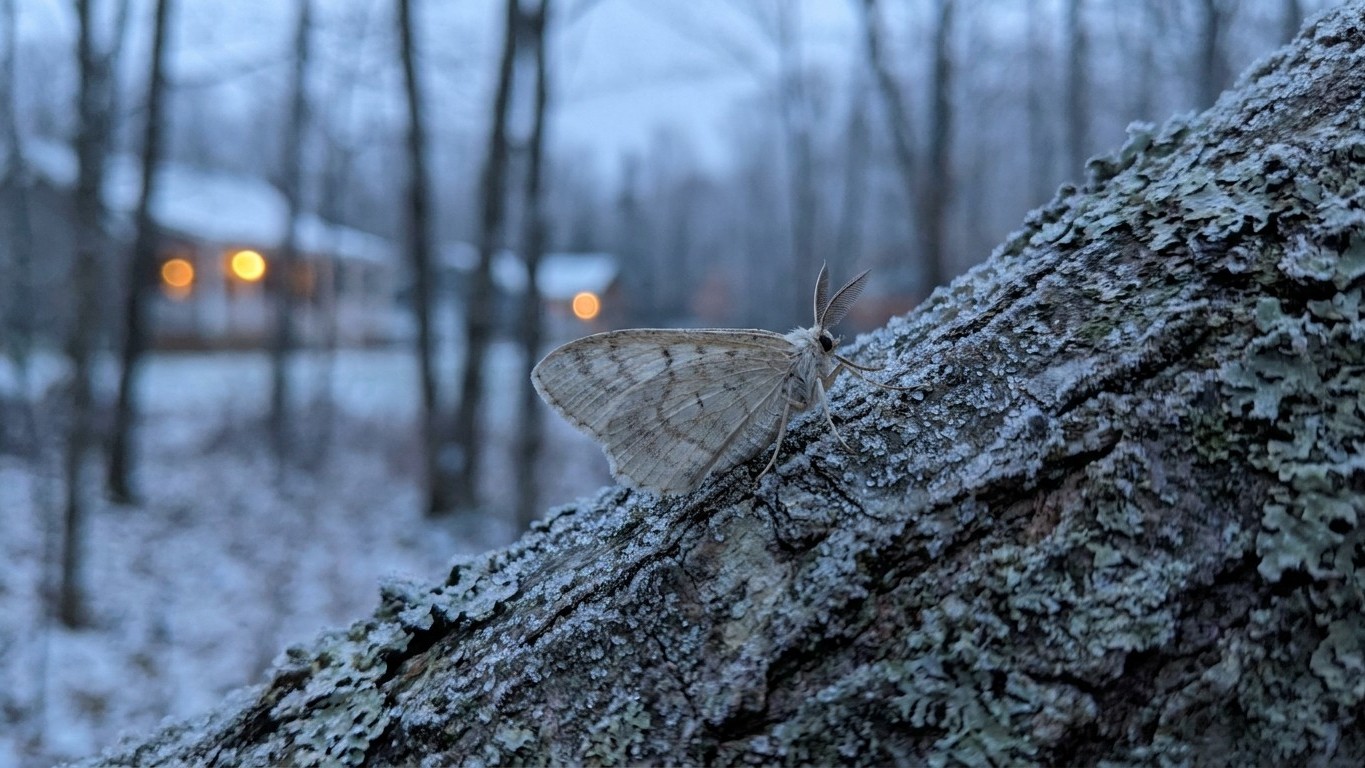

Winter moth activity in Nova Scotia follows a predictable two-stage calendar: adult moths fly and mate from late November through December, while their offspring hatch as tiny caterpillars in April and feed through early June. The most effective control window falls in early spring, before larvae move deep into unfurling leaf buds, when dormant oil sprays and targeted insecticide applications still reach the insect.
Nova Scotia holds an unusual place in this pest’s North American story. The winter moth (Operophtera brumata) is not native to Canada. It arrived from Europe and was first documented in the province back in the 1930s, decades before it turned up in Massachusetts and spread through New England. That head start means Nova Scotia has the longest track record on this continent for studying the moth’s behavior and testing what actually knocks back its population.
The weeks to watch

The name is literal. Adult male moths emerge on the first cold nights of late fall, typically flying on evenings when temperatures hover just above freezing, sometimes into early December if the season runs mild. Homeowners in Halifax, the Annapolis Valley, and coastal communities often notice them fluttering around porch lights and streetlamps on otherwise quiet November nights, since almost no other moth species is active that late in the year.
Females are flightless. They have only vestigial wings and instead crawl up tree trunks to release a pheromone that draws males in. After mating, each female lays 100 to 150 eggs in bark crevices, under loose bark scales, or in lichen on the trunk. Those eggs sit through the entire winter, essentially frozen in place, until spring temperatures trigger hatching.
The larval stage is where the real damage happens. Caterpillars emerge in mid-to-late April, timed to coincide with bud break on host trees. They’re small, pale green, and easy to mistake for other inchworm-type caterpillars, but they move fast once trees leaf out. By late May or early June, larvae drop to the ground on silk threads, burrow into soil or leaf litter, and pupate. They stay underground until the cycle restarts in late fall. That means the visible, damaging phase of winter moth in Nova Scotia lasts only about six to eight weeks each year, but the eggs and pupae sit dormant for the other ten months.
Trees and Crops at Risk
Winter moth caterpillars aren’t picky, but they show clear preferences. Maple trees, especially sugar maple and red maple, take the heaviest hits in Nova Scotia’s forests and residential landscapes. Oak, ash, birch, and apple trees are also common targets, along with ornamental crabapples planted along streets and in yards.
Commercial growers watch this pest closely for a different reason. Nova Scotia’s blueberry industry, one of the largest in Canada, sits in the moth’s feeding range. Larvae that hatch just as blueberry buds swell can strip young leaf and flower tissue before growers even notice, cutting into fruit set for the season. Apple orchards face a similar timing problem: bud break in apple trees often overlaps almost exactly with larval emergence, which is part of why orchard managers in the Annapolis Valley treat winter moth as a standing seasonal concern rather than an occasional nuisance.
Defoliation from a single season rarely kills a mature, healthy tree. The bigger risk shows up over consecutive years of heavy feeding, when a tree loses most of its canopy repeatedly and has no chance to rebuild energy reserves. Young trees, newly transplanted stock, and trees already stressed by drought or root damage are far more vulnerable to lasting harm.
What Actually Stops Winter Moth
Control strategies split into three practical categories: biological, mechanical, and chemical. Nova Scotia’s long history with this pest has made it something of a testing ground for the first option.
Biological Control: The Parasitic Fly
The most consequential development in winter moth management didn’t come from a spray bottle. It came from a small parasitic fly called Cyzenis albicans, introduced deliberately in Nova Scotia decades ago specifically to bring winter moth populations under control. The fly lays its eggs on leaves that winter moth caterpillars are actively feeding on. When larvae ingest the fly eggs along with plant tissue, the parasite develops inside the caterpillar and eventually kills it before it can pupate successfully.
This approach worked well enough in Nova Scotia that it became a model researchers later replicated in Massachusetts and other New England states dealing with their own winter moth outbreaks. It’s not an instant fix. Establishing a parasitic fly population that reaches effective density can take five to ten years. But once established, it provides ongoing suppression without repeated chemical treatment, which matters for large-scale forest management where annual spraying isn’t realistic.
Mechanical and Timing-Based Control
For homeowners with a handful of affected trees, sticky bands wrapped around trunks in November catch wingless female moths as they climb up to mate, physically removing them from the breeding cycle before eggs get laid. This works best on isolated ornamental trees rather than in a wooded lot, since moths can still fly in from surrounding vegetation.
Dormant oil sprays, applied to bark and branches in late winter before bud break, smother overwintering eggs directly. Timing is everything here: too early and the oil doesn’t reach late-laid eggs, too late and hatching larvae have already dispersed into buds where the spray can’t reach them. Extension offices in the Maritimes generally recommend applying dormant oil in the final weeks before typical bud break for the local area, which in most of Nova Scotia falls in the first half of April.
Targeted Insecticide Applications
Once larvae have hatched but before they’ve moved deep inside expanding buds, a narrow window opens for insecticide treatment. Products containing Bacillus thuringiensis subspecies kurstaki (commonly sold as Btk) target caterpillars specifically and break down quickly, minimizing harm to pollinators and other insects when applied correctly. Btk needs to be ingested by the larvae, so it works best in the first one to two weeks after hatching, while caterpillars are still feeding on exposed leaf surfaces.
Broader-spectrum insecticides exist and are used in some commercial orchard and blueberry operations, but they carry more risk to beneficial insects, including the parasitic flies that provide long-term natural control. Anyone managing a home landscape should weigh that tradeoff before reaching for a stronger product than the situation actually requires.
Monitoring and Early Detection
Catching an infestation early makes every other control method more effective. A few signs point to active winter moth presence on a property:
- Small, pale green inchworm-style caterpillars on leaves and buds in April and May
- Ragged, skeletonized leaves on maple, oak, or apple trees shortly after bud break
- Silk threads hanging from tree canopies in late May as larvae drop to pupate
- Wingless moths crawling on tree trunks or fence posts on mild nights in late November and December
Nova Scotia’s Department of Natural Resources and Renewables, along with regional extension services, tracks winter moth activity as part of broader forest pest monitoring. Property owners who notice repeated, severe defoliation over multiple seasons, particularly on young or ornamental trees, generally get more useful guidance by reporting it locally than by treating it as an isolated one-year problem.
One detail that surprises a lot of people: winter moth damage in Nova Scotia often looks worse on the edges of tree stands and along roadways than deep in forest interiors. Larvae blow in on wind currents after hatching, and edge trees catch more of that drift, which is part of why urban and suburban maples sometimes take a harder hit than trees just a few hundred yards into denser woodland.