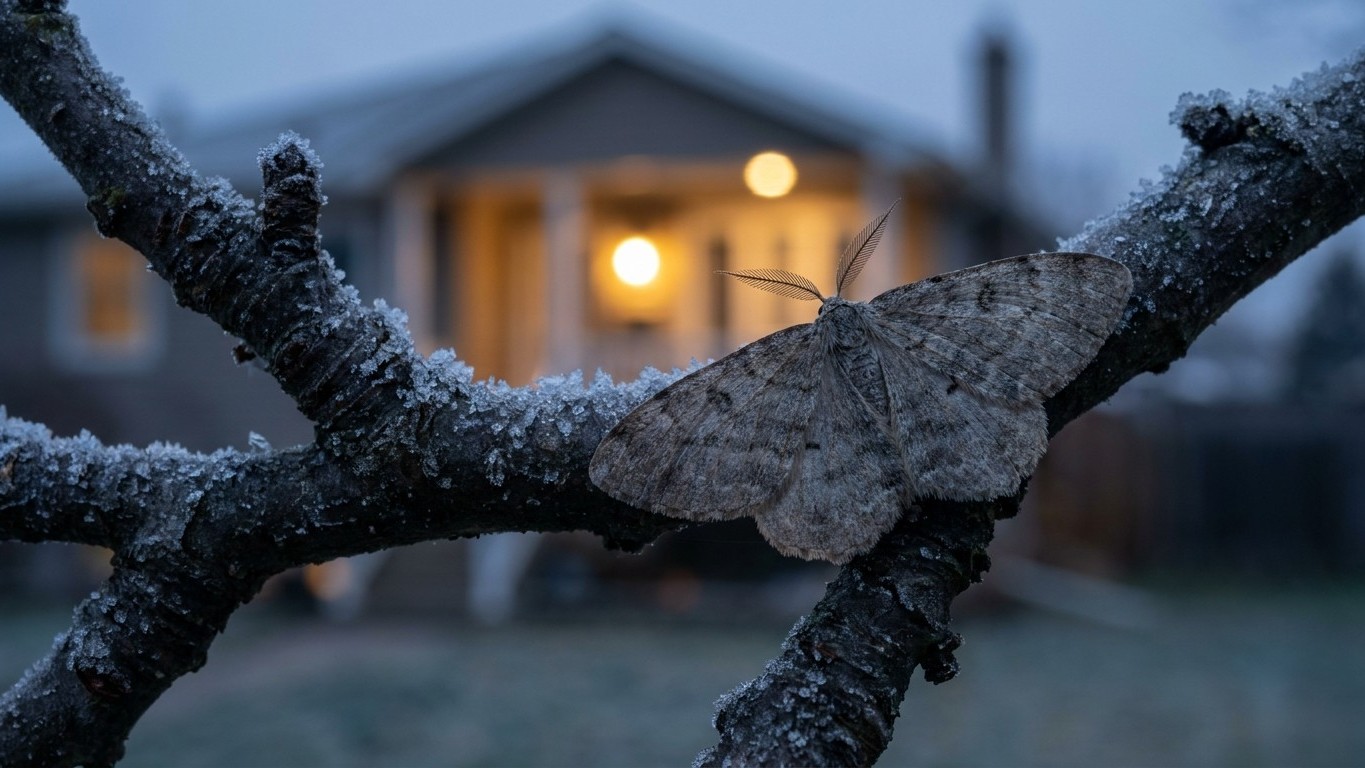

Winter moth adults take flight across Prince Edward Island on mild evenings from late November through December, right when most homeowners have already put their yard tools away for the season. That timing is exactly what makes this insect tricky: it’s active when almost nothing else is, and by the time the damage shows up the following spring, the moths themselves are long gone.
Prince Edward Island sits at the edge of a range that’s been expanding slowly across Atlantic Canada for nearly a century. Whether you’re dealing with an established population or just want to recognize an early arrival on your own maple or apple tree, knowing the calendar and the control window matters more than knowing the bug’s Latin name.
The weeks to watch

The name isn’t a marketing gimmick. Operophtera brumata is one of the only moth species in the region that emerges as an adult in late fall and early winter instead of spring or summer. Males are the ones you’ll actually see, small gray-brown moths fluttering around porch lights or car headlights on nights when the temperature climbs above freezing, typically sometime between mid-November and the end of December.
Females never join that display. They’re wingless, or nearly so, and instead of flying they crawl up the trunk of a host tree to mate and lay eggs in bark crevices, under lichen, or in old pruning wounds. That single detail explains why winter moth spreads at a crawl compared to most invasive insects. Without flight-capable females, the population can’t jump miles in a season on its own. It moves the slow way, tree by tree, unless people help it along by moving infested nursery stock, firewood, or branches with egg masses still attached.
Eggs sit through the coldest months and hatch in spring, timed almost precisely to bud break on maple, oak, apple, ash, and blueberry, among other hosts. The tiny caterpillars crawl into unfolding buds and feed from the inside out for four to six weeks before dropping to the soil to pupate, where they’ll wait until the next cold flight season to start the cycle again.
Where This Pest Actually Stands on the Island
Winter moth has a long documented history in Nova Scotia, where populations have been established since the 1930s, making Atlantic Canada one of the oldest known footholds for this species outside its native Europe. From there it has expanded gradually along parts of the New England coast, reaching Massachusetts, Maine, Rhode Island, and Connecticut over the following decades, aided mostly by human transport of plant material rather than the moth’s own limited mobility.
Prince Edward Island’s situation is best described as a watch zone rather than a confirmed widespread infestation. The province’s mild coastal microclimates and its proximity to already-affected mainland areas create the right conditions for winter moth to take hold, but that doesn’t mean every backyard maple on the Island is currently under attack. Isolated detections, nursery stock inspections, and monitoring traps are the tools provincial and federal plant health programs typically rely on to catch new arrivals before they spread from a single property to a neighborhood.
That distinction matters for homeowners. If you spot heavy leaf skeletonization on a maple or a fruit tree in late spring, winter moth is one possibility, but it’s far from the only one. Treating every case of chewed leaves as a confirmed winter moth outbreak leads to unnecessary spraying and, ironically, can kill off the natural predators that would otherwise keep populations in check.
What Actually Stops Winter Moth
Control works best when it’s timed to the insect’s two vulnerable windows: the fall flight period, when females are climbing tree trunks, and the early larval stage right after bud break. Miss both, and you’re stuck waiting until next year.
Trapping and Tree Banding in Fall
Sticky bands wrapped around tree trunks in October and left through December intercept wingless females before they can lay eggs. This is a monitoring tool as much as a control method: a heavily loaded band tells you exactly how bad next spring’s caterpillar problem is likely to be, without needing to guess. Pheromone traps designed for male winter moths are the other half of the monitoring picture and are the standard way agricultural extension programs track population trends year over year.
Dormant Oil Applications
Horticultural oil sprayed on trunks and branches in late winter, before bud break, smothers overwintering eggs directly. This window is narrow, usually a few weeks in March depending on how the season is running, and it closes fast once buds start to swell. Oil applied too early or too late does very little good.
Bt Sprays on Young Larvae
Once caterpillars hatch and start feeding inside buds, applications of Bacillus thuringiensis var. kurstaki (Btk) can knock back populations if timed to the first two weeks after bud break, while larvae are still small and exposed enough to ingest treated foliage. Btk is selective for caterpillars, which makes it a lower-impact choice than broad-spectrum insecticides for anyone worried about bees or other pollinators working the same trees.
Biological Control
The longer-term fix, and the most effective one where it’s been established, is a small parasitic fly called Cyzenis albicans. Researchers introduced this natural enemy of winter moth in Nova Scotia and later in parts of New England specifically to bring populations down without ongoing chemical treatment. The fly lays its eggs on leaves that caterpillars are actively eating; once ingested, the parasite develops inside the caterpillar and eventually kills it before it can complete its life cycle. It takes several years for a released population of these flies to build up enough numbers to meaningfully suppress winter moth, but in areas where it’s taken hold, it’s done more to stabilize outbreak cycles than any spray program.
Winter Moth or Bruce Spanworm? The Mix-Up That Costs Homeowners Money
Here’s where things get genuinely confusing, even for people who spray on schedule every year. Bruce spanworm, a native species found throughout the Maritimes, looks almost identical to winter moth as both an adult and a caterpillar. The two species also fly during roughly the same fall window and can even interbreed, producing hybrids that complicate identification further for anyone without a microscope and some patience.
The practical difference is damage level. Bruce spanworm rarely reaches the destructive population densities that winter moth can, and it’s part of the native food web that local birds and parasites are already adapted to keep in check. Spraying aggressively against what turns out to be a normal Bruce spanworm presence wastes money and unnecessarily disrupts a native insect that isn’t actually a problem.
A few field clues can help narrow things down, though lab confirmation is the only way to be certain:
- Winter moth caterpillars tend to show up in denser clusters on a single branch than Bruce spanworm
- Heavy, repeated skeletonization across multiple years on the same trees leans toward winter moth
- Sticky trunk bands loaded with dozens of wingless females in a single fall season point toward an established winter moth population rather than a native spanworm presence
If you’re seeing consistent, worsening defoliation on the same maples or fruit trees for two or three years running, that pattern is worth reporting to provincial plant health or agriculture extension contacts rather than guessing from a photo online. Early detections in a new area are exactly the kind of data that determines whether a biocontrol release program eventually gets considered for a given region.
One detail that surprises a lot of people: winter moth caterpillars don’t actually need to touch the ground to move between trees once they hatch. They spin fine silk threads and let the wind carry them from branch to branch, sometimes tree to tree, in a behavior called ballooning. It’s a small mechanism, but it’s the reason a single egg-laying female climbing one trunk in December can turn into damage on three or four nearby trees by the following June, even without any human help moving plant material at all.
Related guides
- Winter moth in New Brunswick: When It Shows Up and What Stops It
- Winter moth in Nova Scotia: When It Shows Up and What Stops It
- Winter moth in Quebec: When It Shows Up and What Stops It
- Winter moth in Rhode Island: When It Shows Up and What Stops It
- Winter moth in Massachusetts: When It Shows Up and What Stops It