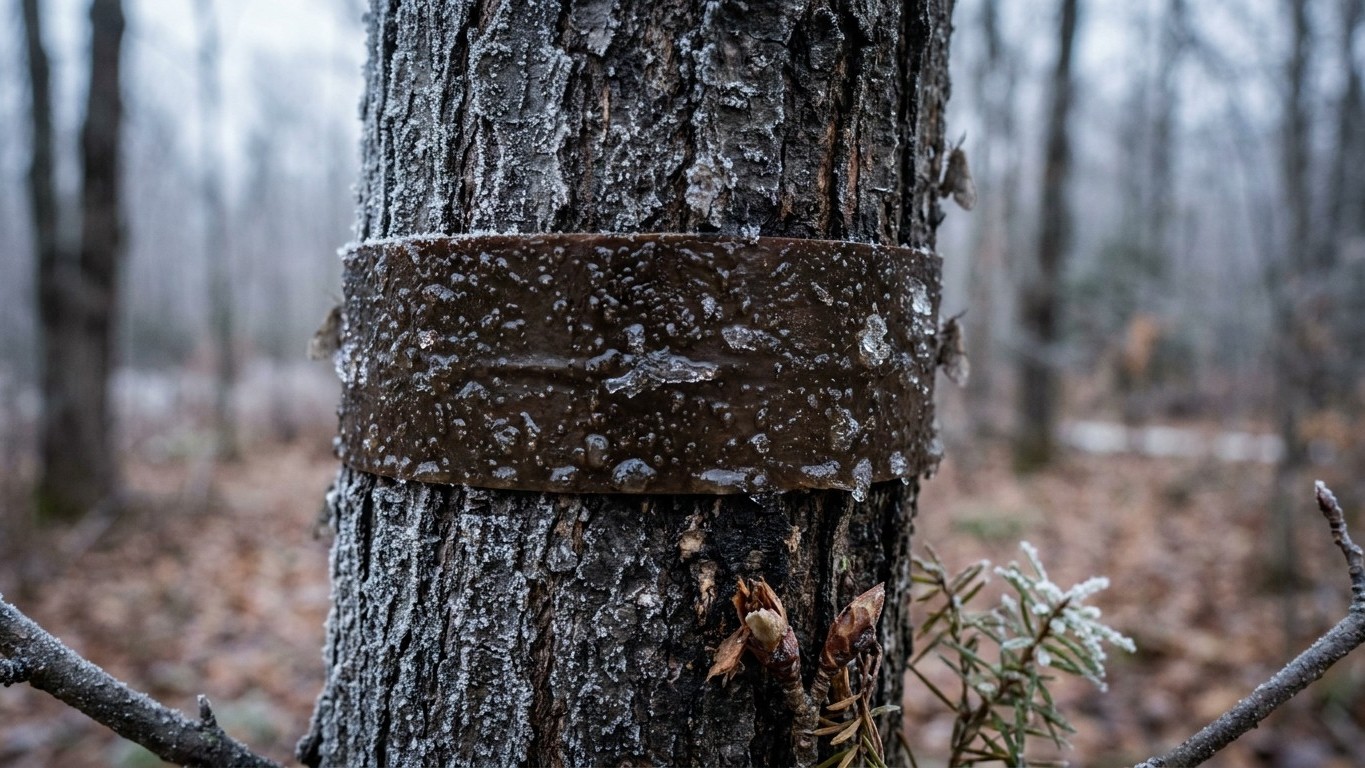

Winter moth adults start showing up in Quebec landscapes in late November, right after the first hard frosts, and they stick around into December on mild nights. The damage from that flight doesn’t show up until the following April and May, when eggs laid on tree bark hatch into tiny caterpillars that chew their way into swelling buds. Stopping the cycle means acting at both ends: sticky bands on trunks in fall, and timed oil or Bt sprays in spring before the larvae disappear into the foliage.
That two-season rhythm is what confuses a lot of homeowners in the Montérégie, Estrie, and Outaouais regions, where the moth has been turning up with more regularity over the past decade. You don’t see the culprit doing the damage. You see chewed, tattered maple and oak leaves in May and wonder what happened, when the actual insect responsible was active back when your thermometer read near freezing.
A Life Cycle Split Between Two Very Different Seasons

Winter moth (Operophtera brumata) is a European import first confirmed in Nova Scotia in the 1930s, and it has been creeping westward along the St. Lawrence corridor and into pockets of southern Quebec ever since. The species survives Canadian winters by doing almost nothing during the cold months. Adults emerge from the soil in late fall, and that’s where things get strange: males fly to find mates, but females are essentially wingless. They can only crawl, so they climb straight up the nearest tree trunk and wait.
A mated female lays several hundred eggs in bark crevices, under lichen, or in old egg cases, then dies. Those eggs sit through the entire Quebec winter, insulated in the bark, and they don’t hatch until soil and air temperatures line up with bud swell on host trees, usually in early to mid-April in the milder parts of southern Quebec. The newly hatched larvae are barely visible to the naked eye, and they immediately crawl into unopened buds or ride wind currents on silk threads to reach nearby trees, a behavior called ballooning that lets a single infestation spread across a whole yard in days.
By late May the caterpillars, now pale green with a faint white stripe down each side, drop to the ground on more silk threads and burrow into the soil to pupate. Adults emerge from that same soil months later, closing the loop. One generation per year, but the timing is unforgiving for anyone trying to intervene late.
Where It Turns Up in Quebec, and What It Eats
Confirmed populations and monitoring interest have concentrated in the southern band of the province, closest to the Ontario and Maritime populations that seeded the spread: the Montérégie, Estrie (Eastern Townships), and parts of the Outaouais. Urban and suburban tree cover with a mix of mature maples, oaks, and fruit trees gives the moth exactly the host diversity it needs.
The caterpillars aren’t picky. Sugar maple, red maple, oak, birch, and apple or crabapple trees all rank as preferred hosts, and blueberry bushes take a hit too, which matters in a province where small-fruit growers and backyard blueberry patches are common. Sugar maple is the one that raises eyebrows locally, since repeated heavy defoliation over several consecutive springs can weaken a tree enough to reduce sap flow and vigor, a real concern for anyone tapping trees for syrup or simply hoping to keep a mature maple healthy for decades. A single defoliation year rarely kills a tree outright. Three or four years running is a different story.
Winter Moth or Bruce Spanworm? The Mix-Up That Matters
Quebec already has a native look-alike, the Bruce spanworm, and the two species overlap so closely in appearance that even experienced arborists sometimes need a hand lens or genetic test to tell them apart. Both are small grayish-brown moths, both fly in late fall, and both have flightless females that climb tree trunks to lay eggs. The practical difference for property owners is less about identification and more about what it means for control.
Bruce spanworm is native and its populations are naturally kept in check by a suite of local predators and parasites that evolved alongside it. Winter moth arrived without that built-in pressure, which is exactly why its populations can explode in newly colonized areas before nature catches up. Researchers have also documented that the two species can interbreed where their ranges overlap, producing hybrids that complicate both identification and pest forecasting. For a homeowner, the takeaway is simpler: if you’re seeing repeated heavy defoliation on the same trees every spring, treat it as winter moth territory and act on the timeline below, regardless of which species you think you’re looking at.
What Actually Stops It
Control works best as a layered approach, hitting the insect at the two moments in its life cycle when it’s most vulnerable: the wingless female climbing the trunk in fall, and the newly hatched larvae feeding in the open before buds close around them.
Fall: Sticky Bands to Intercept Females
Wrapping a band of sticky material, tree-safe adhesive over a paper or fabric barrier, around the trunk in mid to late October catches wingless females before they reach the canopy to lay eggs. This is one of the few control methods that requires zero pesticide and works purely on the moth’s odd biology. It won’t stop moths arriving by ballooning from a neighbor’s untreated trees, but on an isolated tree or in a yard where most neighbors band their trees too, it measurably cuts down the next spring’s hatch. Bands need to go up before the first mild nights of late fall and should be checked periodically, since a heavy batch of trapped moths or debris can create a bridge for later arrivals to cross.
Early Spring: Dormant Oil Before Bud Break
Horticultural oil applied while eggs are still on the bark, before any green tissue shows, suffocates unhatched eggs without harming the tree. Timing is everything here. Spraying too early wastes product on eggs that haven’t fully developed, and spraying after bud break risks damaging new growth while missing larvae that have already tucked themselves inside buds. In most of southern Quebec that window falls in late March to the first days of April, and it moves earlier or later depending on how the spring is running that particular year, so watching bud swell on the actual tree matters more than circling a date on a calendar.
Bud Break: Bacillus thuringiensis (Bt) While Larvae Are Exposed
Once eggs hatch, there’s a narrow window, typically a week or two, when larvae are small and feeding on the outside of expanding buds before they burrow deeper into leaf clusters. This is when Bt kurstaki, a naturally occurring bacterium that targets caterpillars specifically and leaves bees, birds, and pets unaffected, does its best work. Applied as a spray to foliage, it needs to be ingested by the caterpillar to work, so coverage of the newly opening leaves matters more than soaking the whole tree. Miss that window and the larvae are already sheltered inside curled leaves where sprays can’t reach them effectively.
The Long Game: Biological Control
The most durable fix so far hasn’t come from a spray bottle at all. A parasitic fly, Cyzenis albicans, was introduced in Nova Scotia decades ago specifically to fight winter moth, and it worked: populations there dropped to a fraction of their outbreak peaks over roughly a decade as the fly established itself and its larvae began killing winter moth caterpillars from the inside. Similar releases have since been tried in parts of the northeastern United States with encouraging results. Quebec hasn’t seen the kind of sustained, province-wide outbreak that would justify a large-scale release program yet, but entomologists tracking the species keep this option in their back pocket for areas where populations climb and stay high for several consecutive years.
A Practical Calendar for Homeowners
Trying to remember all of this in the moment is harder than it sounds, since the actions split across two seasons that feel unrelated. A rough sequence for anyone dealing with confirmed or suspected winter moth on their property:
- Mid to late October: Wrap sticky bands around trunks of maple, oak, and fruit trees before nighttime temperatures start dropping consistently.
- Late March to early April: Apply dormant horticultural oil to bark and branches while eggs are visible and before any green bud tissue emerges.
- Bud break, roughly one to two weeks after oil treatment: Apply Bt kurstaki to newly opening foliage if larvae are present, checking buds by hand for the tiny green caterpillars first.
- Ongoing: Track defoliation severity year over year. A single rough spring rarely threatens a healthy mature tree, but three consecutive years of heavy feeding on the same maple warrants a call to a certified arborist to assess overall tree health and root reserves.
One detail that surprises a lot of people: the same conditions that make a Quebec winter feel endless, extended cold with a late, slow spring thaw, actually work against the moth by compressing its hatch window and syncing it more tightly with predictable bud-break dates. A string of unusually mild winters, on the other hand, tends to widen that window and makes populations harder to pin down from one year to the next, which is part of why entomologists keep an eye on how this insect’s range shifts as regional weather patterns continue to change.