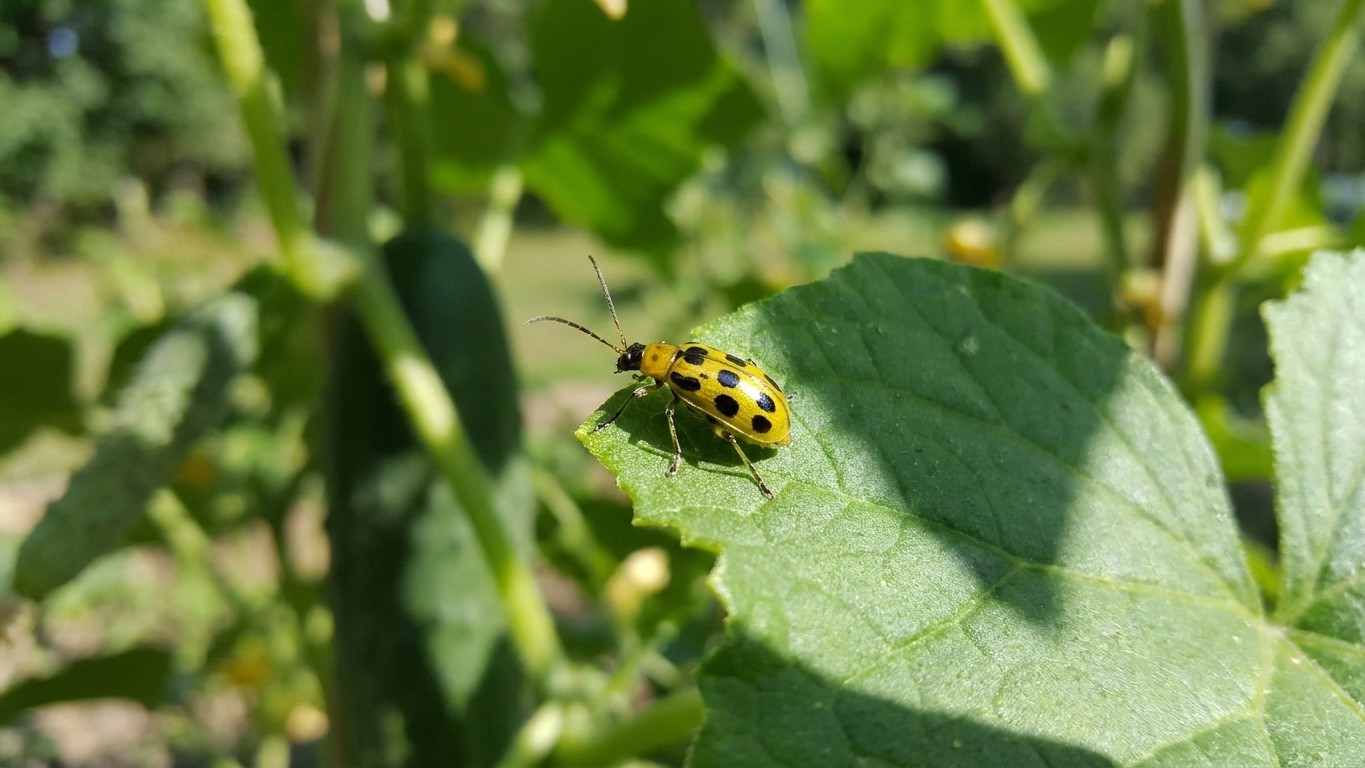

Spotted cucumber beetles start turning up in New Jersey gardens as early as the last week of April in the southern counties, and by mid-May they’re active statewide. The real damage window runs from June through September, with a second generation hatching in late summer that often does more harm to squash, melon, and bean crops than the spring arrivals. Row covers installed before emergence, delayed planting past the first beetle wave, and targeted insecticide applications at the seedling stage are what actually keep populations from wrecking a cucurbit patch.
When Spotted Cucumber Beetles Arrive in New Jersey

Adult beetles overwinter in leaf litter, hedgerows, and the edges of wooded lots, then emerge once soil temperatures climb past roughly 55°F. In Cape May and Cumberland counties, that can happen by late April. Further north in Bergen or Sussex county gardens, expect the first sightings closer to the second or third week of May. New Jersey’s growing season, generally frost-free from early May through mid-October depending on the zone, lines up almost exactly with the beetle’s active period.
What surprises a lot of home gardeners is the double-generation pattern. The spring adults lay eggs at the base of cucurbit plants, larvae feed on roots for three to four weeks, and a new batch of adults emerges by late July or August. That second wave is often the bigger threat because it coincides with fruit set on squash, cucumbers, and melons, and the beetles will chew directly into ripening produce, not just foliage.
Warm, wet springs push emergence earlier. A mild winter followed by a rainy April, which New Jersey has seen more often over the past decade, can mean beetles show up a full two weeks ahead of the historical average. Gardeners who plant by the calendar instead of watching soil temperature sometimes get caught off guard when transplants go in the ground right as the first generation is hunting for tender seedlings.
Identifying the Beetle Correctly
The spotted cucumber beetle (Diabrotica undecimpunctata) is roughly a quarter-inch long, greenish-yellow, with twelve black spots arranged in rows across its back. It’s frequently confused with the striped cucumber beetle, which has yellow and black longitudinal stripes instead of spots. The distinction matters because the two species overlap in New Jersey but the spotted variety has a wider host range, feeding on beans, corn, and even soybeans as larvae, in addition to the usual squash-family targets.
Why This Beetle Does More Damage Than Its Size Suggests
The bigger issue isn’t the chewing itself. It’s bacterial wilt, a disease the beetle carries in its gut and transmits through feeding wounds on leaves and stems. A plant infected early in the season can wilt and die within two to three weeks, and there’s no cure once infection sets in. Rutgers Cooperative Extension has tracked bacterial wilt as one of the leading causes of cucumber and squash losses in home gardens across the state, and the spotted cucumber beetle is one of the two confirmed vectors, along with its striped cousin.
Larvae add a second layer of trouble. Underground, they feed on roots and can girdle young corn seedlings, which is why this species is also known regionally as the southern corn rootworm. A backyard grower who rotates squash into a spot where corn grew the previous year may unknowingly be setting up a larval population that’s already established before the cucurbits even germinate.
Adult beetles also feed on flowers, which cuts into pollination and fruit set even when a plant survives the wilt risk. A squash plant that looks otherwise healthy but produces few fruits is sometimes suffering from flower damage rather than a watering or soil problem, and it’s worth checking blossoms for beetle activity before assuming a fertility issue.
What Actually Stops the Spotted Cucumber Beetle
Timing beats almost every other control method. Delaying cucurbit transplants by even ten to fourteen days past the first observed beetle activity in a given area lets the spring generation move through its peak before the most vulnerable seedling stage arrives. Commercial growers in South Jersey have used staggered planting dates for exactly this reason, and it translates directly to home gardens.
Physical barriers work well for the first three to four weeks after planting. Floating row covers, sealed at the edges with soil or landscape staples, keep adult beetles off young plants entirely. The catch is that most cucurbits need pollinator access once flowering starts, so covers have to come off right around bloom time, which is also unfortunately when beetle pressure often peaks. Some gardeners split the difference by removing covers only during morning hours when bees are active, then resealing them in the afternoon, though that’s labor-intensive for anything beyond a few raised beds.
Trap cropping is a lower-effort option that’s gained traction in New Jersey extension trials. Planting a small block of a highly attractive squash variety, like Blue Hubbard, along the perimeter of the garden draws beetles away from the main crop. Treating just that trap block with an insecticide, rather than spraying the whole garden, cuts chemical use significantly while still protecting the harvest crop.
For active infestations, insecticidal soap and neem oil provide moderate suppression when applied directly to beetles on contact, best done in early morning when the insects are sluggish from cooler temperatures. For heavier pressure, products containing spinosad or pyrethrin offer stronger knockdown, but timing sprays for early morning or evening avoids killing bees that are working the same flowers. Reading and following label directions on any pesticide is non-negotiable, both for legal compliance and because cucurbit flowers are only open for pollinators during a narrow daily window.
Yellow sticky traps placed near cucurbit beds help with monitoring more than control, but they do give an early warning that beetles have arrived before damage becomes visible on plants. Checking traps twice a week from late April through August gives a realistic picture of when populations are building toward the second generation.
Cultural Practices That Reduce Long-Term Pressure
Crop rotation matters more for this beetle than for many other garden pests, given its larval feeding on corn and bean roots in addition to cucurbits. Avoiding back-to-back plantings of these crop families in the same bed for at least two seasons interrupts the larval life cycle meaningfully. Fall cleanup, removing plant debris and tilling under crop residue after harvest, eliminates overwintering sites and reduces the population that emerges the following spring.
Some gardeners in New Jersey have had success interplanting cucurbits with radishes or nasturtiums, which appear to reduce beetle landing rates, though the effect is modest and shouldn’t replace row covers or monitoring as a primary strategy. Beneficial nematodes applied to soil around the root zone target the larval stage and have shown reasonable results in university trials, offering an option for gardeners trying to avoid broad-spectrum insecticides entirely.
Resistant Varieties and Regional Notes
No cucumber or squash variety is fully immune to bacterial wilt once beetles establish feeding damage, but some cucumber cultivars bred for wilt tolerance hold up longer under moderate pressure. Seed catalogs increasingly list wilt tolerance as a trait, and choosing those varieties for gardens in beetle-heavy counties like Salem or Gloucester can buy extra weeks of productive harvest even under pressure.
North Jersey gardeners, working with a shorter frost-free window, generally see a single dominant generation rather than the pronounced two-wave pattern common further south. That means monitoring can taper off earlier in the season, typically by mid-August, whereas South Jersey growers should keep row covers and traps in place through early September to catch the second generation before it targets late-season melons and winter squash.
Anyone dealing with repeated, severe infestations year after year in the same garden bed should consider that the problem may be more about overwintering habitat than in-season control. A brush pile, unmown grass strip, or wood pile adjacent to the vegetable garden gives adult beetles a place to survive winter just yards from next year’s plantings, and clearing that habitat often does more good than any spray program. The Rutgers Plant & Pest Advisory publishes seasonal pest tracking specific to New Jersey conditions, which is a useful way to time interventions to actual local emergence rather than a generic calendar date.