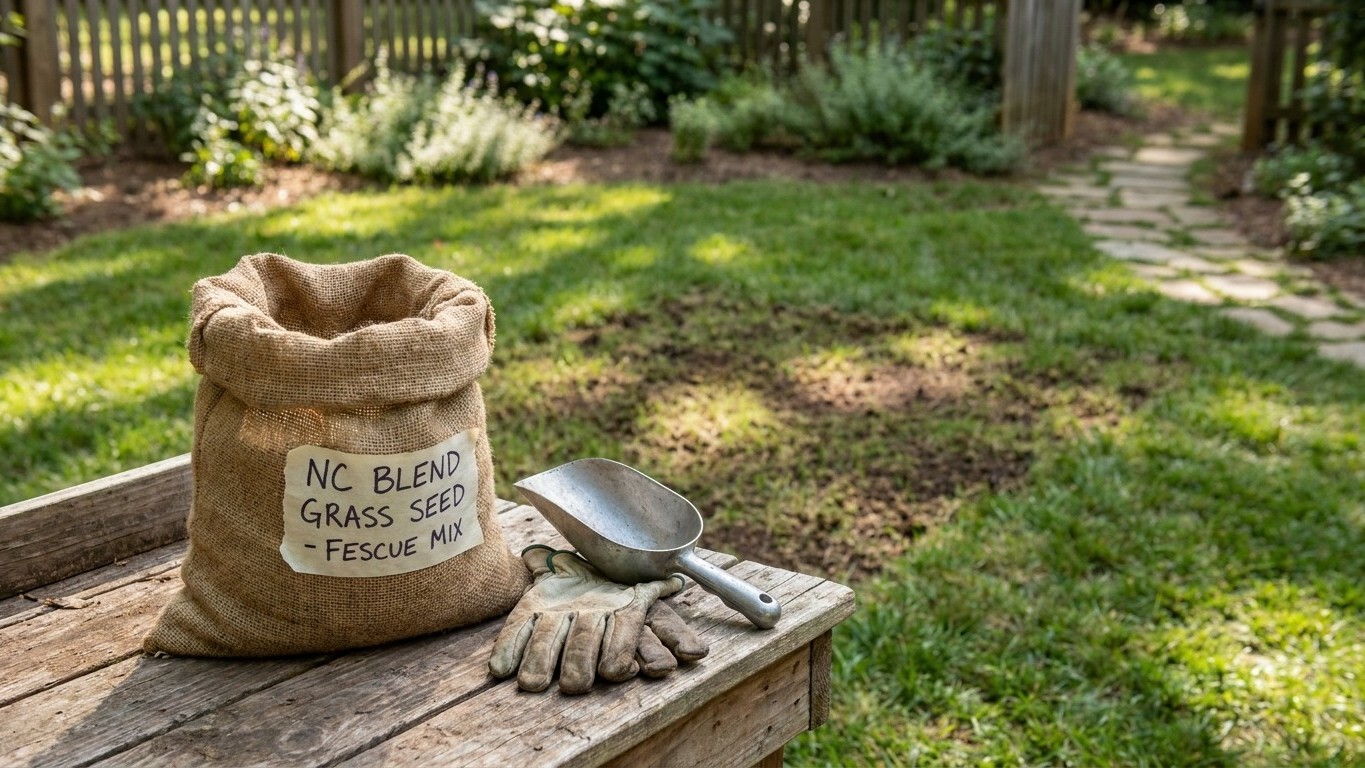

There’s no single grass that stays green in your yard all year, and that’s the honest answer. North Carolina sits in a band where cool-season grass fades in summer heat and warm-season grass browns out from the first fall freeze until spring, so you have to pick which season you’re willing to see it look rough. Walk out and check two things: how much sun that lawn actually gets, and whether kids or a dog are running on it in July. That tells you whether tall fescue or a warm-season grass like bermuda or zoysia is the right starting point.
The short answer for North Carolina
There is no single best grass seed for a North Carolina lawn, because most of the state, and Charlotte in particular, falls in the transition zone: the band where neither cool-season nor warm-season turf performs without a weak season. Clemson Cooperative Extension’s HGIC 1214 groups the realistic choices into two camps. Tall fescue, Kentucky bluegrass and perennial ryegrass sit on the cool-season side. Zoysiagrass and bermudagrass sit on the warm-season side.
The choice comes down to which season you can tolerate looking rough. A cool-season lawn seeded with tall fescue stays green from fall through spring and slows or thins under summer heat and drought stress. A warm-season lawn of bermudagrass or zoysiagrass turns thick and traffic-tough in summer and goes dormant and straw-colored from the first fall freeze until it greens back up in spring. That winter dormancy is not death, the grass is simply waiting.
Tall fescue is the default pick for most home lawns in and around Charlotte because it seeds directly into bare soil each fall, tolerates shade better than the warm-season grasses, and needs no full renovation once it is established. Bermudagrass and zoysiagrass are usually installed as sod, plugs or sprigs rather than seed, spread aggressively once rooted, and reward a yard with full sun and heat reflected off driveways or south-facing walls. Neither camp is objectively better, each is better at a specific job. This trade-off sits underneath every other North Carolina Lawn Care decision, from which species you plant to when you feed it.
Which one suits your yard depends on how much sun it gets, how much foot traffic it carries, and whether you can accept a few brown months in exchange for a tougher summer lawn. Full sun with kids and dogs running on it year-round points toward bermudagrass or zoysiagrass. Shade under mature hardwoods, or a lawn you want green for winter curb appeal, points toward tall fescue.
Working through the year

The two lawn types are on opposite clocks, so working by the calendar means working by the grass you actually have, not the calendar of the neighbor’s lawn across the street.
If your lawn is tall fescue, Kentucky bluegrass or perennial ryegrass
Follow Clemson Cooperative Extension’s HGIC 1219 Tall Fescue Maintenance Calendar, the reference for cool-season lawns in this region. Fall is the main working season for a cool-season lawn: overseed and apply nitrogen once the weather cools, and get pre-emergent herbicide down before spring weed seed germinates. Mow at a taller height through the warm months to shade the crown and the soil surface underneath it. Through summer, resist cutting short just because growth slows, since a lower deck exposes the crown to heat it cannot yet handle, and taller cool-season turf recovers from drought stress far more readily than turf already stressed by a close cut.
If your lawn is bermudagrass or zoysiagrass
Follow Clemson Cooperative Extension’s HGIC 1216 Bermudagrass Maintenance Calendar or HGIC 1217 Zoysiagrass Maintenance Calendar, matched to the species you actually planted, since the two green up and slow down on close but not identical schedules. Spring is the working season here. Wait for full green-up before that first nitrogen application, because feeding a still-dormant warm-season lawn wastes fertilizer and feeds early weeds instead of grass. Summer is when you mow most often and water to keep the lawn actively growing rather than surviving. As days shorten into fall, feeding and mowing taper off, and the lawn is left to harden off for winter rather than pushed into soft new growth it cannot support once frost arrives.
| Grass | Season type | Usually planted as | Main trade-off |
|---|---|---|---|
| Tall Fescue | Cool-season | Seed | Green all winter, thins in a dry July |
| Kentucky Bluegrass | Cool-season | Seed, often blended with fescue | Fine texture, less heat tolerant alone |
| Perennial Ryegrass | Cool-season | Seed, as a nurse grass or overseed | Fast to germinate, short-lived in heat |
| Zoysiagrass | Warm-season | Sod, plugs or sprigs | Dense and traffic-tough, brown from first frost to spring |
| Bermudagrass | Warm-season | Sod, sprigs, or seed of hybrid types | Most heat and drought tolerant, spreads into beds |
What changes across North Carolina
The dates and figures above are measured at or near Charlotte, in the Piedmont, and the rest of the state does not share them evenly.
The Blue Ridge Mountains to the west sit at higher elevation and run several weeks behind the Piedmont in spring. The last threat of frost lingers longer there, which tilts the transition-zone trade-off further toward cool-season grass. A warm-season lawn planted at altitude has a shorter working season to establish before cold weather returns. The coastal plain to the east warms earlier in spring and holds heat longer into fall, which favors bermudagrass and zoysiagrass and shortens the brown winter dormancy those grasses show compared with a lawn in Charlotte.
Elevation is not the only local variable. A lawn shaded by mature hardwoods or shielded by hills stays noticeably cooler on a summer afternoon than one in wide open sun, and that microclimate difference can matter as much as which side of the state a yard sits on. Treat every date in this article as a window measured at one station, not a fixed line on a map. NOAA’s normals cited here come from the Charlotte station specifically, and a lawn near Asheville or along the coast at Wilmington will fall on a different first fall frost window entirely.
The mistakes this climate punishes
The transition zone forgives less than either a purely cool or purely warm climate, because a grass here is always closer to its stress limit than it would be at the center of its natural range.
- Feeding a warm-season lawn in fall. Nitrogen applied to bermudagrass or zoysiagrass after growth has slowed pushes soft new tissue right before frost, and that soft tissue is what winterkills. The damage shows up as dead patches the following spring, not right away.
- Seeding tall fescue, bluegrass or ryegrass in late spring. Cool-season seed needs weeks of mild soil temperature to root before summer heat arrives. Sown in May near Charlotte, seedlings germinate straight into the hottest stretch of the year, and most of the stand is gone by July.
- Mowing a cool-season lawn short going into summer. A low cut removes the leaf tissue that shades the crown and the soil beneath it. The lawn does not look damaged the week you cut it. It shows the damage three or four weeks later once drought sets in.
- Treating winter brown as dead. A dormant bermudagrass or zoysiagrass lawn is straw-colored from the first fall freeze until spring green-up, not dying. Tearing it out and reseeding in winter wastes money on a lawn that would have recovered on its own.
- Skipping pre-emergent timing on either grass type. Missing the spring window lets crabgrass and other summer annual weeds establish before the turf has filled back in, and by midsummer the weeds have already out-competed the grass for light.
Most of these mistakes share one root cause: treating a transition-zone lawn as though it belongs firmly in one season’s calendar. Check the North Carolina Lawn Care Calendar, Month by Month for the window that matches your species before you fertilize, seed or mow at the wrong end of the year.
Checking this against your county
Every figure above is anchored to Charlotte, and county-level advice differs enough that it is worth a direct check before buying seed or sod. North Carolina State University’s Cooperative Extension Service publishes species-specific guidance and soil testing that most seeding, feeding or mowing decisions should start from anyway.
Find your county office through the extension service before you commit to a species, and ask whether your area leans closer to the Piedmont, mountain or coastal pattern described above. Find yours through NC State Extension.
Common questions
Can I plant tall fescue and bermudagrass in the same lawn?
They do not mix well as an intentional blend. Bermudagrass spreads aggressively and will invade a fescue stand over a few seasons, and most homeowners end up treating one as a weed in the other. Pick one species as the lawn and manage the other as an intruder if it shows up.
Is it too late to seed grass in October?
That depends on which grass you have. For tall fescue and the other cool-season species, October is generally within the fall seeding window this region relies on, though NOAA’s Charlotte-area normals put the first fall freeze at October 30 to November 8, so seed early enough in the month for roots to establish before the ground cools hard. For bermudagrass or zoysiagrass, fall seeding is not the plan at all. Those lawns are established from sod, plugs or sprigs in spring, not from seed in autumn.
Why does my zoysiagrass stay green longer than my neighbor’s bermudagrass?
Both are warm-season grasses, but they do not slow down and green up on identical schedules even growing side by side in the same neighborhood. Small differences in the specific cultivar, sun exposure and soil also shift the timing a week or two either direction.
Do I need to reseed my fescue lawn every single year?
Not if the existing stand is healthy and reasonably thick. Annual fall overseeding thickens a thinning lawn and replaces grass lost to summer stress, but a dense, well-established fescue lawn can go a year or two without a full overseed and still hold its density.