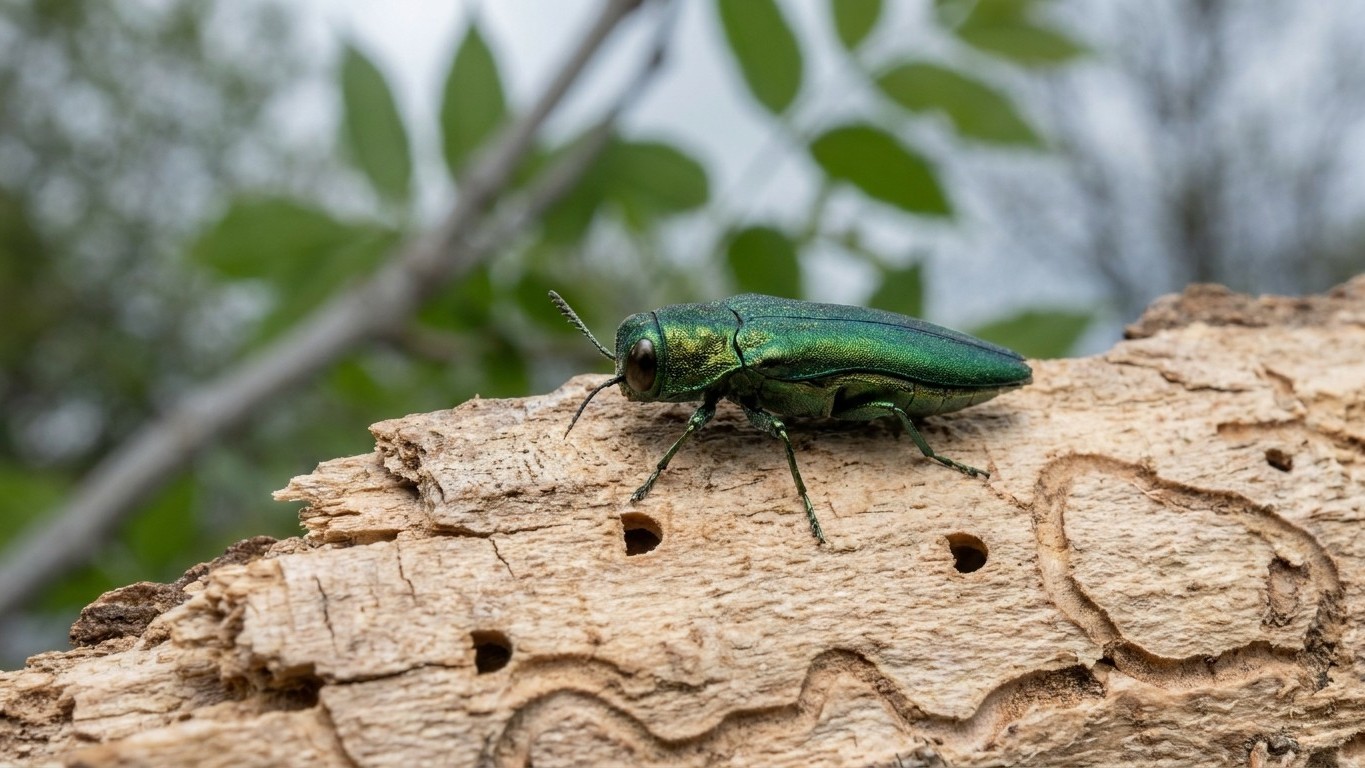

Emerald ash borer reached North Dakota in the fall of 2023, when officials confirmed an infestation in a Fargo neighborhood. Cass County became the state’s first quarantine zone, and the insect hasn’t slowed down since. If you own ash trees anywhere near the Red River Valley, or you’re relying on a shelterbelt planted decades ago to block winter wind, the clock is already running.
The weeks to watch

The confirmation came from a routine trap survey, not a homeowner complaint, which tells you something about how quietly this beetle operates. By the time visible dieback shows up in a canopy, the tree has usually been infested for two or three years already. North Dakota Department of Agriculture inspectors found larvae and exit holes in Fargo ash trees in September 2023, making North Dakota one of the last states in the ash borer’s steady march westward and northward from its original Michigan detection back in 2002.
Cass County got the first quarantine designation, restricting the movement of ash wood, ash nursery stock, and hardwood firewood out of the area. That’s standard protocol nationwide. The beetle itself flies only a few miles a year on its own. Humans do the heavy lifting, mostly by hauling firewood from an infested campsite to a cabin two hundred miles away. Since the initial Fargo find, survey efforts have expanded across eastern North Dakota, and additional detections in neighboring counties have followed the pattern seen in Minnesota and South Dakota: slow initial spread, then a jump once the population builds.
Why This Matters More in North Dakota Than in Most States
North Dakota’s relationship with ash trees is different from, say, Ohio’s. After the Dust Bowl, the state planted hundreds of thousands of trees in shelterbelts, the long rows of trees that break wind across farmland and reduce soil erosion. Green ash became a workhorse species for these plantings because it tolerates drought, cold, and poor soil better than almost anything else available at the time. Estimates from state forestry programs put ash at a significant share of the trees in these windbreaks across the prairie, and in many small towns ash makes up a third or more of the street tree canopy.
That concentration is the problem. Emerald ash borer doesn’t just kill ornamental trees in city parks. It threatens the wind protection that keeps topsoil in fields and snow off rural highways. When Minnesota agriculture officials studied the economic exposure from ash loss, shelterbelt function came up again and again as a concern distinct from urban tree removal costs. North Dakota’s exposure follows the same logic, just spread across a state with fewer urban centers and a lot more open farmland depending on those tree lines.
The Cold Doesn’t Save Us
There’s a persistent hope that North Dakota winters, some of the coldest in the Lower 48, might simply freeze the insect out. Research on EAB cold tolerance shows larvae can survive down to roughly minus 20 to minus 30 degrees Fahrenheit before mortality rates climb sharply, and larvae feeding under bark are somewhat insulated from ambient air temperature. A brutal cold snap might knock back a local population at the margins, but it won’t eliminate an established infestation. Fargo’s average winter lows don’t consistently hit that threshold, and even where they do, one cold week doesn’t undo years of buildup.
How to Spot It Before the Tree Is Beyond Saving
Recognizing an infestation early gives you options. Waiting until the whole canopy is bare leaves you with one option: removal.
Look for these signs on ash trees, and only ash trees, since EAB doesn’t attack maples, oaks, or other species:
- D-shaped exit holes in the bark, about the size of a grain of rice, usually appearing first in the upper canopy
- Thinning or dying branches at the top of the tree, working downward over successive seasons
- Bark splitting vertically, revealing S-shaped tunnels (galleries) carved by larvae underneath
- Increased woodpecker activity, sometimes stripping bark in patches as birds dig for larvae, a symptom foresters call “blonding”
- Epicormic sprouting, meaning clusters of small shoots growing directly from the trunk or major limbs as the stressed tree tries to compensate
Adult beetles themselves are metallic green, about half an inch long, and genuinely hard to spot since they spend most of their time high in the canopy. Homeowners almost always notice the damage before they notice the insect. Adults emerge and become active from late May through July in North Dakota’s climate, laying eggs in bark crevices that hatch into the larvae doing the actual damage over the following year.
What Actually Stops or Slows the Spread
No treatment eradicates emerald ash borer once it’s established in a region. Nobody has managed that anywhere in North America since 2002. What exists instead is a toolkit for slowing the spread and protecting individual high-value trees.
State and Federal Quarantine Rules
Quarantines restrict moving ash wood products and firewood out of infested counties. North Dakota’s rules track federal guidance coordinated through the U.S. Department of Agriculture’s Animal and Plant Health Inspection Service, which has managed the national EAB response since the insect’s first U.S. detection. Violating a quarantine isn’t just a technicality. It’s the single most effective way ordinary people accidentally spread this insect hundreds of miles in a season.
Systemic Insecticide Treatments
For trees homeowners want to keep, licensed applicators can use systemic insecticides, most commonly emamectin benzoate injected directly into the trunk, or imidacloprid applied as a soil drench or trunk injection. Trunk injections generally protect a tree for one to two years per treatment and work best when started before infestation is severe, ideally when a tree is still within about 15 miles of a known infested area. Once more than half the canopy is already dead, treatment success rates drop sharply, and removal becomes the more realistic choice.
These treatments aren’t cheap over the life of a tree, and they’re not a one-time fix. A homeowner committing to save a mature ash is committing to repeat treatments roughly every two years for as long as they want that tree standing. For a single specimen shading a house, that math often makes sense. For a quarter-mile shelterbelt row, it usually doesn’t.
Biological Control
Federal and state agencies have released several species of tiny parasitic wasps in infested regions across the Midwest as a longer-term suppression tool. These wasps target EAB eggs and larvae and don’t sting people or pets. They won’t save individual trees on any useful timeline, but where established, they can reduce EAB population density over a decade or more, which matters for the next generation of ash trees that regrow from surviving root systems or replanting efforts.
What Landowners in North Dakota Should Do Now
If you’re within the current quarantine area or a county bordering it, start by identifying how many ash trees you actually have, since many people underestimate ash presence in a mixed windbreak until someone points it out. Decide early which trees are worth treating, based on size, location, and what they’re actually doing for your property, whether that’s shade, wind protection, or simple curb appeal.
For everyone else in the state, the most useful single habit is refusing to move firewood. Buy it where you’ll burn it, and burn what you buy rather than hauling leftovers home. That one behavior change does more to slow statewide spread than almost anything else an individual can control.
Report suspected infestations to the North Dakota Department of Agriculture rather than guessing on your own. Early confirmation helps state surveyors map the actual edge of the infestation, which in turn determines where quarantine boundaries and treatment recommendations get updated. Given that Fargo’s 2023 detection likely represented an infestation already several years old by the time it was found, every new report submitted earlier rather than later buys real time for the next town down the road.
Related guides
- Emerald ash borer in Nova Scotia: When It Shows Up and What Stops It
- Emerald ash borer in Ontario: When It Shows Up and What Stops It
- Corn earworm in North Dakota
- Emerald ash borer in Prince Edward Island: When It Shows Up and What Stops It
- Emerald ash borer in Saskatchewan: When It Shows Up and What Stops It