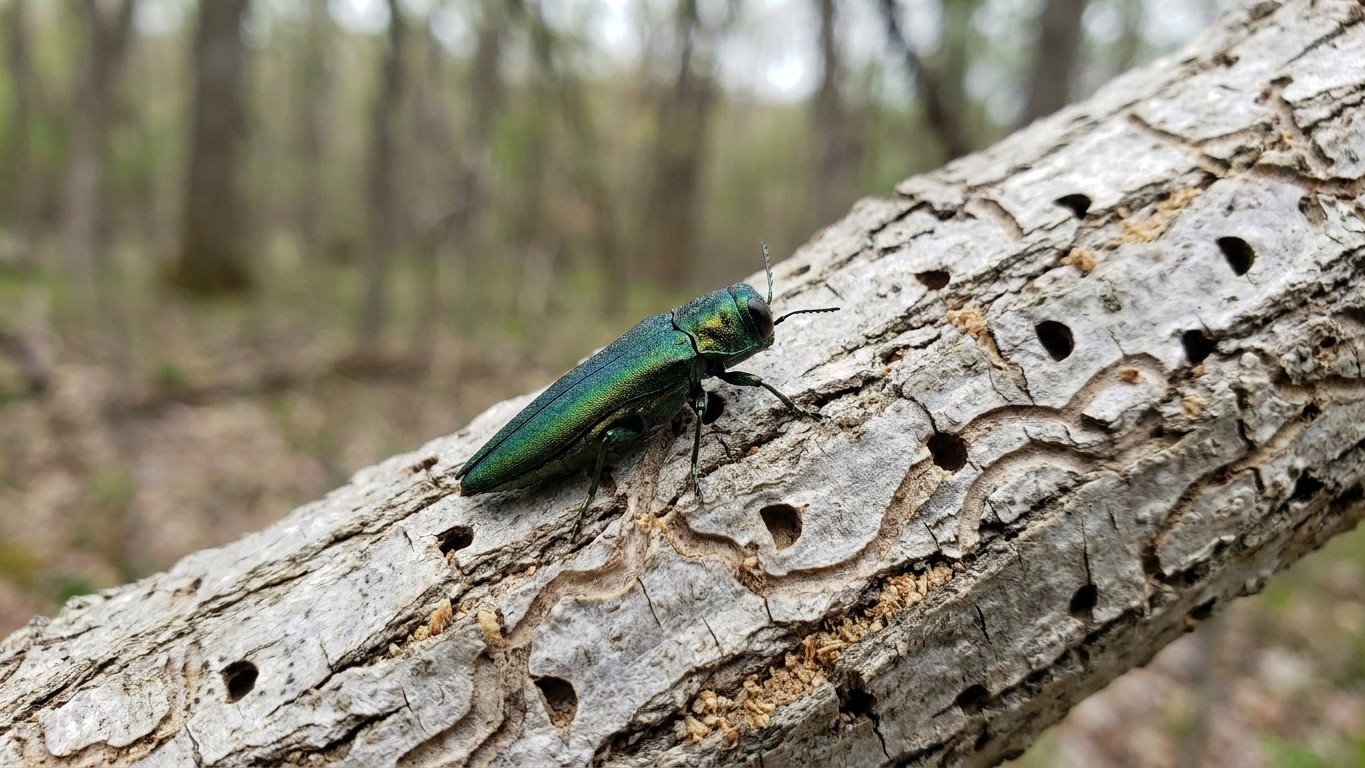

Emerald ash borer arrived in Nova Scotia in 2018, when the Canadian Food Inspection Agency confirmed an infestation in the Bedford area of Halifax. It hasn’t left, and it isn’t going to. What stops it from wiping out every ash tree in the province is a mix of quarantine rules on moving wood, targeted insecticide treatments for high-value trees, and a slow-building population of parasitic wasps that attack the beetle in its larval stage. None of that reverses an infestation once a tree is heavily damaged, but together they buy time and limit how fast the insect spreads.
The Regulated Zone Since the Bedford Detection

The initial detection near Bedford triggered a regulated area under the Plant Protection Act, restricting the movement of ash logs, branches, wood chips, and firewood out of the infested zone. That regulated zone has been adjusted since 2018 as surveyors found the beetle in new spots across the Halifax Regional Municipality and into neighboring counties. The pattern is familiar to anyone who’s followed EAB’s march across Ontario, Quebec, and the northeastern United States: it moves slowly on its own (adult beetles typically fly less than half a mile a year), but it jumps long distances fast whenever someone hauls infested firewood to a new campground or cottage.
That’s the uncomfortable truth about this insect. Natural spread from Bedford would have taken decades to reach the rest of the province. Human transport can do it in a single summer weekend. The Canadian Food Inspection Agency keeps updated maps of regulated areas, and checking them before moving any ash wood is the single easiest way a Nova Scotia property owner avoids accidentally spreading the infestation. Details on the current regulated zones and movement restrictions are maintained on the CFIA’s emerald ash borer page.
Why ash trees in this province are particularly exposed
White ash (Fraxinus americana) grows throughout Nova Scotia’s mixed hardwood forests, often as a scattered component rather than in pure stands, which actually helps a little since it slows the beetle’s ability to move tree-to-tree through a dense monoculture. Urban and suburban plantings are a different story. Ash was a popular street and yard tree for decades precisely because it grows fast, tolerates road salt and compacted soil, and casts decent shade within a couple decades of planting. That popularity is now a liability. Neighborhoods in Halifax, Bedford, and Dartmouth with heavy ash plantings from the 1980s and 90s are facing the same wave of canopy loss that hit cities like Windsor and Toronto a decade earlier.
There’s also a cultural dimension worth noting. Black ash, while less common in Nova Scotia than in New Brunswick or Maine, holds deep significance for Mi’kmaq basket-making traditions across the Maritimes. Losing black ash stands to EAB isn’t just an ecological loss column on a spreadsheet, it’s a threat to a craft passed down through generations.
How to identify an infested ash tree
Symptoms build slowly, then all at once. In the first year or two of infestation, a tree often shows no visible signs while larvae feed under the bark. By the time damage is obvious, the beetle has usually been established for two to four years already.
Watch for these signs on ash trees specifically (maples, oaks, and birches are not hosts, so don’t confuse general tree stress with EAB):
- Canopy dieback starting at the top and outer branches, often uneven from one side of the tree to the other
- Epicormic sprouting, meaning thin shoots growing directly out of the trunk or main branches, a stress response as the tree tries to compensate for lost canopy
- D-shaped exit holes in the bark, roughly 1/8 inch across, where adult beetles chewed their way out
- Bark splitting that reveals S-shaped or serpentine tunnels underneath, carved by feeding larvae
- Blonding, or patches of lighter-colored bark where woodpeckers have stripped away the outer layer hunting for larvae, often the earliest visible clue
A tree showing woodpecker blonding on multiple branches in late winter is worth a closer look come spring. That symptom alone has tipped off arborists to infestations before any exit holes were visible at all.
What actually slows the spread
Three approaches work in combination. None works alone, and none is a permanent fix once a tree is badly compromised.
Firewood rules and the quarantine zone
Moving firewood is the number one way this beetle jumps to new areas, full stop. Nova Scotia’s regulated zone restricts moving ash material, including firewood of any species cut within the zone, since EAB larvae can hide in wood that looks perfectly normal to a camper loading up the truck. The advice from provincial and federal agencies is consistent nationwide: buy firewood where you’ll burn it, and burn what you buy, rather than transporting it from home. This single behavior change, adopted broadly, has measurably slowed EAB’s spread in other provinces.
Systemic insecticide treatment
For ash trees worth protecting, mainly mature specimens in yards, parks, or streetscapes, licensed arborists can apply a systemic insecticide injected directly into the trunk. The most commonly used product in Canada is TreeAzin, based on azadirachtin, a naturally occurring compound extracted from neem tree seeds. It doesn’t kill adult beetles outright, but it disrupts larval development enough that most treated larvae die before completing their life cycle. Treatments need to be repeated every two years and only make economic sense for trees you’d genuinely miss if they died, which is why municipalities tend to reserve it for high-value street trees rather than trying to treat every ash in a forest stand.
Biological control with parasitoid wasps
Federal researchers have released several species of tiny, non-stinging parasitoid wasps in EAB-infested regions across Canada, including Tetrastichus planipennisi and Oobius agrili, both of which target EAB eggs or larvae specifically and pose no risk to other insects or to people. These releases take years to build a self-sustaining population large enough to meaningfully suppress beetle numbers, and Nova Scotia’s program is still in an earlier stage than places like southern Ontario, where releases began well over a decade ago. It’s a long game, closer to establishing a natural predator-prey balance than to eradicating the pest.
What removal and disposal actually look like
Once a tree is more than about 30 to 50 percent dead in the canopy, treatment usually isn’t worth it anymore, and removal becomes the safer option, both for reducing the beetle population and for basic safety, since dead ash wood becomes structurally unreliable within a couple of years and drops brittle limbs without much warning. Within the regulated zone, removed ash material typically needs to be processed on-site (chipped to a specified size) or disposed of at an approved facility rather than hauled elsewhere. Homeowners removing a dead or dying ash should check with a certified arborist or the municipality about disposal requirements before assuming a standard yard-waste pickup will take it.
Replanting with a mix of species rather than another single species is the practical lesson many municipalities learned the hard way from Dutch elm disease decades earlier. Red maple, serviceberry, and native oak species are commonly recommended substitutes for homeowners in the Maritimes looking to replace a lost ash without repeating the same vulnerability.
What Nova Scotia property owners can do this year
Anyone with mature ash on their property, particularly within or near the Halifax Regional Municipality, benefits from a simple annual check: look at the upper canopy in late spring for dieback, check trunks and lower branches in winter for woodpecker damage, and note any thin sprouts growing straight out of the bark. Catching an infestation in its early stage is the difference between a treatable tree and a removal job. Reporting suspected new detections outside the current regulated area to the CFIA also matters more than most homeowners realize, since those reports are what allow the regulated zone map to stay accurate and help slow the beetle’s spread into untouched parts of the province.
One detail that surprises a lot of people: EAB doesn’t actually kill trees by eating leaves or bark the way a gypsy moth or tent caterpillar does damage. The larvae feed on the phloem layer just under the bark, the tissue that moves sugars produced by photosynthesis down to the roots. A heavily tunneled tree essentially starves from the inside while its leaves still look green from a distance, which is exactly why so many infestations go unnoticed until the damage is already severe.
Related guides
- Emerald ash borer in New Brunswick: When It Shows Up and What Stops It
- Emerald ash borer in Ontario: When It Shows Up and What Stops It
- Emerald ash borer in Prince Edward Island: When It Shows Up and What Stops It
- Emerald ash borer in Quebec: When It Shows Up and What Stops It
- Emerald ash borer in Maine: When It Shows Up and What Stops It