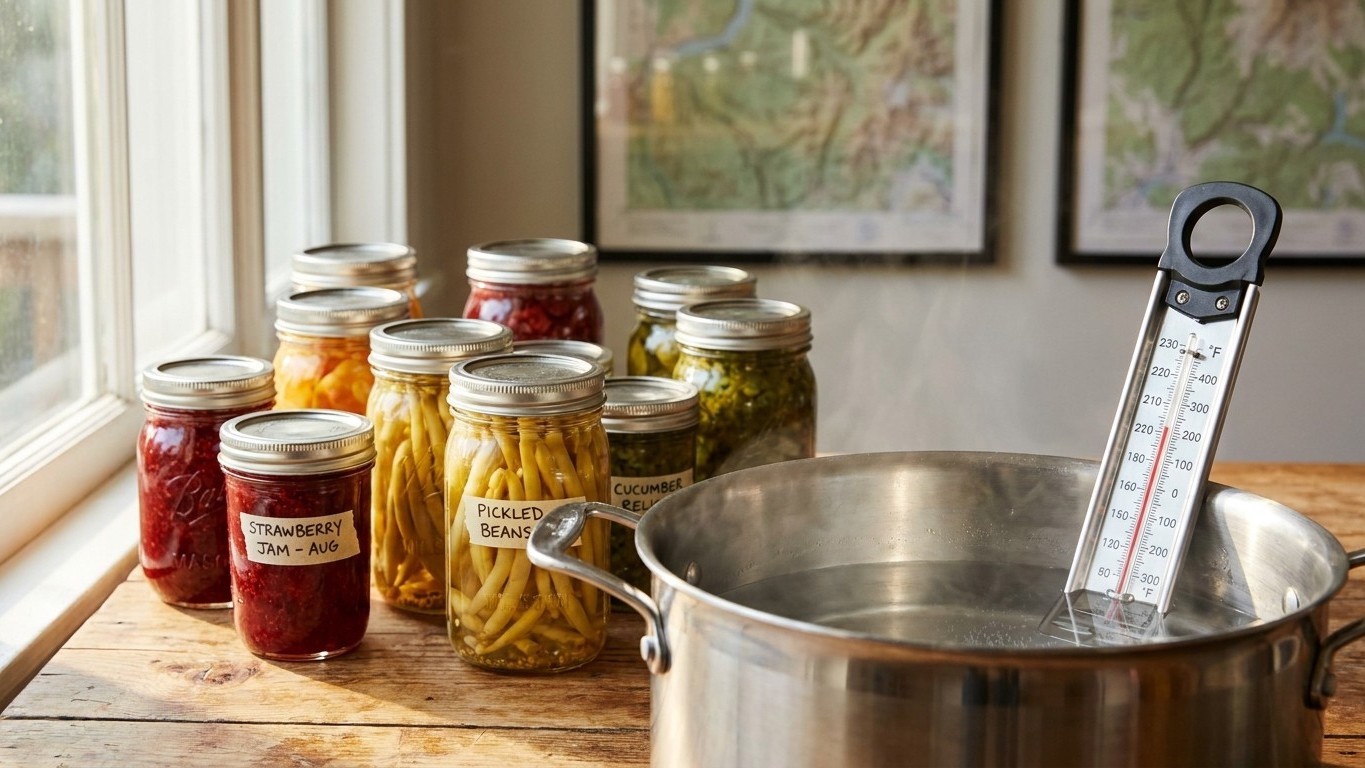

Halifax sits at 197 feet above sea level, and published USDA boiling-point references put water in that range between 208°F and 212°F, not far below the sea-level mark of 212°F. For a home canner working near that elevation, this changes almost nothing. But Nova Scotia is not one elevation, and canners working in the province’s higher inland spots need their own number before they touch a jar.
The short answer

Halifax, the reference city for this elevation figure, sits at 197 feet, according to geographic elevation data from Open-Meteo’s geocoding service (which draws on GeoNames). The USDA’s Complete Guide to Home Canning, as published by the National Center for Home Food Preservation, brackets the boiling point of water in this general low-elevation band between 208°F and 212°F. That’s a narrow window, and it sits right on top of the 212°F sea-level standard that every tested canning recipe assumes.
What that means in practice: if you can near Halifax, or anywhere else in Nova Scotia sitting in that same 0 to 2,000 foot band, your water is boiling close enough to the sea-level mark that the standard processing times printed in tested recipes are doing the job they were designed to do. This is not an elevation that quietly weakens your canner without you noticing. It’s the opposite end of the spectrum from, say, a mountain town at 6,000 feet, where the boiling point drops several degrees and every single jar processed at a sea-level time comes out under-processed.
Why the province still matters here
Nova Scotia is not flat from coast to coast. The figure above describes Halifax, the province’s largest population center and a useful reference point, not the elevation of the whole territory. Inland areas and highland terrain, including parts of Cape Breton, sit meaningfully higher than the coastal lowlands where most Nova Scotians live and can. A state or province spans a range of elevations, sometimes a wide one, and the number that matters for your jars is the one where your kitchen actually sits, not the one attached to the nearest big city on a map.
So the short answer has two parts. Near Halifax and along most of the province’s coastline, you’re working in a band where altitude adjustments generally aren’t the deciding factor in a safe process. Move inland or uphill, and the calculation changes, sometimes enough that skipping the adjustment turns a good recipe into a risky one. The only way to know which situation applies to you is to find your own elevation, not borrow Halifax’s.
Why a lower boil is a weaker process
Water has a ceiling. At sea level, that ceiling is 212°F, and no amount of vigorous, rolling, lid-rattling boiling pushes it higher. Add more heat past that point and the water doesn’t get hotter, it just boils away faster. This is basic physics, but it trips up a lot of home canners who assume a harder boil compensates for elevation. It doesn’t. The temperature of boiling water is fixed by atmospheric pressure, not by how much flame is under the pot.
As elevation rises, atmospheric pressure drops, and so does the temperature at which water boils. At 10,000 feet, water boils at roughly 194°F, a full 18 degrees below the sea-level mark. That’s the mechanism, in full: less pressure pushing down on the water’s surface means the water molecules need less energy, and therefore less heat, to break free as steam. The water is still boiling. It’s just boiling cooler.
A cooler boil kills less. Home canning relies on heat to destroy microorganisms, most critically the spores of Clostridium botulinum, the organism behind botulism. A tested processing time is calculated for a specific temperature held for a specific duration. Drop the temperature and hold the same duration, and you’ve delivered a weaker process than the recipe was designed to achieve, even though the water was boiling the entire time and the jars looked perfectly normal coming out of the canner.
This is why “just boil it longer and harder” isn’t a fix, and why the correction has to come from somewhere else. In a boiling-water canner, the compensation is more time. The water can’t get hotter, so the food needs to sit in that cooler bath longer to receive an equivalent dose of heat. In a pressure canner, the compensation is different: pressure raises the boiling point of water past 212°F regardless of elevation, so the adjustment there is more pressure, not more time, to reach the target temperature the recipe calls for. Both fixes exist because the underlying problem is identical: elevation lowers the ceiling on boiling-water temperature, and the process has to be rebuilt around wherever that new ceiling lands.
Finding your own elevation
Halifax’s 197 feet is a reference point, not a stand-in for your kitchen. Before adjusting anything, find the number that actually applies where you live.
- Start with the National Center for Home Food Preservation’s own “Find Your Elevation” page, built specifically to help home canners locate this figure without guesswork.
- Enter your town, or the nearest recognized location to your home, since the tool works from named places rather than exact street addresses.
- Note the elevation in feet, not meters, since US and Canadian tested canning recipes are built around foot-based elevation bands.
- Check that number against the elevation bands listed in your specific tested recipe, since different recipes and different canning methods break the bands at different cutoffs.
- If your home sits between two listed elevations or you’re unsure which band applies, round up to the higher band rather than the lower one; overprocessing by a small margin is a minor quality tradeoff, underprocessing is a safety failure.
- Recheck this figure if you can seasonally at a cabin, cottage, or relative’s home at a different elevation than your primary kitchen, since the adjustment travels with the location, not with you.
This step takes a couple of minutes and it’s the single most consequential decision in the whole canning process, because every processing time and every pressure setting downstream depends on getting this number right first.
What goes wrong
- An under-processed jar that looks perfect. A jar canned at the wrong elevation seals normally, seals with a satisfying pop, and sits on the shelf looking exactly like a safe one. There’s no visual, textural, or smell-based way to tell the difference. The remedy is entirely upstream: get the elevation right before processing, because there’s no way to fix it after the jar has cooled.
- A recipe copied from a sea-level source without adjustment. Recipes shared informally, printed in older community cookbooks, or found on sites that don’t specify elevation bands often assume sea-level conditions by default. Using one as-is at a higher elevation, without checking whether it names an adjustment, quietly weakens the process. The remedy is to only trust recipes that explicitly state their elevation assumptions and provide adjusted figures for higher bands.
- A pressure gauge read as if elevation didn’t exist. Pressure canners need higher pressure at higher elevations to reach the same internal temperature, and a canner set to a sea-level pressure at a higher elevation delivers less heat than intended, even though the gauge needle looks steady and correct. The remedy is confirming the pressure setting for your canner type (weighted or dial gauge) and your specific elevation band before starting the load, not partway through it.
- Assuming a small number of feet doesn’t matter. Some canners round down or ignore a modest elevation because it feels too minor to matter. Elevation bands in tested recipes exist precisely because even a few hundred feet can shift which band applies, and the tested times are built around those band cutoffs, not around approximate feelings of “close enough.”
Where the exact adjustment comes from
This page won’t hand you a processing time or a canner pressure, and that’s deliberate. The correct adjustment depends on the specific food, the specific canning method, and your specific elevation band together, and that figure lives in the tested recipe for that food, not in a general article about altitude. Reach for the National Center for Home Food Preservation’s published guidance for your exact recipe and follow the elevation adjustment listed there.
The reason for this caution isn’t bureaucratic. Clostridium botulinum spores, if they survive an under-processed jar, produce a toxin with no detectable taste and no detectable smell. A jar can look, smell, and taste completely normal and still be dangerous. That’s precisely why the adjustment has to come from a tested source matched to your food and your elevation, never from a general rule of thumb applied across the board.
Common questions
Does Halifax’s elevation apply to my whole address in Nova Scotia?
No. Halifax’s 197 feet is a reference point for the province’s largest city, not a province-wide figure. Nova Scotia includes coastal lowlands and higher inland terrain, and your own elevation, found through the NCHFP’s elevation tool, is the number that matters for your jars.
If I’m near sea level, can I skip checking my elevation at all?
It’s still worth confirming, since “near the coast” and “at 197 feet” aren’t automatically the same thing, and tested recipes are built around specific elevation bands rather than general impressions of proximity to water.
Does boiling water harder compensate for a lower elevation boiling point?
No. Once water reaches its boiling point for that elevation and pressure, additional heat doesn’t raise the temperature further, it just boils the water away faster. The only real compensations are more time in a boiling-water canner or more pressure in a pressure canner.
Can I use the same elevation adjustment for every recipe I can?
No. Elevation adjustments are tied to the specific tested recipe and canning method, so always check the adjustment listed for that exact food and process rather than reusing a figure from a different recipe, even at the same elevation.