
Colorado potato beetles start showing up in Connecticut gardens in late April to mid-May, right around the time soil temperatures climb past 50°F. What stops them isn’t a single spray or trick, it’s a combination of timing, physical removal, and rotating where you plant potatoes and other nightshades each year. Chemical controls exist, but this beetle has built up resistance to entire classes of insecticides, so the most reliable defense is still low-tech: check your plants, pull off what you find, and don’t grow potatoes in the same spot two years running.
When Colorado Potato Beetles Emerge in Connecticut

These beetles spend the winter as adults buried 4 to 6 inches deep in soil, often right at the edge of last season’s potato patch. They don’t fly far to find a new home, so if you had beetles last summer, the same bed is ground zero this year. Once spring soil warms past that 50-degree threshold, usually sometime between late April and the second week of May in most of Connecticut, adults dig out and start walking toward the nearest host plant.
Fairfield County and the shoreline tend to warm a few days earlier than the Litchfield Hills or the northeastern corner of the state, so gardeners inland might see emergence closer to mid-May. Either way, the beetles are hunting for potatoes, tomatoes, eggplant, and petunias, in roughly that order of preference. Females mate within days of emerging and start laying eggs almost immediately, which is why the first two weeks of activity matter more than any other stretch of the season.
The Egg-to-Adult Timeline
A single female can lay 300 to 500 eggs over her lifetime, deposited in clusters of 20 to 40 on the undersides of leaves. Those clusters are bright orange-yellow and easy to spot once you know to flip a leaf over. Eggs hatch in 4 to 9 days depending on temperature, and the larvae then feed for two to three weeks, molting through four growth stages before dropping to the soil to pupate. A full generation, egg to adult, typically wraps up in three to four weeks during a Connecticut summer.
That speed is the problem. Connecticut usually sees one full generation and part of a second each season, and in a warm year with an early spring, a third partial generation isn’t unusual. Skip a week of scouting in June and you can go from a handful of adults to hundreds of larvae stripping plants bare.
Identifying the Beetle and Its Damage
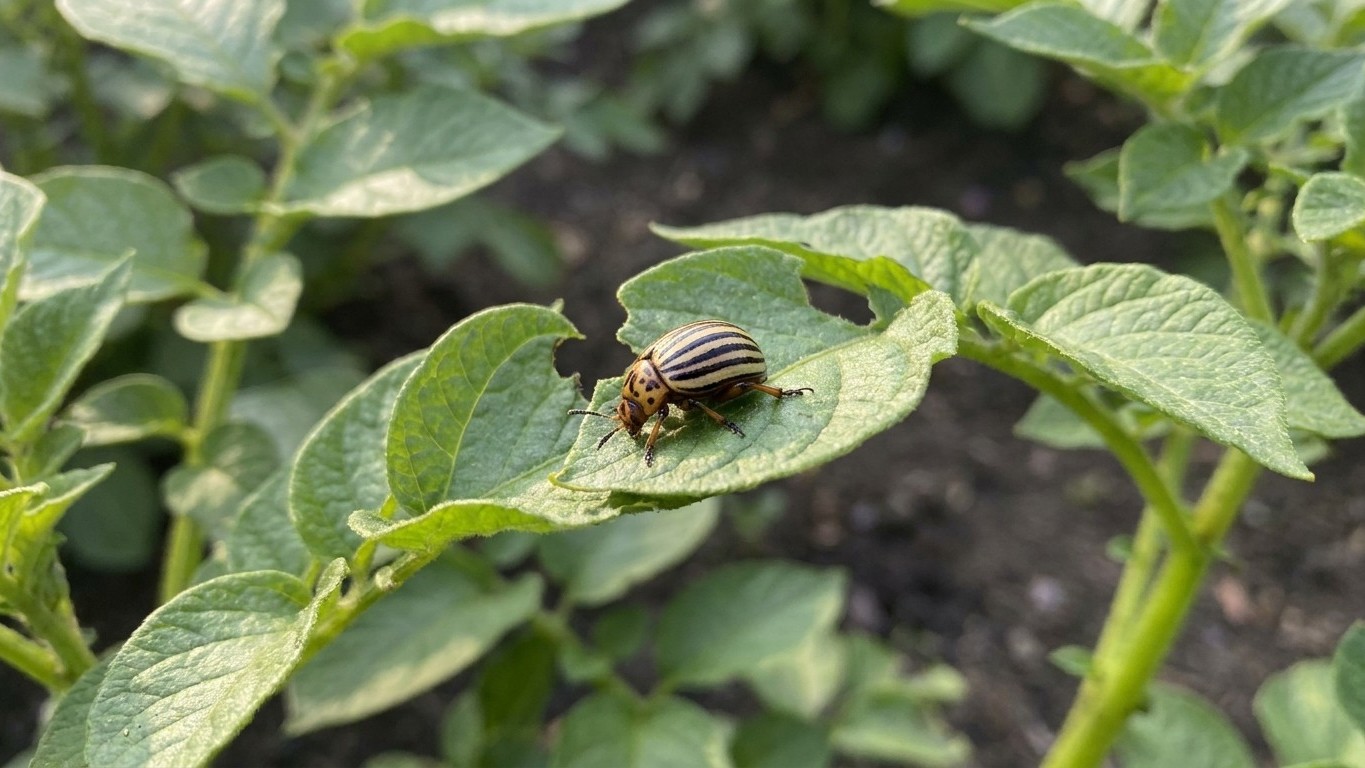
Adults are about 3/8 inch long, rounded, and hard to miss once you’re looking for them: yellow-orange wing covers with ten black stripes running lengthwise (that stripe count is actually where the species name decemlineata comes from). The larvae look nothing like the adults. They’re humpbacked, soft-bodied, and start out dark red before fading to a brick-orange color, with two rows of black spots along each side.
Damage shows up as ragged holes chewed through leaf tissue, starting small and expanding fast as larvae grow. A heavy infestation can defoliate an entire potato plant in a matter of days, and since potatoes rely on leaf growth to bulk up tubers underground, a stripped plant in June or July often means a disappointing harvest in September. Tomato and eggplant damage tends to look similar but progresses more slowly, since those plants aren’t the beetle’s first choice.
One thing worth knowing: a plant that looks skeletonized in late July but was healthy in June almost always points back to a missed egg cluster from three or four weeks earlier. The lag between “I didn’t see anything” and “my plants are gone” is exactly the length of one larval feeding cycle.
What Actually Stops Colorado Potato Beetles
Home gardeners in Connecticut have decent luck with a layered approach rather than relying on one method. Here’s what tends to work, roughly in order of how much effort each takes:
- Hand removal — checking leaf undersides twice a week in May and June, crushing egg clusters, and dropping adults and larvae into a jar of soapy water. Tedious, but for a backyard-sized plot it’s often enough on its own.
- Crop rotation — moving potatoes, tomatoes, and eggplant to a different bed each year, ideally at least 30 feet from the previous location, since overwintering adults have limited walking range.
- Deep straw mulch — a thick layer (4 inches or more) around potato plants makes it harder for emerging adults to reach the surface and interferes with their movement toward host plants.
- Row covers — floating row covers placed at planting time and removed once plants flower (potatoes need pollinators later, but early-season cover keeps the first wave of beetles off).
- Biological insecticides — products containing Bacillus thuringiensis var. tenebrionis (sometimes labeled Bt-san diego) target the larvae specifically and leave most beneficial insects alone.
Spinosad-based products also show good results against larvae and are commonly available at garden centers labeled for vegetable use. Neem oil can slow feeding and egg-laying but works better as a repellent than a knockout treatment, so it’s more useful early in the season than once larvae are already established.
Why Chemical Sprays Alone Often Disappoint
Colorado potato beetle has one of the longest track records of insecticide resistance in American agriculture. Populations in the Northeast, including Connecticut, have developed resistance to pyrethroids, several neonicotinoids, and organophosphates over the decades since those chemicals were introduced. That doesn’t mean chemical control is useless, it means relying on a single product year after year is a losing strategy. Rotating between different modes of action, or skipping synthetic sprays in favor of Bt and hand-picking, tends to hold up better over multiple seasons.
Commercial potato growers in the state deal with this same resistance issue on a larger scale, which is part of why crop rotation and scouting remain standard practice even on farms that do spray. If it doesn’t work as a long-term solution for a 50-acre potato field, it’s not going to work as a long-term solution for four tomato plants either.
Preventing Next Year’s Infestation
The single best predictor of a beetle problem is whether you had one the year before in the same spot. Since adults overwinter in soil near where they fed, tilling the bed in late fall can expose some of them to freezing temperatures and predators before they’ve settled in deep enough to survive winter. It’s not a complete fix, but it knocks the population down before spring.
Trap cropping is another option that works surprisingly well in home gardens. Planting a small block of potatoes a couple weeks earlier than the main crop gives emerging beetles an attractive target to colonize first, concentrating them in one area where they’re easier to remove by hand or treat directly, rather than spreading out across the whole planting.
Attracting natural predators helps too. Ground beetles, lady beetles, and spined soldier bugs all feed on Colorado potato beetle eggs and young larvae, and they’re more likely to stick around in a garden that isn’t blanketed in broad-spectrum insecticide. Leaving some areas of the yard less manicured, with leaf litter or low ground cover nearby, gives these predators a place to overwinter alongside the pest they’re keeping in check.
Connecticut’s growing season runs long enough that a second potato planting in early July, timed after the first generation of beetles has mostly pupated, sometimes dodges the worst of the pressure entirely. It’s a workaround more than a solution, but for gardeners who’ve lost a crop two years running to the same beetle population, shifting the calendar can matter as much as anything sprayed on the leaves.
Related guides
- Colorado potato beetle in New York: When It Shows Up and What Stops It
- Colorado potato beetle in Massachusetts: When It Shows Up and What Stops It
- Colorado potato beetle in Delaware: When It Shows Up and What Stops It
- Colorado potato beetle in Georgia: When It Shows Up and What Stops It
- Colorado potato beetle in Wyoming: When It Shows Up and What Stops It
- Colorado potato beetle in North Dakota: When It Shows Up and What Stops It