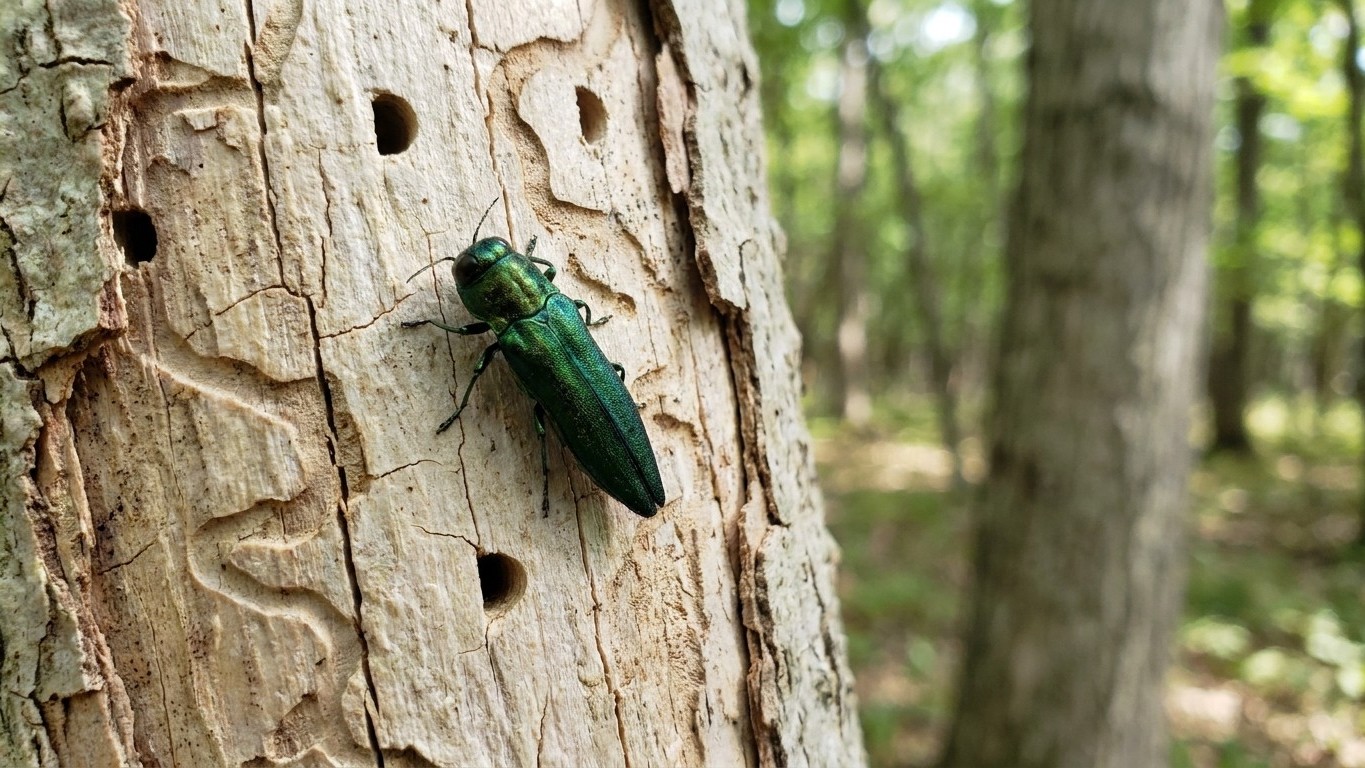

Emerald ash borer showed up in New Brunswick in 2018, confirmed in the Edmundston area of Madawaska County, right along the Quebec border where the insect had already been chewing through ash stands for several years. Since then, the beetle has kept moving south and east through the province, and the Canadian Food Inspection Agency (CFIA) has drawn regulated zones to slow it down. What stops it, realistically, is a mix of quarantine rules, early detection, and targeted insecticide or removal work on individual trees. Nothing eradicates it once it’s established in a region.
How the Beetle Got Into New Brunswick

Emerald ash borer (Agrilus planipennis) is native to East Asia and was first found in North America in 2002, on the Windsor, Ontario/Detroit, Michigan border. From there it spread mostly through human activity, firewood, nursery stock, wood packaging, rather than flying on its own across long distances. The adult beetle can only fly a few miles under its own power in a season.
New Brunswick sits downstream of two infestation fronts. Quebec had confirmed detections for years before the beetle crossed into Madawaska County, and Maine, which shares a long border with New Brunswick, had its own confirmed infestations around the same period. Given that timing, provincial and federal officials didn’t treat the 2018 Edmundston find as an isolated event. It was the expected next step in a spread pattern that had already crossed two other jurisdictions.
Since that first confirmation, additional detections have been reported in other border counties, including areas around Victoria and Carleton. The pattern tracks major transportation corridors and firewood movement more than it tracks forest cover alone, which is exactly why the regulatory response focuses so heavily on wood movement rather than just tree health.
Which Trees Are at Risk in New Brunswick
New Brunswick’s forests carry white ash and black ash as the dominant species, with green ash showing up in planted and urban settings. All three are vulnerable. Emerald ash borer does not discriminate much between ash species, though black ash in wetter sites sometimes shows infestation a bit later than white ash in drier upland stands.
Ash accounts for a modest but locally important share of New Brunswick’s hardwood forest and a much larger share of some urban street tree inventories. Towns that leaned on ash for boulevard plantings decades ago, a common choice because it grows fast and tolerates road salt and compacted soil, are now facing the same reckoning that hit cities in the Great Lakes region a decade earlier: losing a large percentage of street canopy in a compressed window of a few years.
Homeowners with a mature ash in the yard should know the tree typically dies within one to four years of visible symptoms once the beetle is established locally. That’s a much faster decline than most people expect from an insect, comparable to a slow-motion version of what a bark beetle outbreak does to pine.
Recognizing an Infested Ash Tree
The signs cluster into a few reliable categories, and most homeowners can check for them without climbing a ladder:
- D-shaped exit holes in the bark, about the width of a grain of rice, left when adult beetles emerge in late spring or early summer
- Canopy thinning that starts at the top of the tree and works downward, often mistaken for drought stress the first year
- Bark splitting to reveal S-shaped larval tunnels (galleries) underneath
- Epicormic sprouting, clusters of small shoots growing low on the trunk as the tree tries to compensate for canopy loss
- Vertical bark stripping from woodpeckers feeding on larvae, sometimes called “blonding” because it exposes lighter inner bark
Any one of these on its own could mean something else, drought, a different borer, storm damage. Two or more together on a mature ash is worth reporting to provincial forestry officials or the CFIA rather than guessing.
Regulated Areas and Firewood Rules
Once emerald ash borer is confirmed in a region, the CFIA typically establishes a regulated area under the Plant Protection Act. Inside that zone, moving ash material, including firewood of any species, nursery stock, logs, branches, and wood chips, outside the boundary is restricted or requires a movement certificate. The firewood rule covers all species, not just ash, because it’s nearly impossible to guarantee a load of mixed firewood doesn’t include an infested piece.
This is the single most effective tool against long-distance spread. Beetles that fly a few miles a season are a manageable, slow-moving problem. Beetles riding in a truck bed to a cottage two provinces away are how the infestation jumped from Michigan to half of eastern North America in under twenty years. Anyone camping in or near New Brunswick should buy firewood locally at the destination rather than hauling it from home, even from within the province, and definitely not across the US-Canada border.
For current boundaries, movement certificate requirements, and which counties fall inside a regulated zone, the CFIA maintains official pest program pages that get updated as the infestation front moves. That’s the source to check before transporting any wood product, since provincial extension offices generally point back to the same federal listing. CFIA’s emerald ash borer program page lists the current regulated areas.
What Actually Stops or Slows the Beetle
Nothing available today eliminates emerald ash borer once it’s established across a landscape. Control tools work at the level of an individual tree or a delayed timeline for a neighborhood, not eradication of the species from a region. That distinction matters when deciding whether to treat or remove a specific ash tree.
Insecticide Treatment for High-Value Trees
Systemic insecticides applied by trunk injection or soil drench can protect an individual ash tree for one to three years per treatment, depending on the product and application method. Imidacloprid soil treatments are common for lower-value or smaller trees, while emamectin benzoate trunk injections tend to be reserved for larger, higher-value specimens because the treatment is more expensive but lasts longer and works faster once absorbed.
Canada also has a biopesticide option not widely available in the US: TreeAzin, developed through federal forestry research and based on azadirachtin, a compound derived from neem tree seeds. It’s applied by trunk injection and has been used in municipal EAB response programs across several provinces. Treatment only makes sense for trees worth the ongoing cost, typically prized shade trees, street trees with heritage value, or specimens in a spot where removal would be expensive or disruptive. A tree already showing more than 30 to 50 percent canopy loss usually isn’t a good treatment candidate; the beetle population inside the tree is often too far along for the insecticide to catch up.
Biological Control
Federal researchers have released several species of parasitoid wasps as biological control agents against emerald ash borer, including Tetrastichus planipennisi and Oobius agrili, both of which attack EAB larvae or eggs and were sourced from the beetle’s native range in Asia. These releases don’t wipe out an infestation, but research suggests they can reduce beetle density over time in areas where they establish, which may help some ash regeneration survive in forest settings even after the initial wave of mortality passes through.
Removal and Replacement
For most homeowners, removal before the tree becomes a safety hazard is the practical answer, especially for ash that’s already showing significant canopy dieback. Dead ash wood becomes brittle and unpredictable faster than most hardwoods, and a dead ash near a driveway or house is a different risk calculation than a dead ash out in a back lot. Replacing with a mix of species, rather than another single-species planting, is the standard recommendation from provincial forestry programs precisely because monoculture street plantings are what made the ash borer’s arrival so costly for cities to begin with.
What Homeowners in New Brunswick Should Do Now
If there’s a mature ash tree on the property, the first move is identification, confirming it’s actually ash and not being mistaken for something else, since several native trees share a loosely similar leaf structure. From there, a seasonal check for the signs above, particularly in late spring and again in early fall, catches most infestations early enough to make a treat-or-remove decision with some breathing room.
Reporting a suspected find to provincial Department of Natural Resources and Energy Development staff or through CFIA channels helps track the spread front, which in turn helps neighboring property owners and municipalities plan ahead rather than react. The beetle’s slow flight range means a confirmed detection in one neighborhood is a reliable early warning for the surrounding few miles over the following two or three years, not an immediate citywide emergency.
Related guides
- Emerald ash borer in Quebec: When It Shows Up and What Stops It
- Emerald ash borer in Nova Scotia: When It Shows Up and What Stops It
- Emerald ash borer in Newfoundland and Labrador: When It Shows Up and What Stops It
- Emerald ash borer in North Dakota: When It Shows Up and What Stops It
- Cabbage maggot in New Brunswick
- Seedcorn maggot in New Brunswick
- Winter moth in New Brunswick
- Emerald ash borer in Prince Edward Island: When It Shows Up and What Stops It