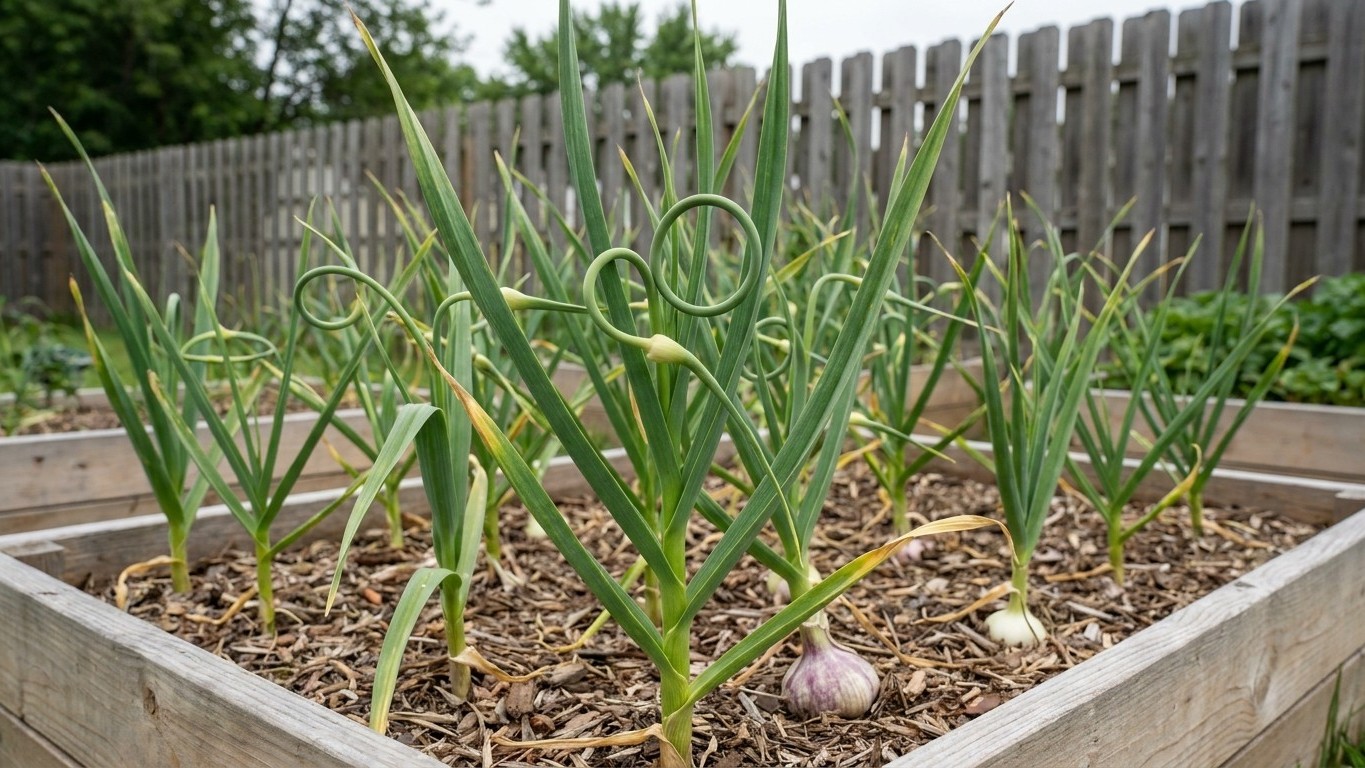

Garlic in Nunavut gets lifted in a narrow midsummer window, generally mid-to-late July into early August, because it went into the ground the previous fall and had only one short growing season to bulk up. The real trigger isn’t a date on a calendar. It’s the foliage: when the lower leaves have browned off but four or five up top are still green, the bulbs are ready to come out of the ground.
When garlic is ready to lift in Nunavut
Garlic grown this far north follows the same basic pattern as anywhere else: planted in autumn, it sits dormant through the coldest months, then pushes up growth once the ground softens and daylight stretches out. The bulb itself forms underground through the brief summer, and by the time you’re ready to dig, that whole cycle has run its course over close to a year, not a few months.
The leaf test matters more here than in milder regions because Nunavut’s growing season leaves almost no margin for guessing wrong. Wait too long and the wrapper layers that protect each bulb start to split apart underground, especially in the wetter pockets of a garden bed. Pull too soon and you get small, undercured bulbs that won’t keep. Five or six green leaves left standing, with the rest gone brown and papery, is the signal gardeners across cold climates use, and it applies just as directly in Rankin Inlet or Iqaluit as it does further south.
Why the frost date still shapes the calendar
The first fall frost doesn’t decide when you lift garlic in summer, but it decides how much runway the whole growing cycle has, and that shapes when planting happened the previous autumn and how compressed the summer growth window turns out to be. At the Rankin Inlet A station, Environment and Climate Change Canada’s Canadian Climate Normals for 1981-2010 put the average first fall frost at September 13. That’s a midpoint, not a guarantee: in one year out of every two, frost arrives later than that date, sometimes considerably later.
Treat that September 13 figure as the center of a window, not a line you can plan around with confidence. It also comes from a single station. Nunavut spans multiple climate zones, and communities away from Rankin Inlet, particularly those further north or at higher elevation, run their own timelines that can lag well behind it. If you’re gardening elsewhere in the territory, use the Rankin Inlet normal as a reference point, not a local forecast.
Curing it, and where to hang it here
Curing is what turns a freshly dug, dirt-covered bulb into something that will actually keep through winter. The process is straightforward everywhere: bulbs need warm, dry, moving air out of direct sun for several weeks so the outer wrappers dry down and seal, and the neck tightens up above the bulb. What’s different in Nunavut is that almost none of this can happen outdoors.
Further south, gardeners hang garlic in open sheds or under porch roofs where ambient warmth and airflow do the work. That’s not realistic here. Even in July and August, outdoor humidity swings and cold snaps can undo weeks of drying in a single damp stretch, and once the season turns toward that average September 13 frost, outdoor curing is off the table entirely, whether frost actually lands on that date or not.
Finding indoor space that works
The fix is moving curing indoors, but not into a warm, closed room. Garlic cures best in the 70 to 80 degree range with steady air movement, which rules out a heated living space but suits a lot of underused spots in a northern home:
- An unheated porch, mudroom, or entryway with a small fan running
- A garage or shed bay kept above freezing but well short of house temperature
- A spare room with the door cracked and a box fan pointed at hanging bunches
Bundle bulbs loosely, roots and all, and hang them stem-down or lay them on mesh racks so air reaches every bulb, not just the ones on top. Skip plastic bins and sealed bags at this stage entirely; trapped moisture during curing is one of the fastest ways to lose a harvest to rot before it’s even in storage.
Storing it through a Nunavut winter
Once bulbs are fully cured, roots trimmed and loose outer skins brushed off, they need a storage spot that’s cool, dark, dry, and stable. That description sounds like it should be easy to find in a place that spends most of the year cold, but Nunavut homes actually complicate the search. Interior heating runs hard and steady through the winter to keep living spaces livable, which means the warm side of the house is often too warm for garlic, while anything left in an unheated space risks dropping below freezing, which ruins bulbs just as fast as heat does.
The narrow band you’re aiming for
The workable range sits somewhere between a heated hallway and an outdoor shed in January, and finding it usually means testing a few spots with a simple thermometer rather than guessing. A cold entryway that stays above freezing, an insulated but unheated closet on an exterior wall, or a below-grade storage area if the building has one are worth checking. Wherever you land, keep bulbs out of direct light and give them airflow, either loose in mesh bags, in shallow open crates, or braided and hung, never sealed in plastic.
Low humidity is generally an advantage for garlic storage, and Nunavut’s dry winter air, especially indoors where heating drops relative humidity further, works in your favor there. The bigger risk through the darkest months is warmth pushing bulbs into early sprouting, since garlic held too warm will send up green shoots from the center even without any light at all. Check stored bulbs every few weeks and pull any that are softening or sprouting before they affect their neighbors.
What goes wrong here
Most storage failures in this climate trace back to one of a few repeatable mistakes rather than bad luck. Harvesting on a fixed date instead of reading the leaves is a common one: a grower who digs on the same day every year regardless of how the season ran often ends up with bulbs that are underdeveloped or, less often, split from being left too long in wet soil.
Curing indoors without enough airflow causes more losses than the cold ever does. A closed room with bulbs piled on a table, no fan, and residual moisture from a wet harvest is close to ideal conditions for mold to take hold before curing even finishes. A small fan and genuine space between bulbs solves most of this.
Storage temperature swings are the other repeat offender. Bulbs stashed in a spot that seems cool in October but sits next to a heat duct by December will start softening or sprouting mid-winter, while bulbs pushed into an unheated porch during a deep cold snap can freeze solid and turn to mush once thawed. Checking the actual temperature of a storage spot across a full winter, not just assuming it based on how the room feels, catches this before it costs a harvest.
For general planting and storage guidance beyond what’s specific to Nunavut’s climate, Agriculture and Agri-Food Canada’s site is a reasonable starting point: agriculture.canada.ca.
Common questions
Can garlic be cured outdoors anywhere in Nunavut during summer?
It’s risky. Humidity swings and unpredictable cold snaps even in July and August can undo weeks of outdoor drying, and outdoor curing becomes impossible once the season turns toward fall, whether that happens before or after the average frost date.
What temperature should stored garlic bulbs stay at through winter?
The bulbs need a spot that stays above freezing but well below normal indoor heating levels, which in most Nunavut homes means testing entryways, closets on exterior walls, or below-grade spaces rather than assuming any one room works.
Is September 13 a safe date to expect the first frost?
No. It’s the average first fall frost at the Rankin Inlet A station over 1981-2010, meaning frost arrives later than that in roughly half of all years. It’s a planning midpoint, not a guarantee, and other Nunavut communities can run well behind it.
Why does stored garlic sometimes sprout even in a dark closet?
Sprouting is driven mainly by temperature and time, not light exposure. Garlic held too warm for too long will send up green shoots from the bulb’s center regardless of how dark the storage space is, so a spot that’s cool enough matters more than how dark it is.