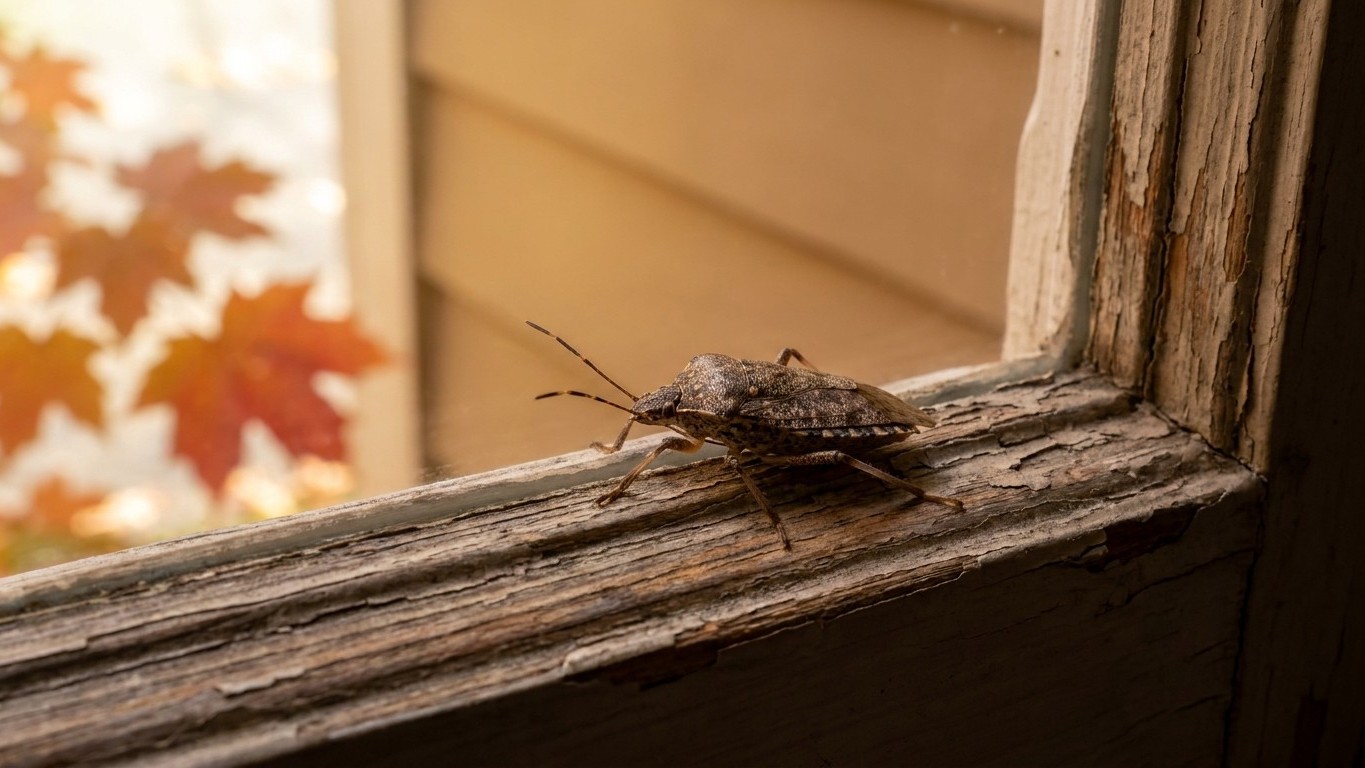

Pennsylvania is ground zero for the brown marmorated stink bug in the United States. This shield-shaped insect first turned up in Allentown in the late 1990s, and nearly three decades later it’s still one of the most common fall invaders in homes across the state. The short answer for anyone dealing with them right now: expect activity to ramp up from September through October as the bugs search for winter shelter, and the best defense is sealing entry points before that migration starts, not after.
Homeowners in Lehigh County have the dubious honor of hosting the species’ first confirmed U.S. population. From there it spread across the eastern half of the country, but Pennsylvania remains one of the states with the heaviest concentrations, alongside Maryland, New Jersey, and Virginia. Penn State Extension has tracked the insect since its arrival and continues to run trapping programs in orchards and field crops statewide.
When Stink Bugs Show Up in Pennsylvania

The brown marmorated stink bug follows a predictable calendar in Pennsylvania, and knowing it makes a real difference for anyone trying to keep bugs out of a house rather than chase them once they’re inside.
Adults emerge from overwintering sites in April or May, once daytime temperatures settle above 60 degrees Fahrenheit. They spend the warmer months feeding on host plants and laying eggs, usually producing one generation per year in Pennsylvania’s climate, sometimes a partial second generation in warmer counties like those in the southeastern corner of the state. Nymphs go through five stages before reaching adulthood, a process that takes roughly six to eight weeks depending on temperature.
Late summer is feeding season. Populations peak in soybean fields, orchards, and backyard gardens from late July into September, which is when growers see the most crop damage. Then, as daylight shortens and nights cool in September and October, adults shift behavior entirely. They stop feeding and start searching for protected spaces to spend the winter, and that search is what brings them to siding, window frames, and attic vents by the thousands.
This fall migration is the reason so many Pennsylvania residents associate the bug with autumn rather than summer. A single sunny wall on the south or west side of a house can attract hundreds of bugs in a single afternoon during peak migration weeks, typically mid-September through mid-October in most of the state.
Winter Behavior Inside Structures
Once inside a wall void, attic, or unused chimney, stink bugs go dormant. They don’t reproduce indoors and they don’t feed, so an infestation won’t grow larger over the winter the way it would with, say, a colony of ants. But dormancy isn’t permanent hibernation. Warm spells in January or February, or a furnace running steadily in a finished attic, can wake bugs up early and send them wandering into living spaces looking for a way back outside. That’s why some households see a second, smaller wave of stink bugs in late winter, well before the spring emergence actually begins outdoors.
Where They’re Most Common Across the State
Distribution isn’t uniform. The southeastern counties, Lehigh, Northampton, Berks, Montgomery, Bucks, and the Philadelphia suburbs, carry the heaviest pressure simply because that’s where the population has had the longest time to establish and spread. Adams and Franklin counties, both major fruit-growing regions, also report significant numbers because orchards provide ideal host plants throughout the growing season.
Central and western Pennsylvania have populations too, but generally at lower density, though that gap has been closing for years as the insect continues its slow push west. Rural areas near wooded edges and agricultural fields tend to see more activity than deep urban cores, since stink bugs rely on a wide range of host plants, including tree of heaven, an invasive tree that happens to be common along Pennsylvania roadsides and disturbed land.
Agricultural impact has been serious enough to justify ongoing research funding. Apple and peach growers in the state have reported crop losses tied directly to stink bug feeding, since the insects pierce fruit skin and leave discolored, pitted flesh underneath that makes produce unsellable at full price. Soybean growers face similar issues, with feeding damage reducing seed quality and yield in heavily infested fields.
Identifying the Brown Marmorated Stink Bug
Not every shield-shaped bug found on a Pennsylvania porch is this particular species. Several native stink bugs look similar, and telling them apart matters if you’re deciding whether an infestation warrants extra sealing work.
- Marbled brown-gray coloring, roughly the size of a thumbnail, about 17 millimeters at full adulthood
- Alternating light and dark bands on the last two antennae segments
- Smooth-edged shoulders, unlike some native species that have small spikes or points
- Lighter banding visible on the outer edge of the abdomen when wings are folded
- A distinctly unpleasant, cilantro-like odor when crushed or disturbed
The smell is often what tips people off before they even get a close look. It’s a defense mechanism, released from glands on the underside of the thorax, and it’s strong enough to linger on hands, clothing, or vacuum cleaner filters for hours.
What Actually Stops Them
Pest control companies in Pennsylvania sell plenty of treatments for stink bugs, but the research consistently points to exclusion as the most effective long-term fix, not pesticide spraying on exterior walls.
Sealing the Entry Points
Stink bugs get inside through gaps most homeowners never think to check: around window and door frames, gaps where siding meets foundation, utility penetrations for cable and gas lines, soffit vents, and chimney caps. Caulking these gaps in August, before the fall migration ramps up, closes the door before the bugs start looking for one. Weatherstripping on exterior doors and repairing torn window screens handles most of the remaining access points. Attic and gable vents deserve mesh screening with holes no larger than 1/16 inch, since standard window screen mesh is often too coarse to stop nymphs and smaller adults.
Handling Bugs Already Inside
Once bugs are indoors, a vacuum with a disposable bag works better than swatting or crushing, since crushing releases the odor and can stain fabric or walls. Emptying the vacuum bag outdoors immediately afterward prevents the smell from lingering in the house. Insecticide sprays applied directly to overwintering bugs inside wall voids are generally discouraged, because dead bugs trapped inside walls can attract secondary pests like carpet beetles, and the chemical treatment does nothing to stop next year’s migration if the entry points stay open.
Light traps and pheromone traps, some developed through USDA-funded research specifically targeting this species, offer another option for reducing numbers around a structure’s perimeter. These traps use an aggregation pheromone that draws bugs toward a collection container rather than toward the house itself, and they’ve become a common tool for both homeowners and commercial growers in the state.
Exterior Perimeter Treatments
Professional pest control companies sometimes apply residual insecticide to exterior walls, foundations, and eaves in late summer, timed to intercept bugs before they find a way inside. This approach has mixed results and typically needs reapplication, since sunlight and rain break down most residual products within a few weeks. It works best as a supplement to sealing gaps, not a replacement for it.
Why This Matters for Pennsylvania Specifically
The state’s mix of dense suburban development next to active farmland creates ideal conditions for large population swings. Suburban houses built near orchards, soybean fields, or wooded edges act as natural landing spots when insects leave crop fields at the end of the season, which explains why some neighborhoods see dramatically heavier stink bug pressure than others just a few miles away.
Penn State’s ongoing monitoring network, which places pheromone traps across dozens of counties, has shown population numbers fluctuating year to year based on winter severity. Colder winters with extended deep freezes reduce overwintering survival rates, while mild winters let more adults make it through to spring, which in turn affects how heavy the following fall’s home invasion turns out to be. Anyone tracking whether this year will be a “bad stink bug year” in Pennsylvania can look at how the previous winter played out as a rough predictor, though it’s far from an exact science given how many other factors, including local host plant availability, shape the numbers.
Related guides
- Brown marmorated stink bug in Maryland: When It Shows Up and What Stops It
- Brown marmorated stink bug in Quebec: When It Shows Up and What Stops It
- Brown marmorated stink bug in Saskatchewan: When It Shows Up and What Stops It
- Brown marmorated stink bug in Indiana: When It Shows Up and What Stops It
- Brown marmorated stink bug in Illinois: When It Shows Up and What Stops It