
Pennsylvania’s long, muggy stretch between May and September is what turns a manageable pest into a real one: the season runs warm and wet enough for flea beetles, aphids, and squash vine borer populations to squeeze in extra generations before frost ever shows up. That’s the mechanism behind every timing note that follows — miss the first wave in June and you’re not fighting one generation in August, you’re fighting three. Ten insects account for nearly every call Pennsylvania gardeners make, and recognizing them early is the whole game.
What Pennsylvania gardens actually deal with

Pennsylvania’s home gardens deal with a defined set of insects that Penn State Extension flags as the ones worth learning to recognize on sight: brown marmorated stink bug, Spotted lanternfly in Pennsylvania, Tomato hornworm in Pennsylvania and tobacco hornworm, aphids, Japanese beetle in Pennsylvania, Colorado potato beetle in Pennsylvania, flea beetles, squash vine borer, cabbage worms and leafminers, and onion thrips along with Onion maggot in Pennsylvania. Gardeners just across the border deal with an overlapping but not identical list, as covered in Garden Pests in Rhode Island: What Shows Up, When, and How to Stop It. A long, humid growing season lets several of these run more than one generation before frost, which is why a light problem in June can be a real one by August. Catching the first generation matters more than any single treatment applied later in the season.
Flea beetles

Flea beetles in Pennsylvania are tiny, shiny black or bronze beetles about 1/16 to 1/8 inch long that jump like fleas when disturbed. They chew small round or irregular holes in the leaves of eggplant, potato and brassica seedlings, sometimes reducing young leaves to lace before the plant even gets going. Row cover over transplants stops most of the damage.
Aphids

Aphids in Pennsylvania are soft, pear-shaped insects about 1/16 inch long, found in green, yellow, black or pink forms, clustered in groups on the undersides of leaves and new shoot tips.” loading=”lazy” />
Aphids are soft, pear-shaped insects barely 1/16 inch long, green, yellow, black or pink depending on species, and they cluster on the undersides of leaves and new growth. Heavy feeding curls and yellows leaves and leaves behind a sticky honeydew that draws ants and grows sooty mold. A strong water spray or insecticidal soap knocks populations down without harming the ladybugs and lacewings that eat them.
Colorado potato beetle

Colorado potato beetle adults are about 3/8 inch long, yellow-orange with ten black stripes running down the wing covers, and the reddish-orange, black-spotted larvae do the real damage, stripping potato and eggplant foliage to bare stems. The insect causes far more trouble in Pennsylvania gardens than in its namesake state; see Garden Pests in Colorado: What Shows Up, When, and How to Stop It for how pressure differs out west. Hand-picking adults and larvae early in the season, before numbers build, is the most reliable home-garden control.
Onion thrips and onion maggot
Onion thrips are pale yellow to light brown, slender insects barely 1/16 inch long that rasp at leaf surfaces, leaving silvery streaks and papery patches. Onion maggot is the legless white larva of a small gray fly, and it tunnels into bulbs and causes rot from the inside out. Crop rotation and floating row cover over young onion sets address both.
Cabbage worms and leafminers

Cabbage worms are pale green, velvety caterpillars up to an inch long that blend into cabbage and broccoli leaves while chewing ragged holes through them. Leafminer larvae are pale, legless maggots that tunnel inside leaf tissue, leaving squiggly white trails visible from outside without any actual hole. Bt (Bacillus thuringiensis) controls the caterpillars, while leafminers mostly need row cover to keep the adult flies off in the first place.
Squash vine borer

The adult squash vine borer looks more like a wasp than a moth, with an orange and black body and clear wings, and it flies by day rather than at night. Its larva is a white to cream caterpillar with a brown head that tunnels inside squash and pumpkin stems, causing sudden wilting of otherwise healthy-looking vines. Slitting the stem to remove the larva, or wrapping the base of young plants before egg-laying starts, can save an infested plant.
Japanese beetle
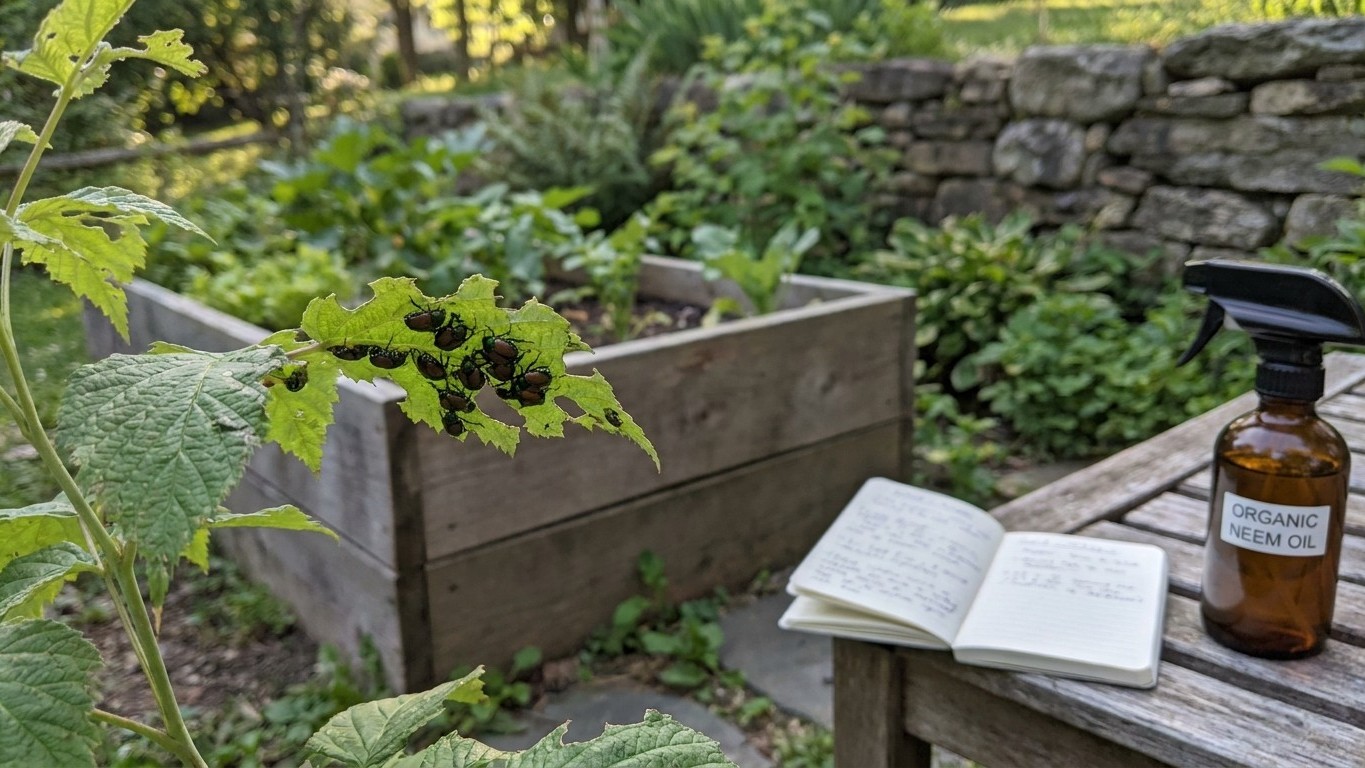
Japanese beetles are about 1/2 inch long with a metallic green head and thorax and copper-bronze wing covers, with small tufts of white hair along the sides of the abdomen. Adults feed in groups, skeletonizing leaves between the veins on roses, beans and grapevines. Hand-picking into soapy water in the morning, when beetles are sluggish, works better than most sprays.
Brown marmorated stink bug
Brown marmorated stink bug is a shield-shaped insect about 5/8 inch long, mottled gray-brown, with alternating light and dark bands on the antennae and around the edge of the abdomen. It pierces fruit and vegetables to feed, leaving discolored, corky patches under the skin on tomatoes and peppers. It is hard to kill in numbers, so exclusion with row cover on ripening fruit matters more than any spray.
Tomato and tobacco hornworm
Hornworms are large green caterpillars, up to four inches long, with pale diagonal stripes down each side and a curved horn at the rear end. They strip whole branches of leaves and can chew into green fruit, and PSU Extension notes damage on tomatoes runs from July through early September near Philadelphia. Hand-picking works well because they are large and easy to spot once you know to check for missing foliage and dark droppings on the leaves below.
Spotted lanternfly
Spotted lanternfly adults are about an inch long with gray forewings covered in black spots and red underwings marked with black and white that show only in flight. Young nymphs are black with white spots, turning red with black and white markings as they mature. They feed on plant sap through a needle-like mouthpart, weakening vines and trees and leaving behind sticky honeydew. Scraping egg masses off bark in fall and winter, and reporting sightings to PSU Extension, helps track its spread.
Telling damage apart

Not every damaged leaf means a pest problem, and treating the wrong cause wastes both money and time. Start by looking at the pattern of the damage instead of just the fact of it.
- Ragged holes and chewed leaf edges: chewing insects like Japanese beetles, cabbage worms or hornworms feeding directly on the tissue.
- Fine white or yellow stippling across a leaf, without holes: something sucking sap from the surface rather than chewing it.
- Squiggly white tunnels inside a leaf, with no opening: leafminer damage, since the insect never touches the leaf surface at all.
- Sudden wilting of a whole vine or stem that still looks green: often squash vine borer working inside the stem.
- Sticky, shiny residue on leaves, often followed by black sooty mold: honeydew from aphids or stink bugs, not a fungal disease on its own.
Insect versus disease versus watering fault
Wilting that does not recover overnight after a good soak is rarely a watering problem. Disease usually shows up as spots, rings or blotches with defined edges, sometimes with a yellow halo, and it spreads leaf to leaf rather than concentrating where an insect has been feeding. Wilting from underwatering droops the whole plant evenly and bounces back within hours of watering, while wilting from squash vine borer or a stem disease does not recover no matter how much water goes on. Yellowing that starts at the bottom of the plant and moves upward, with no holes or stippling anywhere, is more often a nutrient or watering issue than a pest one, and checking the roots and stem base before reaching for a spray saves a lot of wasted treatments.
When each one shows up
Pest arrival in Pennsylvania tracks plant growth stages and soil warmth more closely than the calendar, but a rough rhythm holds across most of the state.
Early in the season, as soon as seedlings and transplants go in, flea beetles and aphids are usually the first to show up, since both are quick to find tender new growth. Cabbage worms and onion maggot follow shortly after, tracking the brassica and onion transplants they depend on. Colorado potato beetle adults emerge from the soil around the same time potato and eggplant foliage fills in, and their egg masses hatch into the destructive larvae within a couple of weeks.
Midsummer through fall
By early to midsummer, as vines run and fruit sets, squash vine borer moths are laying eggs at the base of squash and pumpkin stems, and Japanese beetle adults start showing up on roses, beans and grapevines. Onion thrips build through the same stretch as bulbs size up. Hornworm damage on tomatoes runs from July through early September near Philadelphia, according to Penn State Extension, and gardeners elsewhere in the state should expect a similar midsummer-through-early-fall window, shifted a little earlier or later with local temperatures. Brown marmorated stink bug pressure tends to build steadily through summer and peaks as fruit ripens, since the insects are drawn to the sugars developing in tomatoes and peppers.
Fall webworm appears in late summer into early fall, per PSU Extension, spinning silk nests at branch tips on ornamental and fruit trees. Spotted lanternfly nymphs are active from spring through early summer, with adults appearing by midsummer and remaining a problem into fall as they lay egg masses on bark, fences and outdoor furniture ahead of winter. Checking plants weekly through the growing season, rather than waiting for obvious damage, catches most of these while populations are still small enough to manage by hand.
What actually works
Prevention beats intervention for nearly every pest on this list, and it is also the cheaper option over a full season.
Prevention
Rotate crops so the same family, tomatoes and their relatives, the squash family, or brassicas, does not land in the same bed as last year, since that disrupts the overwintering of Colorado potato beetle, onion maggot and squash vine borer near the plants they need. Fine mesh row cover only works if it goes on at transplant, before the pest finds the bed, and it needs to come off in time for pollination on crops like squash that need bees to get in. Timing transplants a little later, once soil has warmed, can let seedlings get past their most vulnerable stage before flea beetle and cabbage worm pressure peaks. Encouraging predators pays off over a season rather than overnight: ladybugs, lacewings and parasitic wasps handle aphids and small caterpillars if the garden has flowering plants nearby to support them and isn’t sprayed with broad-spectrum insecticides that kill the predators along with the pests.
Targeted intervention
For targeted intervention once pests are found, hand-picking works well for anything large enough to see and slow enough to catch: Japanese beetles, Colorado potato beetle adults and larvae, and hornworms. Bt (Bacillus thuringiensis) controls caterpillar pests like cabbage worms and hornworms without harming bees or beneficial insects, because it only affects insects that ingest it. Insecticidal soap and horticultural oil work on soft-bodied aphids and thrips but need direct contact and repeat applications, since neither has any residual effect once it dries.
Home remedies like garlic spray, dish soap mixtures and companion planting with marigolds have little evidence behind them for pests like stink bugs, lanternfly or squash vine borer, and relying on them while an infestation builds costs more time than it saves. Pheromone traps marketed for Japanese beetles are also worth skipping in a home garden, since the lure draws in more beetles from neighboring properties than it actually catches.
What control costs
Cost is not just the price of a product. It is also how many times a method has to be repeated before frost, and how much of that repetition falls on the gardener.
| Method | Cost | Time per use | Repeat needed |
|---|---|---|---|
| Hand-picking | None beyond a bucket of soapy water | A few minutes daily during peak activity | Daily to weekly through the season |
| Row cover and barriers | One-time material cost, reusable for several seasons | Minutes to install at transplant, then hands-off | Reapply only if torn, remove for pollination |
| Biological controls (Bt, beneficial insects) | Low to moderate, occasional product reapplication | A few minutes per application | Every 7 to 10 days or after rain |
| Sprays (soap, oil, broader insecticides) | Moderate, repeat purchases add up over a season | Minutes per application plus mixing | Every 5 to 10 days, more with heavy rain |
Hand-picking and row cover cost the least over a full season, since neither needs repurchasing once you own the cover, and both avoid harming the ladybugs and lacewings that keep aphid numbers down for free. Sprays are the most expensive option once repeat purchases are counted, not because any single bottle costs much, but because most need reapplying every week or two, and broad-spectrum products can wipe out the predators that would otherwise keep the next generation in check. Biological controls like Bt sit in the middle: the product is inexpensive, but timing each application to catch young caterpillars, before they grow too large to control, takes more attention than either hand-picking or a barrier left in place.
Local help
Penn State Extension is the best first call for identifying an unfamiliar pest or confirming which generation you are looking at, and its offices track regional outbreaks like spotted lanternfly spread county by county. Send a clear photo or a sample through your county extension office before treating anything you can’t confidently name, since misidentifying a beneficial insect as a pest is one of the more common ways sprays get used where they shouldn’t. For other Pennsylvania-specific basics like frost dates and soil testing, our Pennsylvania guides cover the rest of the season.
A Closer Look at Pennsylvania’s Most Persistent Pest
If you garden anywhere in Pennsylvania, chances are you’ve already met this one, even if you didn’t know its name. The state has the dubious honor of being where this insect first established itself in the country, and it hasn’t loosened its grip since. For the full rundown on the brown marmorated stink bug, including when it first showed up near Allentown back in the late 1990s and why it’s remained one of the most common headaches for gardeners nearly thirty years later, that page walks through the timing of its appearances through the season and the specific steps that actually keep it off your plants. It’s worth reading closely if you’ve noticed shield-shaped bugs clustering on your siding in fall or turning up on tomatoes and peppers in summer, since this pest isn’t going anywhere and understanding its pattern is most of the battle. Start there before moving on to the rest of what’s covered on this hub.
Common questions
Do I need to spray for stink bugs every year?
Not automatically. Brown marmorated stink bug numbers swing a lot from year to year, and a light year doesn’t call for the same response as a heavy one. Check ripening fruit for corky, discolored patches before deciding whether exclusion with row cover is worth the effort this season.
Are ladybugs actually eating my aphids, or is that a myth?
They really are, and so are their larvae, which look nothing like the adult beetle: small, dark, alligator-shaped grubs often mistaken for a pest themselves. A garden with a visible ladybug population usually needs less aphid intervention than one without, so it’s worth learning to recognize the larval stage before treating it as a threat.
My tomato fruit has sunken, discolored patches but the leaves look fine. What’s going on?
That pattern points to stink bug feeding rather than a leaf disease, since the insects pierce ripening fruit directly without touching much foliage. Blossom end rot looks similar but forms at the blossom end of the fruit and relates to calcium uptake and watering, not insect feeding, so check exactly where on the fruit the damage sits before treating either one.
I already see flea beetle holes on my seedlings. Is it too late to save them?
Usually not. Seedlings often outgrow light flea beetle damage once they have a few true leaves, especially if row cover goes on now to stop further feeding. Replace a seedling only if the growing tip itself is destroyed rather than just the outer leaves.