
Squash vine borer moths start flying in Kentucky gardens in late June, with egg-laying activity running heaviest through mid-July and continuing into August in warmer parts of the state. There’s no cure once a larva is tunneling inside a stem, so the real fight happens before that: row covers pulled early, weekly stem checks, and fast action the moment you spot the telltale sawdust-like frass at the base of a plant.
This pest hits zucchini, yellow summer squash, and pumpkins the hardest across Kentucky gardens, from the Bluegrass region to the western Purchase counties. Understanding its schedule and its weak points is what separates a squash patch that limps to harvest from one that collapses in a week.
What Squash Vine Borer Looks Like and What It Actually Does

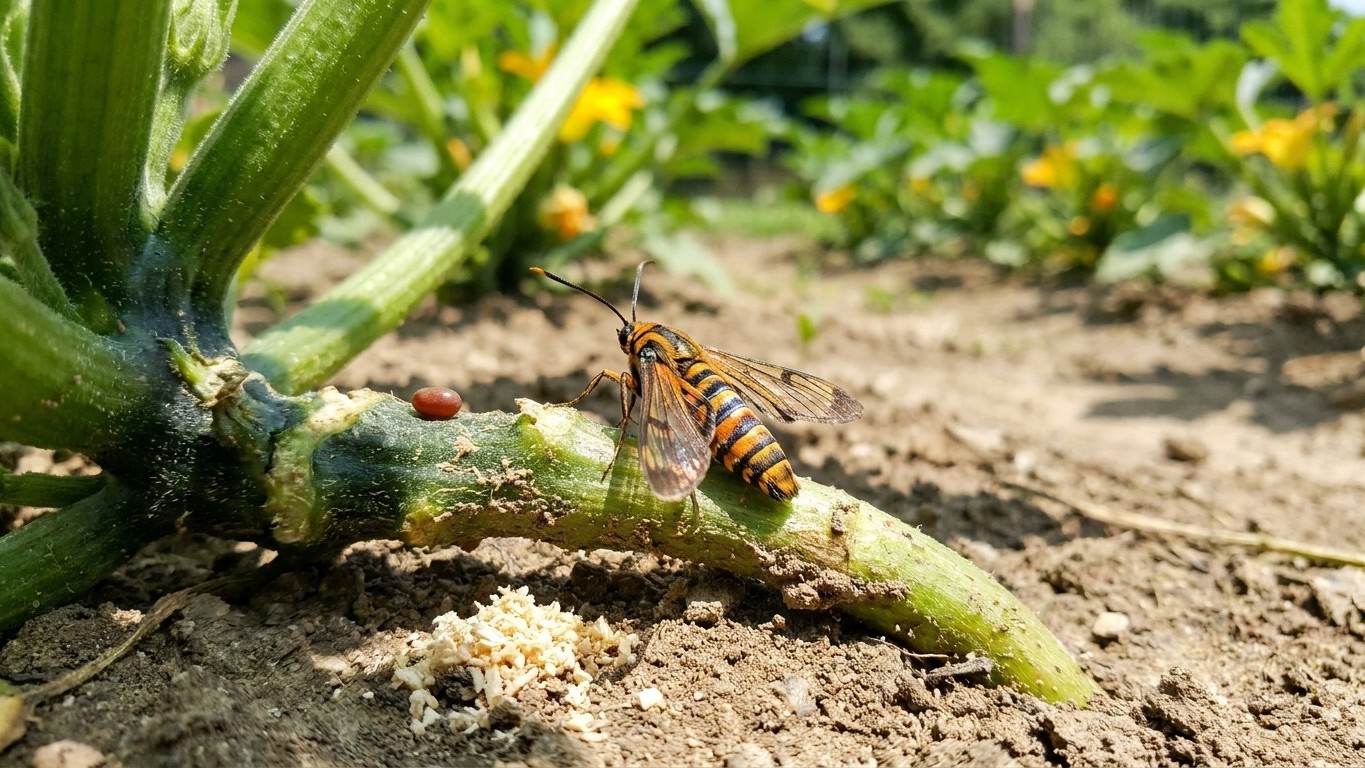
The adult is a moth, but it doesn’t look like one. It flies during the day, has a wingspan close to an inch and a half, and sports an orange-and-black abdomen that makes gardeners mistake it for a wasp. That daytime activity is worth remembering, because most people scanning their garden at dusk for pests never see the actual culprit doing its damage.
Females lay small, reddish-brown eggs individually at the base of squash stems, right where the plant meets the soil. Within a week to ten days, tiny white larvae with brown heads hatch and immediately bore into the stem. From that point on, they’re feeding inside the plant’s vascular tissue, out of sight and largely out of reach.
The first sign most gardeners notice isn’t the moth or the egg. It’s a vine that looked perfectly healthy on Tuesday and is wilting badly by Thursday, even though the soil is moist. Pull back the leaves near the base and you’ll usually find a wet, yellowish, sawdust-textured frass pushed out through a small entry hole in the stem. That frass is the giveaway. Cut the stem open lengthwise near that spot and you’ll likely find one or more cream-colored larvae, sometimes over an inch long by the time they’re done feeding.
Left alone, a single larva can hollow out enough of a main stem to cut off water and nutrient flow to the entire plant. Heavily infested vines often collapse entirely within two to three weeks of the first wilting symptoms.
When Squash Vine Borer Shows Up in Kentucky
Squash vine borer overwinters as a larva or pupa inside a tough silken cocoon buried one to two inches deep in the soil, usually right where an infested vine grew the year before. It doesn’t migrate in from somewhere else each spring. It’s already there, waiting on the right soil temperature to trigger emergence.
Entomologists track this insect using a degree-day model rather than a fixed calendar date, because a warm spring pushes emergence earlier and a cool, wet one delays it. Adult moths typically begin emerging once accumulated degree days (base 50°F, starting around March 1) reach roughly the 1,000 to 1,200 range. In practical terms for most of Kentucky, that translates to adult moths taking flight sometime in the back half of June, with numbers building through the first three weeks of July.
Western Kentucky counties along the Mississippi and lower Ohio River tend to warm up faster in spring, so gardeners there often see moth activity start a week or so ahead of central and eastern Kentucky. In a mild year, some gardeners in the western part of the state have reported borer damage by late June. In the hills of eastern Kentucky, where spring soil warms more slowly, late June to early July is a more typical start.
Kentucky generally sees one full generation per growing season, but partial second-generation activity isn’t rare in warmer years, especially in the western part of the state. That means egg-laying doesn’t necessarily stop after the first wave in July. Gardeners who let their guard down in August because they think the danger has passed sometimes get a second, smaller round of infestations right when their fall squash and pumpkins are sizing up.
What Actually Stops It
Once a larva is inside the stem, insecticides sprayed on leaves do nothing. The larva is feeding on internal tissue, protected from any topical treatment. That single fact drives almost every effective control strategy for this pest: everything worth doing has to happen before the egg hatches, or has to physically get to the larva inside the stem.
Exclusion and Timing
Lightweight floating row covers, installed right after planting or transplanting and sealed at the edges with soil or stakes, keep egg-laying moths off young plants entirely. The catch is that squash needs pollinators to set fruit, so covers have to come off once flowers appear. That creates a window most gardeners in Kentucky use deliberately: cover the plants through the first three to four weeks of growth, then remove the cover right as flowering starts, timed to land after the earliest wave of moth emergence has passed if possible.
Staggered planting helps too. A second or third sowing of summer squash two to three weeks apart means that even if the first planting takes a hit, later plantings can still produce a harvest, and they may dodge the peak of moth activity altogether.
Weekly Stem Inspection
Starting in late June and continuing into August, running a hand along the base of each vine once a week catches eggs before they hatch. The eggs are tiny and easy to miss, but a strip of clear tape pressed over a suspected egg and removed will pull it off the stem without damaging the plant. Any frass spotted early, before wilting sets in, is worth investigating with a sharp knife. Slitting the stem lengthwise near the entry point, removing the larva, and then mounding moist soil over the wounded section often lets the plant recover and keep producing.
Targeted Insecticide Applications
For gardeners who want a chemical option, the timing has to match the moth’s egg-laying window, not the appearance of damage. Applications aimed at the base of stems, timed weekly from the point adults are first spotted through the peak of egg-laying activity, can prevent larvae from ever getting established. Spraying leaves or fruit does little good against this particular pest, since the vulnerable target is the stem base, not the foliage.
Resistant and Tolerant Varieties
Not all squash are equally attractive to this insect. Varieties with thick, solid stems, like butternut, cushaw, and tromboncino, resist larval establishment far better than hollow-stemmed zucchini and yellow summer squash. Gardeners in Kentucky who’ve struggled year after year with borer losses in their zucchini often find that switching a portion of the garden to butternut or cushaw cuts losses dramatically without giving up squash altogether.
Vine Burying as Insurance
Squash vines root at nodes along their length wherever they touch soil. Mounding soil over several nodes as the vine grows encourages secondary root systems to develop. If the main stem base does get bored through and collapses, a plant with established secondary roots further down the vine can often keep growing and producing, essentially working around the damage.
Fall Cleanup Matters More Than Most Gardeners Realize
Since the insect overwinters in the soil right where infested vines grew, removing and destroying squash vines at the end of the season, rather than leaving them to break down in place, reduces the population of cocoons available to emerge the following June. Tilling the soil in fall or early spring to a depth of a few inches can also expose and disrupt overwintering cocoons, though it won’t eliminate them entirely since some sit below typical tillage depth.
Crop rotation offers less protection against this particular pest than it does against many others, since adult moths are strong fliers capable of covering a good distance to find host plants in a new location. That’s a detail worth knowing before assuming a simple bed swap next season will solve a recurring squash vine borer problem on its own.
Related guides
- Squash vine borer in Indiana: When It Shows Up and What Stops It
- Squash vine borer in Ohio: When It Shows Up and What Stops It
- Squash vine borer in Louisiana: When It Shows Up and What Stops It
- Squash vine borer in Maine: When It Shows Up and What Stops It