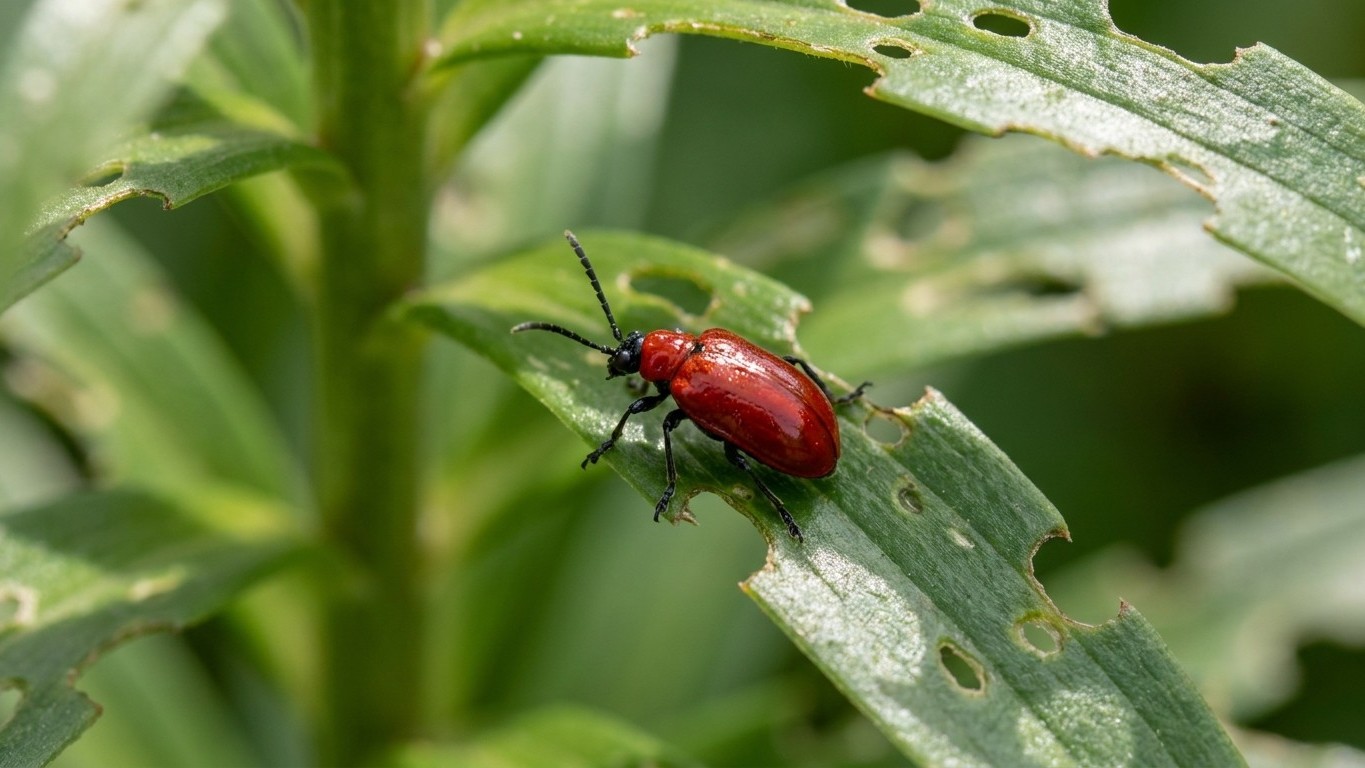

The lily leaf beetle showed up in Prince Edward Island the same way it invades most of Atlantic Canada: quietly, then all at once, chewing through a bed of prized lilies in a single June weekend. Adults emerge as soon as the soil warms in spring, typically from late April through May depending on the year, and they stick around into fall. Nothing eliminates the beetle completely on the Island right now, but a combination of hand removal, targeted sprays, and an imported parasitic wasp keeps populations low enough that lily growers can still get a decent bloom.
If you garden anywhere from Charlottetown to Summerside to the North Shore, this insect is worth learning to recognize early. Waiting until the leaves look shredded means you’re already behind.
What the Lily Leaf Beetle Looks Like and Why It Matters in PEI Gardens

Lilioceris lilii is small, about a quarter inch long, with a glossy scarlet-red back and a jet-black head, legs, and antennae. It’s easy to spot against green foliage, which is almost funny given how much damage it manages to do before most gardeners notice. The color isn’t camouflage. It’s a warning, and the beetle doesn’t seem to worry much about predators eating it.
The insect targets true lilies, meaning Lilium species like Asiatic, Oriental, and Turk’s cap lilies, along with fritillaria. Daylilies (Hemerocallis) aren’t true lilies botanically, and the beetle mostly leaves them alone. That distinction matters a lot for PEI gardeners deciding what to plant, since daylilies tolerate the Island’s clay-heavy soil and short season just as well and rarely get touched by this pest.
Both adults and larvae feed on leaves, buds, and flowers. Left unchecked over a season, a heavy infestation can strip a lily clump down to bare stems, which weakens the bulb going into winter. A plant that gets defoliated two years running often fails to come back at all.
The PEI Timeline: When to Expect Beetles, Eggs, and Larvae
PEI’s growing season runs cooler and later than southern New England or Ontario’s Golden Horseshoe, and the beetle’s schedule shifts accordingly. Adults overwinter in leaf litter, garden debris, and the top layers of soil, often tucked near where lilies grew the previous summer. They don’t need much depth to survive an Island winter; a couple inches of loose mulch or old mums foliage does the job.
Spring Emergence (Late April to Late May)
Once daytime temperatures push consistently past the low 50s Fahrenheit, adults crawl out and head straight for emerging lily shoots. This is the single best window to catch the problem before it multiplies. A beetle you squash in early May is a beetle that never lays eggs.
Egg-Laying and Larval Feeding (Late May Through July)
Females lay eggs in irregular rows on the undersides of leaves, small and orange-red, easy to miss unless you flip leaves over on purpose. Eggs hatch within a week or two, and the larvae that emerge are genuinely unpleasant to handle: they cover themselves in their own excrement as a defense against predators, forming a slimy black coating over an otherwise soft orange body. This habit is disgusting but functional. Birds and other predators tend to leave the larvae alone once they’re covered.
Larvae feed heavily for two to three weeks, then drop into the soil to pupate. This is usually the period of worst visible damage, since larvae eat more per body weight than adults and often skeletonize entire leaves.
New Adults and Fall Preparation (Late July Through October)
A new generation of adults emerges in midsummer, feeds for several more weeks, and then seeks overwintering sites as temperatures drop in September and October. In most PEI seasons this produces one full generation per year. Longer, warmer stretches can occasionally push a partial second generation, though it’s less common at this latitude than farther south.
What Actually Stops the Lily Leaf Beetle
No single method wipes out the beetle. What works is layering a few approaches across the season, starting the moment shoots poke through the soil.
Hand-Picking, Still the Most Reliable Tool
Adult beetles have one useful weakness: when disturbed, they drop straight to the ground and play dead rather than fly away. Holding a container of soapy water under the plant and gently shaking the stem knocks beetles right in, where they drown quickly. Early morning works best, since cooler temperatures make the beetles sluggish and less likely to bolt.
Larvae get removed the same way, though most gardeners wear gloves given the frass coating. Checking leaf undersides weekly through late May and June catches egg masses before they hatch; scraping them off with a fingernail into soapy water takes seconds and prevents an entire generation from developing.
Organic Sprays for Larvae
Neem oil products containing azadirachtin disrupt larval feeding and molting, and they work reasonably well against the softer-bodied larval stage. They’re far less effective against hardened adults, so timing matters: spray during the larval window in June rather than trying to hit adults in spring. Spinosad-based products offer another organic option with similar timing requirements. Both need reapplication after rain and work best as part of a rotation rather than a single fix.
A Parasitic Wasp Doing Quiet Work
Researchers in the northeastern United States and eastern Canada have released two European parasitoid wasps, Tetrastichus setifer and Lemophagus errabundus, as biological control agents against the lily leaf beetle. These wasps lay their own eggs inside beetle larvae or pupae, and over time they’ve established populations in parts of New England and the Maritimes, gradually suppressing beetle numbers in areas where they’ve taken hold. It’s a slow process measured in years, not one growing season, and coverage across PEI specifically remains uneven. Where the wasps are established, though, gardeners report noticeably less larval damage than in the years right after the beetle first arrived.
Garden Sanitation That Actually Helps
Clearing dead lily foliage and nearby leaf litter in fall removes some of the overwintering habitat adults rely on. It won’t eliminate the local population since beetles also overwinter in soil away from the immediate garden bed, but it does reduce the head start they get each spring. Avoiding thick mulch piled directly against lily stems removes another convenient hiding spot.
Protecting Lilies Season After Season
Consistency beats intensity with this pest. A gardener who checks lily leaves for ten minutes every week from late April through July will do more good than someone who sprays once and walks away. The beetle’s habit of dropping and playing dead actually works in the gardener’s favor once you know the trick, and larvae hiding under their own waste are still easy to spot once you know what to look for.
Planting choices matter too. Gardeners who’ve lost patience with repeated defoliation sometimes shift toward daylilies or other perennials the beetle ignores, while keeping a smaller, closely monitored patch of true lilies where hand removal is manageable. That trade-off, fewer true lilies in exchange for less weekly maintenance, is a reasonable compromise for anyone tired of losing blooms to a beetle that, for now, still calls Prince Edward Island home.
Related guides
- Lily leaf beetle in New Brunswick: When It Shows Up and What Stops It
- Lily leaf beetle in Nova Scotia: When It Shows Up and What Stops It
- Lily leaf beetle in Quebec: When It Shows Up and What Stops It
- Lily leaf beetle in Rhode Island: When It Shows Up and What Stops It
- Seedcorn maggot in Prince Edward Island
- Winter moth in Prince Edward Island
- Striped cucumber beetle in Prince Edward Island
- Lily leaf beetle in Maine: When It Shows Up and What Stops It