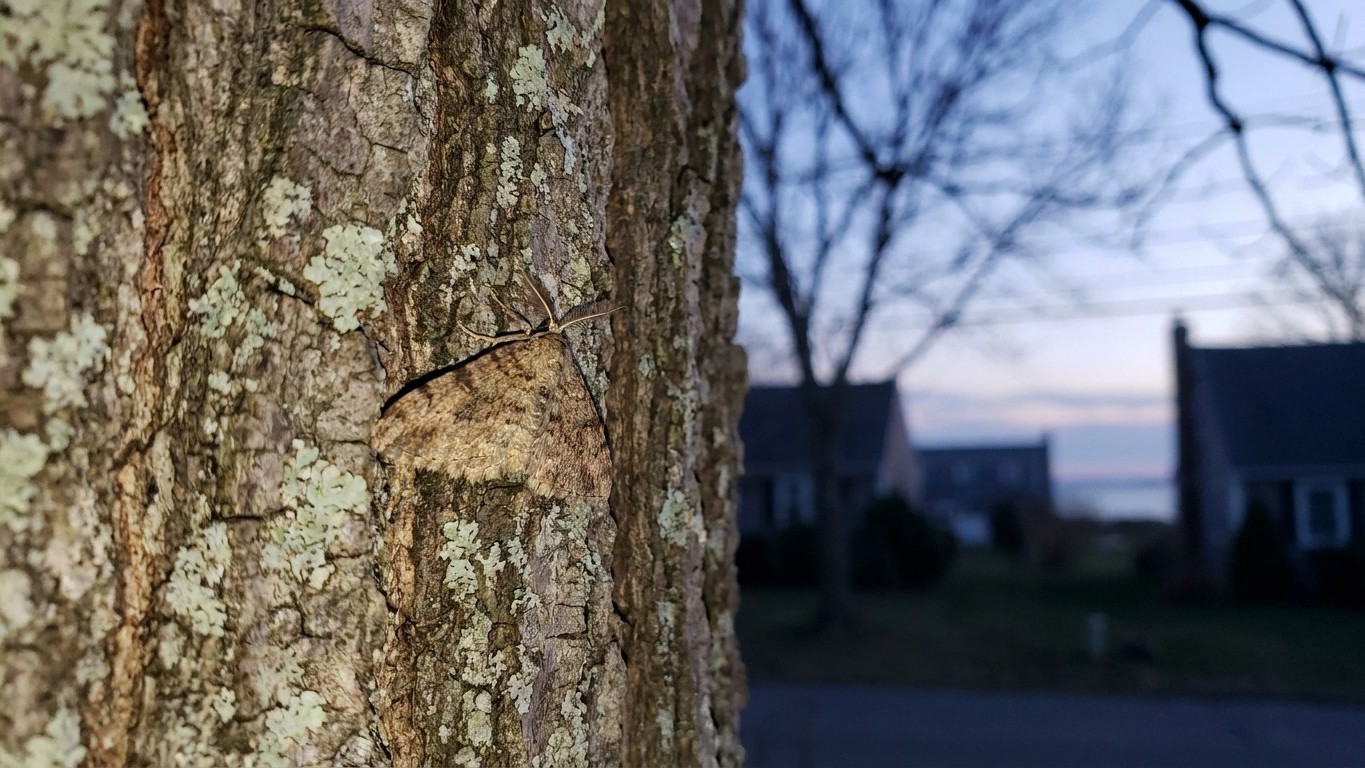

Winter moth caterpillars start feeding on Rhode Island trees the moment buds break in April, but the adult moths that lay the eggs for that damage show up months earlier, flying on the first mild nights of late November through December. If you’ve noticed small tan-and-brown moths fluttering around porch lights or car headlights on a cold coastal evening, that’s your window to act before the real trouble starts in spring.
Rhode Island has dealt with this pest since the early 2000s, when it spread down from Massachusetts along the coastline. The state’s mild, humid winters and abundance of maple, oak, and fruit trees make it a comfortable place for Operophtera brumata to settle in, particularly in Washington and Newport counties where the ocean keeps temperatures a few degrees warmer than inland.
The Winter Moth Timeline in Rhode Island

Unlike most moths, this species runs on a backward schedule. Adults emerge from the soil as temperatures dip toward freezing, not as they warm up. In Rhode Island, that typically means late November through the third week of December, with a few stragglers into January during a mild stretch.
Only the males fly. Females are wingless, essentially useless stubs that can’t lift them off the ground, so they crawl up the nearest tree trunk and release a pheromone that draws males in for mating. After that, each female lays several hundred eggs in bark crevices and under lichen, then dies within days. The eggs sit through winter, tough enough to survive a hard freeze, and start hatching right around the time buds swell on maples and fruit trees, usually mid-April in southern Rhode Island.
Newly hatched caterpillars are pale green with a faint white stripe down each side, barely the width of a thread. They crawl into unopened buds and feed from the inside before the leaves have even unfurled, which is why a tree can look chewed to pieces within days of leafing out. Feeding continues through May, then the caterpillars drop to the ground on silk threads, burrow a few inches into the soil, and pupate through summer. By November, the cycle starts over.
What the Damage Actually Looks Like
Homeowners in South County and along the East Bay often describe the same scene: a healthy-looking oak or maple in early April turns ragged and full of small holes by month’s end, with skeletonized leaves hanging on thin threads of tissue. Sugar maple, red maple, oak, ash, and apple trees take the heaviest hits, along with blueberry bushes and roses in home gardens.
A tree that gets defoliated once usually pushes out a second flush of leaves and survives fine. The real problem shows up after two or three consecutive years of heavy feeding, when the tree’s energy reserves run low and it becomes vulnerable to drought stress, secondary insects, and disease. Fruit growers see a different kind of loss: caterpillars tunnel directly into apple and blueberry buds, which can wipe out a season’s crop even without killing the plant.
One detail that surprises people: winter moth caterpillars are often confused with the native fall cankerworm or spring cankerworm, which cause similar bud damage around the same time. The distinguishing feature is movement. Winter moth caterpillars are loopers with only two pairs of prolegs, so they arch their back into a loop as they crawl, similar to an inchworm. If you’re seeing that looping motion on a defoliated maple in mid-April, winter moth is the likely culprit.
Where It’s Worst in Rhode Island
Coastal towns bear the brunt of it. Newport, Narragansett, Warwick, and the Bristol/Barrington area report the heaviest populations, largely because the moderating effect of Narragansett Bay keeps winter temperatures in the range this species prefers. Inland communities in Providence County and northern Rhode Island see lighter pressure, though populations have crept further from the coast over the past decade as the insect establishes itself more broadly.
Urban and suburban settings with mature street trees, especially maples planted along sidewalks, tend to show the most visible damage simply because there’s less canopy diversity to dilute the feeding pressure. A single strip of Norway maples on a residential street can look completely stripped while a mixed woodland a mile away shows barely a mark.
Biological Control: The Parasitic Fly That’s Already Working
The most effective long-term control against winter moth in Rhode Island isn’t a spray at all. It’s a small parasitic fly called Cyzenis albicans, imported from Europe and released across Massachusetts and Rhode Island starting in the mid-2000s through a research program led by entomologists at the University of Massachusetts Amherst. The fly lays eggs on leaves near feeding caterpillars, and its larvae develop inside the winter moth caterpillar, killing it before it can pupate.
Where the fly has established, winter moth populations have dropped by more than 90 percent over a period of several years, mirroring what happened decades earlier in Nova Scotia when the same fly was used to control an outbreak there. Coastal Rhode Island sites, including areas around Newport and South County, have shown measurable population declines as the fly spreads on its own without further releases needed. This is a slow process, typically taking five to ten years to reach full effect in a given area, but it doesn’t require homeowners to do anything, and it doesn’t harm native moth or butterfly species because the fly is specific to winter moth’s close relatives.
For details on the biology and spread of this control program, the University of Massachusetts Amherst Extension maintains research and management information at ag.umass.edu.
What Homeowners Can Actually Do
Timing Matters More Than Product Choice
Because winter moth caterpillars feed inside buds during their earliest, most vulnerable stage, the single most useful thing a homeowner can do is treat before bud break, not after leaves have already been shredded. Once caterpillars have tunneled deep into a bud, most topical treatments can’t reach them.
Dormant oil applications in early spring, before buds swell, smother overwintering eggs on bark and can meaningfully reduce the number of caterpillars that hatch. This works best on smaller ornamental trees and fruit trees where thorough coverage is realistic. On mature shade trees, coverage gets difficult and the payoff shrinks.
Sticky Bands Catch the Flightless Females
Because female winter moths can’t fly, wrapping trunks with a sticky barrier band in late November, before the females start climbing, physically blocks them from reaching the canopy to lay eggs. This is inexpensive, chemical-free, and works well on individual high-value trees like a favorite maple or fruit tree. It won’t help a whole yard full of trees, but for one or two specimens worth protecting, it’s often the best return on effort.
Targeted Sprays for Heavy Infestations
When caterpillars are actively feeding in April and May, products containing Bacillus thuringiensis subspecies kurstaki (commonly sold as Bt) target caterpillars specifically and break down quickly, leaving minimal residue on the tree or surrounding soil. Spinosad-based products offer another option with a similar caterpillar-specific mode of action. Both need to go on while caterpillars are small and still exposed on new foliage, generally within two to three weeks of bud break, because older caterpillars tucked deeper into developing leaves are harder to reach and less affected by the product.
Broad-spectrum insecticides can work but come with a real tradeoff: they also kill the parasitic flies and other natural predators that are doing the long-term work of bringing winter moth populations down across the state. Spraying a tree that’s already showing signs of the biological control program in effect (patchy rather than complete defoliation, fewer moths than neighboring untreated areas) can actually set back the very process that’s fixing the problem for free.
When to Call a Professional
Large shade trees, especially those over 20 feet tall, aren’t practical for homeowner spray equipment to cover thoroughly. A licensed arborist or pest control operator has access to trunk injection systems and elevated spray equipment that reach the upper canopy where most of the feeding happens. This becomes worth the cost after two consecutive years of significant defoliation on a tree you want to keep long-term, since that’s the point where stored energy reserves start running low enough to threaten the tree’s overall health.
Rhode Island’s University of Rhode Island Extension and local Department of Environmental Management offices can also help identify whether a particular property falls within an area where the parasitic fly has already established, which changes the calculus on whether spraying makes sense at all.