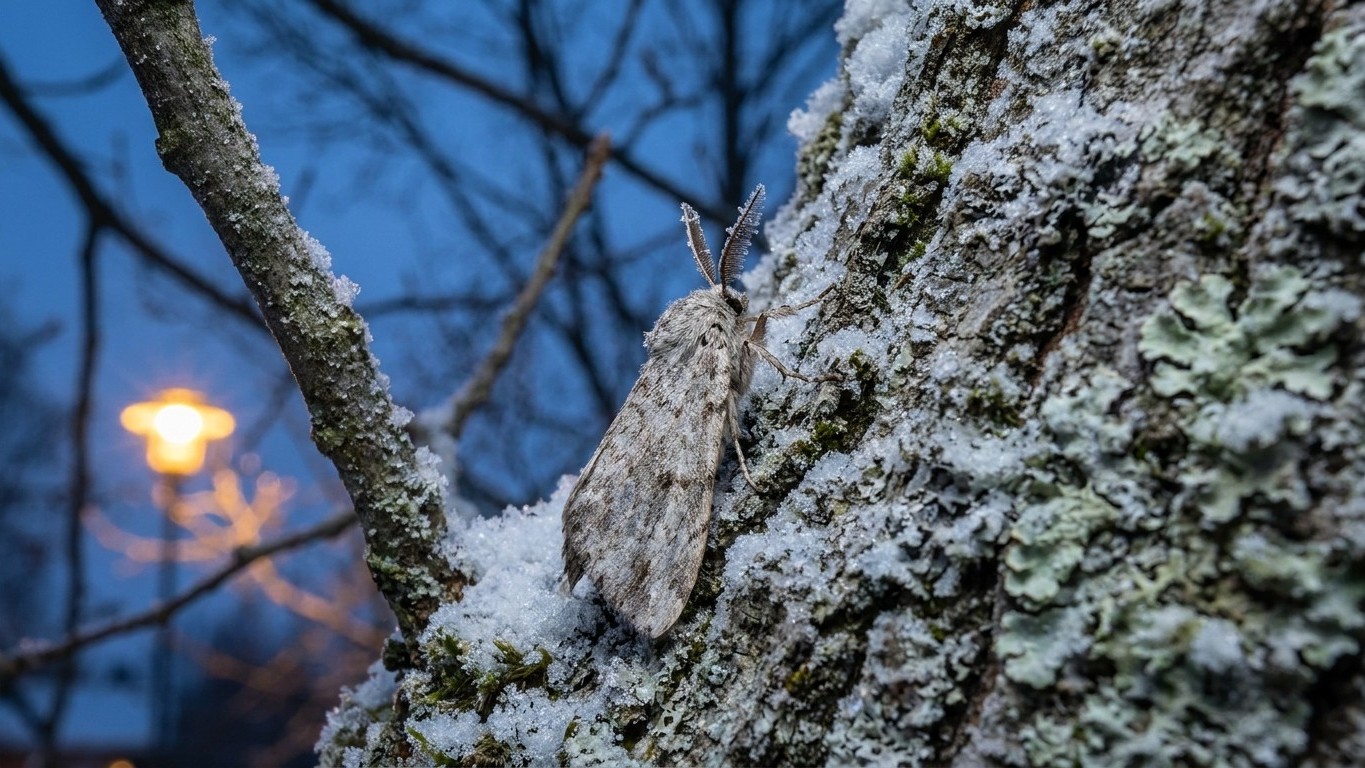

Winter moth caterpillars strip leaves off maples, oaks, and fruit trees across eastern Massachusetts every spring, and the adult moths that lay next year’s eggs fly during the exact weeks you’d least expect an insect to be active: late November through December, often right through a light snow. That timing is why the name fits. Everything else about this pest, from where it concentrates to how homeowners actually stop it, follows from that unusual winter flight.
Winter moth (Operophtera brumata) is not native to New England. It arrived from Europe, likely through Nova Scotia in the 1930s, and reached Massachusetts by the early 2000s. Since then it has become one of the most visible defoliators along the coast, thick enough some springs to make oak canopies look scorched by early June.
The weeks to watch

The adult moths emerge from the soil and mate during a narrow window, usually starting around Thanksgiving and running into late December, sometimes stretching into a mild January if temperatures stay above freezing. Males are the ones you’ll notice fluttering around porch lights and streetlamps on cold nights. Females can’t fly at all. Their wings are reduced to small stubs, so they simply crawl up the nearest tree trunk and wait for a male to find them.
After mating, females lay eggs in bark crevices, under lichen, and in other tight, sheltered spots on the trunk and branches. Those eggs sit through the entire winter, essentially frozen in place, then hatch in early spring, timed almost exactly to bud break on host trees, usually mid-to-late April in most of eastern Massachusetts. The newly hatched caterpillars are tiny and pale green, and they don’t waste time. They crawl into unfolding leaf buds and start feeding before the leaves have even fully expanded, which is part of why damage can look severe so early in the season.
Feeding continues through May and into early June. By then the caterpillars, recognizable as pale green inchworms with a faint white stripe down each side, are close to an inch long. Around early-to-mid June they stop feeding, drop to the ground on silk threads, and burrow into the soil to pupate. They stay underground all summer and into fall, then emerge as adults when the cold returns, completing a one-year cycle that runs backward from how most people expect insect seasons to work.
Where in Massachusetts It Hits Hardest
Winter moth populations are heaviest along the coast, which tracks with how the species first spread. Cape Cod, the Islands, and the South Shore have dealt with some of the worst outbreaks since the early 2000s, with the North Shore and greater Boston area following close behind. Inland communities see lower pressure, generally, though the insect has continued to expand its range westward over the past two decades as milder winters make more of the state hospitable to it.
Coastal exposure isn’t the only factor. Winter moth favors a specific set of host trees, and neighborhoods with a lot of them tend to see repeat, concentrated damage year after year. The preferred menu includes:
- Red and sugar maple
- Oak species, especially red oak
- Crabapple and apple trees
- Cherry and other flowering fruit trees
- Blueberry bushes
Properties with mature maples or oaks close to the house, or anyone growing blueberries or apples, tend to notice the damage first and worst, simply because those are the trees the caterpillars prefer over species like ash or birch.
How to Tell Winter Moth Damage From Something Else
The giveaway is timing combined with the shape of the damage. Winter moth caterpillars create irregular holes and ragged, tattered leaf margins rather than the skeletonized leaves left by beetles like Japanese beetle, which shows up later in summer, in July. Because winter moth caterpillars feed while leaves are still unfurling, badly hit trees can look thin and sparse by late May even though nothing appears to be crawling on them anymore. That’s because by the time the damage becomes obvious, the caterpillars have already dropped and disappeared into the soil.
Heavily defoliated trees, especially oaks that get stripped two or three years running, can suffer real stress. A single bad spring rarely kills a healthy, established tree. Repeated defoliation on top of drought or root stress is a different story, and it’s the combination that arborists in eastern Massachusetts have flagged as a genuine risk to declining oaks over the past fifteen years.
What Actually Stops Winter Moth
Dormant Oil Timing (And Its Limits)
Horticultural oil applied during the dormant season is a standard recommendation for a lot of overwintering insect pests, but it has real limits against winter moth specifically. Because eggs are tucked into bark crevices, under bud scales, and beneath lichen rather than sitting exposed on twigs, oil coverage is inconsistent at best. Some arborists still apply it as one layer of a broader strategy, but it shouldn’t be relied on as a standalone fix.
Bt Sprays at the Right Window
Bacillus thuringiensis var. kurstaki, usually just called Bt, is the most reliable homeowner-accessible treatment, and timing is everything. It has to go on while caterpillars are small, in that late-April-to-mid-May window right after bud break, because Bt only works when caterpillars actually ingest treated leaf tissue. Spraying too early misses the hatch. Spraying past late May, once caterpillars are larger and closer to dropping to pupate, sharply reduces effectiveness. Bt is a bacterial insecticide considered low-risk for bees and other non-target insects when applied correctly, which is part of why it’s the go-to recommendation from University of Massachusetts Extension entomologists for residential trees.
Systemic and Contact Insecticides for Severe Cases
For trees with a documented history of heavy defoliation, particularly mature oaks, licensed arborists sometimes recommend a systemic insecticide applied by soil injection or trunk injection in fall or early spring, timed so the active ingredient is present in the leaf tissue by the time caterpillars hatch. This isn’t a homeowner DIY project. It requires proper timing, correct dosing relative to tree size, and licensing in Massachusetts to apply many of these products. For most residential situations, Bt timed correctly, combined with keeping trees healthy through watering during dry spells, covers the need without the added cost and complexity of systemic treatment.
Biological Control: The Long Game That’s Working
The most significant development in winter moth control in Massachusetts didn’t come from a spray at all. Entomologists at the University of Massachusetts Amherst, led by Joseph Elkinton, introduced a parasitic fly called Cyzenis albicans starting in the mid-2000s as a targeted biological control. The fly lays its eggs on leaves that winter moth caterpillars are eating; once ingested, the fly larva develops inside the caterpillar and eventually kills it before it can pupate.
This same fly had already been used successfully against winter moth outbreaks in Nova Scotia and British Columbia decades earlier, with population crashes documented within about a decade of release. In Massachusetts, released populations on Cape Cod and the South Shore have established well enough that researchers have documented measurable declines in winter moth numbers in some release areas, though the process takes years, not a single season, to show real population-level effects. It’s not a fix a homeowner can apply to an individual yard, but it’s the reason some coastal communities that saw brutal outbreaks in the 2000s and early 2010s report noticeably lighter pressure now.
Protecting Trees Without Overreacting
Not every winter moth sighting calls for a spray program. A tree with light, scattered leaf damage and otherwise good color and growth doesn’t need intervention beyond normal care. The trees worth actively protecting are young or already-stressed specimens, mature oaks with a track record of heavy defoliation, and fruit or blueberry plantings where leaf loss directly costs yield.
Sticky bands wrapped around trunks in late fall, right before the flightless females start climbing up to mate, can physically intercept some females before they lay eggs. It’s a low-cost, low-risk tactic that works best on isolated ornamental or fruit trees rather than large shade trees, where climbing females on neighboring trees can still reach the canopy from branches touching nearby trees or structures.
For anyone dealing with a yard full of mature oaks and maples along the Massachusetts coastline, the most useful habit is simple observation each spring: checking buds in mid-to-late April for the first small green inchworms, rather than waiting until the damage is already visible in the canopy weeks later.