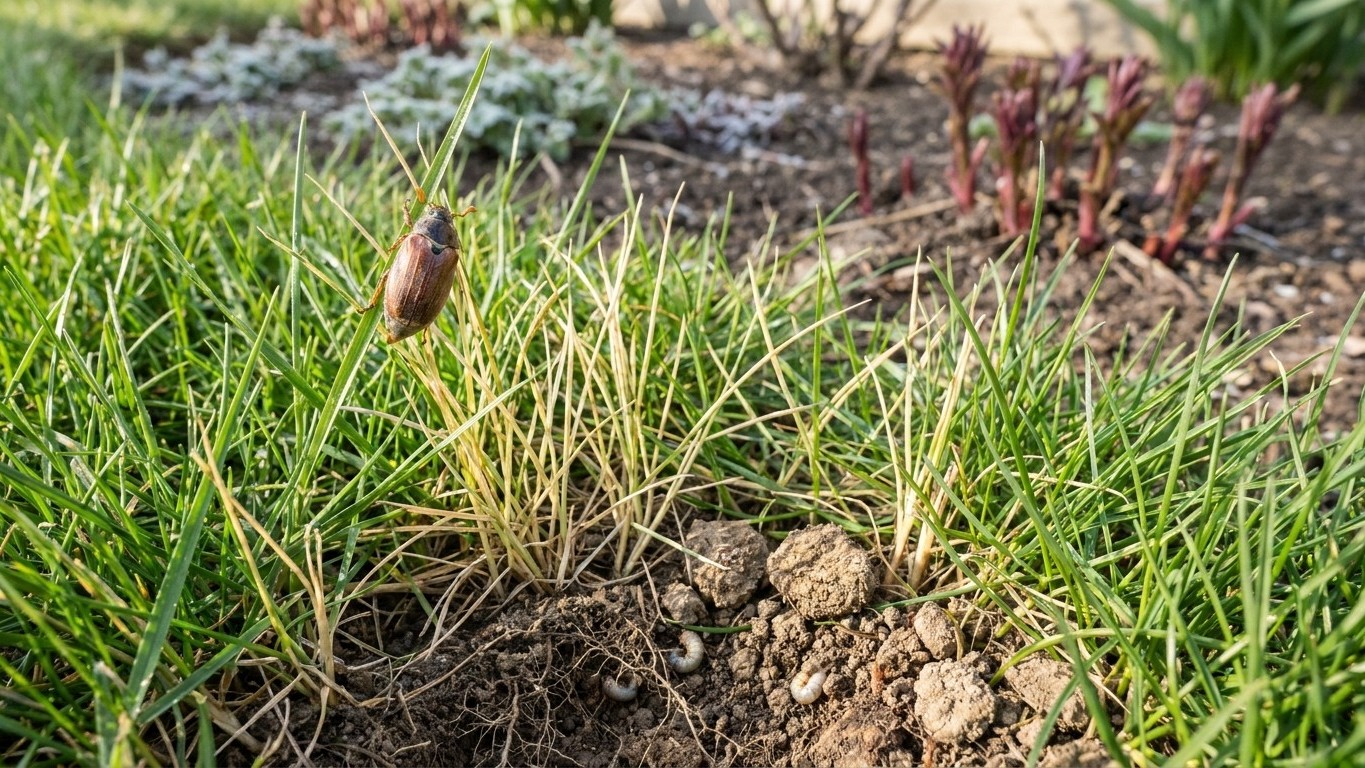

European chafer grubs chew through grass roots long before anyone notices a wilting lawn or a raccoon-torn patch of turf. In Quebec, that damage tracks soil warmth more than a fixed date, and only two territories on this site currently document the insect, which means most of the practical guidance available locally is borrowed from a state just across the border.
Reading the calendar from your last frost

Gardeners here plan around one date: the average last spring frost for the Montreal region, May 6, according to Environment and Climate Change Canada’s 1981-2010 climate normals for the MONTREAL/ST-HUBERT A station. That figure is a mean, not a guarantee. In roughly one year out of two, frost arrives after May 6, so treating it as a safe cutoff is a mistake gardeners make every spring when they rush seedlings outside.
The European chafer doesn’t consult a calendar at all. Adult beetles emerge and mate once soil and air temperatures cross a threshold in early summer, and the timing shifts with how fast the ground warms that particular year. A cold, slow spring pushes emergence later; a warm one pulls it forward. That’s why counting backward or forward from a single average date only produces another range, never a day you can circle in red.
For a home gardener, the practical takeaway is patience rather than precision. Larvae feeding on turf and root systems tends to show up in two waves, one in late summer and fall as young grubs establish themselves, and another in spring as they resume feeding before pupating. Because the exact start of each wave floats with local soil temperature, protective covers over vulnerable beds are better timed to observed beetle activity in your own yard than to a date pulled off a chart. The Montreal station’s normal is a useful reference point for the season’s general rhythm, not a trigger you can automate.
What it attacks, and what the damage looks like
The first sign is almost never the insect itself. It’s a lawn that feels spongy underfoot, or a patch of turf that peels back like a loose carpet when tugged, exposing bare soil and severed roots underneath. Homeowners often notice the secondary damage first: skunks or raccoons digging up sections of yard overnight, hunting the grubs as a food source, leaving torn-up turf that looks worse than the original infestation.
Lawns are the primary target, but the European chafer isn’t limited to grass. Root systems of vegetable seedlings, strawberries, and young ornamental plants can also suffer when grub populations are dense, since the larvae feed indiscriminately on organic material and fine roots in the top few inches of soil. Above ground, adult beetles are less destructive but not harmless: at dusk in early summer, they feed on the foliage of certain trees and shrubs, leaving ragged, chewed edges on leaves, though this cosmetic damage is minor compared to what the larvae do below the surface.
Identifying which life stage caused the damage matters because it determines whether anything can still be done. Adult beetles flying and feeding at dusk are a signal that eggs will soon be laid in nearby soil, still a window for preventive action. Once those eggs hatch and larvae bury into the root zone, the visible symptom (a wilting patch, a dead-looking section of lawn) reflects damage that’s already happened. By the time turf pulls up in sheets, the grubs responsible have often already matured past the stage where most home interventions have any effect.
Distinguishing chafer damage from drought stress
Drought-stressed grass turns uniformly brown and stays rooted when pulled. Chafer-damaged turf, by contrast, lifts easily in irregular patches, often near the edges of a lawn or close to garden beds, because the root mat has been severed rather than just dried out. Checking whether a patch resists a gentle tug is a quick way to tell the two apart before assuming it’s a watering problem.
How Quebec sits in this pest’s range

This site currently documents the European chafer in two territories, which points to a narrower distribution rather than a pest found everywhere across the network. A count that small suggests Quebec sits closer to an edge of the insect’s established range in this region, not solidly in the middle of it, which also explains why locally generated guidance is scarce.
Because dedicated Quebec-specific research on this insect is limited, the nearest published guidance on this site comes from the University of Vermont Extension, across the border. That’s worth stating plainly rather than blending the two together: Vermont’s climate, soil conditions, and pest pressure aren’t identical to Quebec’s, even where they’re close geographically. Borrowing extension guidance from a neighboring state is common practice when local data hasn’t caught up, but it means applying that advice with some judgment about how well it fits conditions on your own property.
When a pest is documented in only a couple of territories, the honest reading isn’t that it’s rare or severe here, since neither claim is supported by the data. It simply means the written record is thin, and gardeners dealing with it locally are working with regional extrapolation rather than site-specific research. That’s a reasonable starting point, just not a substitute for watching what actually happens in your own lawn season over season.
What actually works against it
Several measures work against this pest, and they are listed here from cheapest to most involved, since prevention timed to egg-laying and early larval stages is what actually stops damage.
- Maintain a dense, well-rooted lawn, since thick turf gives adult beetles fewer bare soil patches to lay eggs in and gives young grubs less room to establish.
- Mow at a taller height and avoid over-watering in midsummer, when adults are choosing egg-laying sites, to reduce the appeal of a lawn before the problem starts.
- Hand-pick or physically disrupt adult beetles at dusk during their brief early-summer flight period, which can reduce the number of eggs laid nearby, though this only works during that narrow window when adults are active above ground.
- Clear garden debris and dense thatch, since both give beetles and young larvae extra cover and moisture, and a thatch layer that’s too thick traps humidity near the soil surface, which favors egg survival, so periodic dethatching removes some of that advantage before the season starts.
- Rotate crops in vegetable beds to help limit repeated feeding on the same root systems year after year, though it does little against turf-based populations that don’t rotate with garden plantings.
The blunt truth is that once larvae have bored into a root system or established themselves under a lawn, none of these preventive measures stop the damage already in motion. At that stage, the options narrow to accepting some turf loss, overseeding damaged patches once grubs have moved on or pupated, and focusing preventive effort on the following season rather than trying to reverse current damage. Timing your defenses around egg-laying and early larval stages, not around the visible symptoms, is what separates an effective response from one that arrives too late to matter.
Common questions
Does the European chafer damage vegetable gardens the same way it damages lawns?
Lawns are the primary target because of the dense root mat grubs feed on, but seedlings and shallow-rooted plants like strawberries can suffer root damage too when grub populations near a garden bed are dense. The symptom looks similar: sudden wilting despite adequate watering, tied to root loss rather than drought.
Is the University of Vermont guidance directly applicable to Quebec conditions?
It’s the closest published source available on this site, but Vermont’s climate and soil conditions aren’t identical to Quebec’s. Treat the timing recommendations as a general guide to adjust against local observations, particularly around when adult beetles are actually seen flying at dusk in your area.
Can a lawn recover on its own after a chafer infestation?
Grass with a healthy root system left elsewhere often fills back in once grub feeding stops for the season, especially with overseeding in fall. Severely damaged patches where the root mat has been fully severed usually need reseeding rather than natural recovery, since there’s little living root tissue left to regrow from.