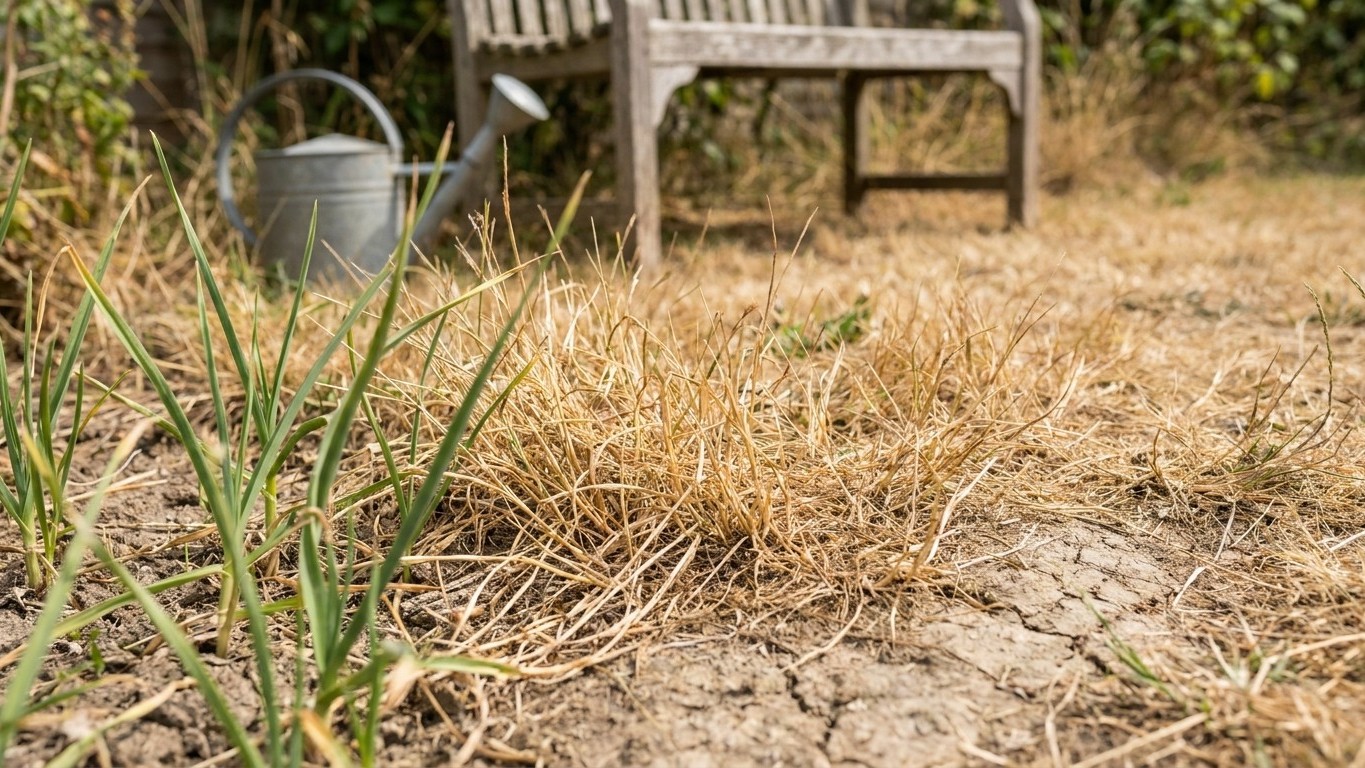

Drought-dormant grass turns tan to gray-brown, but the crown and roots beneath the soil stay alive, waiting for rain. Dead grass turns the same color, only the roots are gone, rotted, or severed, so the blades pull free with no resistance. Grab a handful of the brown grass and tug: if it holds fast, it’s dormant and will recover on its own. If it lifts loose like a rug, look for a cause other than drought before you water, fertilize, or reseed anything.
What you are looking at

Color and pattern
Drought stress rarely announces itself with a clean edge. Cool-season lawns of fine fescue, Kentucky bluegrass, perennial ryegrass, rough bluegrass or tall fescue lose their blue-green cast first, fading to a dull gray-green, then to straw-tan, then to a flat gray-brown as the leaf blades dry from the tip down. Warm-season lawns of bermudagrass, zoysiagrass, centipedegrass, St. Augustinegrass, bahiagrass, carpetgrass or seashore paspalum go through the same color shift, only more slowly, because most of them carry good to excellent drought ratings from Clemson Cooperative Extension’s HGIC 1214 Selecting a Lawn Grass fact sheet.
Drought stress spreads as an uneven, soft-edged wash across the whole lawn, not as a shape with a defined border. It shows first on high ground, thin soil over rock or fill, the strip along a driveway or sidewalk, and any south- or west-facing slope that dries faster than the rest of the yard. If the browning traces the grade of your yard rather than a shape, it likely lines up with the same high and low spots you’d fix by regrading, covered in An Uneven Lawn: Levelling Without Killing the Grass.
Footprints or mower tracks that stay visibly pressed into the grass for hours mean the blades have lost enough water pressure to spring back, an early sign that often shows up before the color changes. Rolled or folded leaf blades, especially on fine fescue and tall fescue, are the plant closing down surface area to cut water loss. A perfect circle with a sharply defined margin, or a straight-edged strip that lines up with a sprinkler zone, is not drought. Those shapes point somewhere else, covered next.
What it is not
The tug test
Before you write off a brown patch as drought, rule out the handful of problems that look similar at a glance but need a different fix, several of them covered in Lawn Problems.
- Grub damage: the turf lifts in a loose mat like a piece of carpet because the roots below the crown have been eaten through.
- Chinch bug damage, mainly in St. Augustinegrass: yellow-to-brown patches that expand outward from a sun-baked spot such as a driveway edge, with roots that are still intact at first.
- Brown patch or dollar spot disease: a near-perfect circle with a sharply defined margin, sometimes with a darker “smoke ring” at the edge, that shows up in humid, overcast weather rather than the driest stretch of the season.
- Dog urine spots: a small, sharply round dead center surrounded by a ring of unnaturally lush, dark green grass from the nitrogen in the urine.
The test that separates all of these from drought takes about thirty seconds. Grab a handful of the affected grass at the base and pull. Grass that’s dormant from drought resists and the blade tends to snap before it releases, because the crown and root system are still gripping the soil. Grass that’s dead from grubs or a disease that has killed the crown lifts free as a mat, roots and soil clinging to the underside, because nothing below the surface is holding on anymore.
What actually causes it
Cool-season vs. warm-season timing
Cool-season grasses (fine fescue, Kentucky bluegrass, perennial ryegrass, rough bluegrass, tall fescue) are built for spring and fall growth. When summer soil moisture drops, the plant closes its stomata to slow water loss, then pulls resources out of the leaf blades and into the crown and root system, shutting down the part you can see to keep the part you can’t see alive. That’s dormancy, and it’s a survival strategy, not a symptom of a dying lawn.
Warm-season grasses (bahiagrass, bermudagrass, carpetgrass, centipedegrass, seashore paspalum, St. Augustinegrass, zoysiagrass) are already built to handle heat and dry spells, which is why bermudagrass and bahiagrass both carry an excellent drought rating and zoysiagrass and St. Augustinegrass a good rating from Clemson Cooperative Extension’s HGIC 1214 fact sheet. Carpetgrass is the exception: despite being a warm-season species, HGIC 1214 rates its drought tolerance very poor, so it browns faster than its warm-season neighbors under the same dry stretch.
What you see today is a delayed report, not a live reading. A lawn channels its water reserves into survival before it shows any visible change, so the brown in front of you reflects a moisture deficit that started weeks earlier, not this week’s forecast. That lag is also why a single good rain rarely turns a drought-stressed lawn green again overnight. The grass has to rebuild leaf tissue from the crown up, which takes time even once water is no longer the limiting factor.
Mowing height plays a bigger role in how fast that deficit shows up than most people expect. Tall fescue cut below the 2.5 to 3.5 inch range recommended by Clemson’s HGIC 1214 fact sheet, or Kentucky bluegrass cut below the 2 to 3 inch range set by Penn State Extension, loses the leaf area it needs to shade its own root zone, so the soil around the roots heats and dries faster. A thick layer of thatch sitting over the root zone compounds the problem by shedding water before it reaches the soil at all, worth ruling out with the measuring method in Thatch: How to Measure It Before You Decide to Remove It.
Fixing it
Step by step
If the tug test says dormant, the fix is patience, not product. A dormant lawn survives on the reserves in its crown and roots, and the single most useful thing you can do is keep it barely alive rather than push it to grow. One deep soak every couple of weeks, enough to wet the root zone rather than just the surface, keeps the crown from drying out completely without breaking dormancy the way frequent light watering would. Repeated cycles of dormancy followed by a green flush followed by dormancy again cost the plant more energy than staying dormant through the whole dry stretch.
Hold off on fertilizer while the lawn is dormant. Nitrogen pushes leaf growth, and a plant that’s shut down leaf growth to save water has nowhere to put that growth except into tissue it can’t support without more water. Clemson’s HGIC 1201 Fertilizing Lawns fact sheet lays out feeding timing by species, worth checking once the lawn resumes active growth rather than while it’s still brown.
Raise the mower rather than lower it. A stressed lawn mowed short loses the leaf area that shades its own crown, so keep the blade at the top of the height range for your grass, whether that’s the 2.5 to 3.5 inches Clemson’s HGIC 1214 fact sheet lists for tall fescue or the 0.75 to 1.5 inches it lists for bermudagrass, and skip a mow entirely if the grass isn’t actively growing.
If the tug test says dead, the fix is patching, not a whole-yard redo, unless the damage is lawn-wide. Cost is the real difference between the two paths: reviving a dormant lawn costs nothing but water and time, while replacing a dead section costs seed, sod, or plugs, plus the water needed to establish whatever you plant. Match the replacement to the site rather than to habit. A shaded corner where St. Augustinegrass or fine fescue died of something other than drought is a poor spot to reseed with bermudagrass, which Clemson’s HGIC 1214 fact sheet rates very poor for shade.
Keeping it from coming back
The species factor
The habit worth changing first is mowing height, not the watering schedule. Watering only matters when rain stops, but mowing height affects how much shade the soil gets every week of the growing season, which is why it showed up first among the causes above. Set the mower to the top of the range for your species and leave it there through the hottest stretch of the year rather than scalping the lawn for a tidy look that costs it drought resistance.
Watering habit comes second: a few deep, infrequent soakings beat frequent shallow ones because they train roots to grow down toward the moisture that’s still there rather than staying shallow and dependent on the next light watering. A lawn with deep roots going into a dry spell has more reserve to draw on before it needs to go dormant at all.
If a particular section of the yard turns brown every year regardless of mowing and watering, the long-term fix may be the species itself rather than the routine. The table below lines up drought tolerance against shade tolerance and mowing height for the twelve grasses covered by Penn State Extension and Clemson Cooperative Extension’s HGIC 1214 fact sheet, useful for matching a replacement to a site that keeps failing.
| Grass | Season | Mowing height | Drought tolerance | Shade tolerance |
|---|---|---|---|---|
| Bermudagrass | Warm | 0.75-1.5 in | Excellent | Very poor |
| Bahiagrass | Warm | 3-4 in | Excellent | Poor |
| Zoysiagrass | Warm | 0.75-2 in | Good | Excellent |
| St. Augustinegrass | Warm | 2.5-4 in | Good | Excellent |
| Seashore Paspalum | Warm | 1-1.5 in | Fair to good | Poor to fair |
| Centipedegrass | Warm | 1.5-2 in | Fair | Fair |
| Carpetgrass | Warm | 1-2 in | Very poor | Fair |
| Fine Fescues | Cool | 2.5-3.5 in | Good | Excellent |
| Tall Fescue | Cool | 2.5-3.5 in | Fair | Good |
| Kentucky Bluegrass | Cool | 2-3 in | Fair | Fair |
| Perennial Ryegrass | Cool | 2-3 in | Fair | Fair |
| Rough Bluegrass | Cool | 2-3 in | Poor | Excellent |
Common questions
How long can grass stay dormant before it’s actually dead?
There’s no fixed number of days that applies everywhere, since it depends on the grass species, the soil, and how hot the stretch is. The tug test is more reliable than a calendar. As long as the crown holds in the soil and resists a firm pull, the plant still has a chance once it gets water.
Should I water a dormant lawn to bring it out of dormancy?
Not unless you’re prepared to keep watering it consistently afterward. Breaking dormancy with a heavy watering and then letting the lawn dry out again forces it through a second stress cycle, which costs more energy than staying dormant through one long dry stretch.
Can I mow a dormant lawn?
Skip mowing if the grass isn’t actively growing, since dormant blades don’t regrow after a cut the way actively growing grass does. If you do mow, raise the deck to the top of the recommended range for your species and make sure the blade is sharp so it isn’t tearing already-stressed tissue.
Why did only part of my lawn go dormant and not the rest?
Usually it comes down to soil depth, slope, or grass type rather than anything you did wrong. A thin strip over a buried pipe, a high spot that sheds water, or a patch of a less drought-tolerant species such as rough bluegrass mixed into an otherwise tolerant lawn will all show stress before the rest of the yard does.