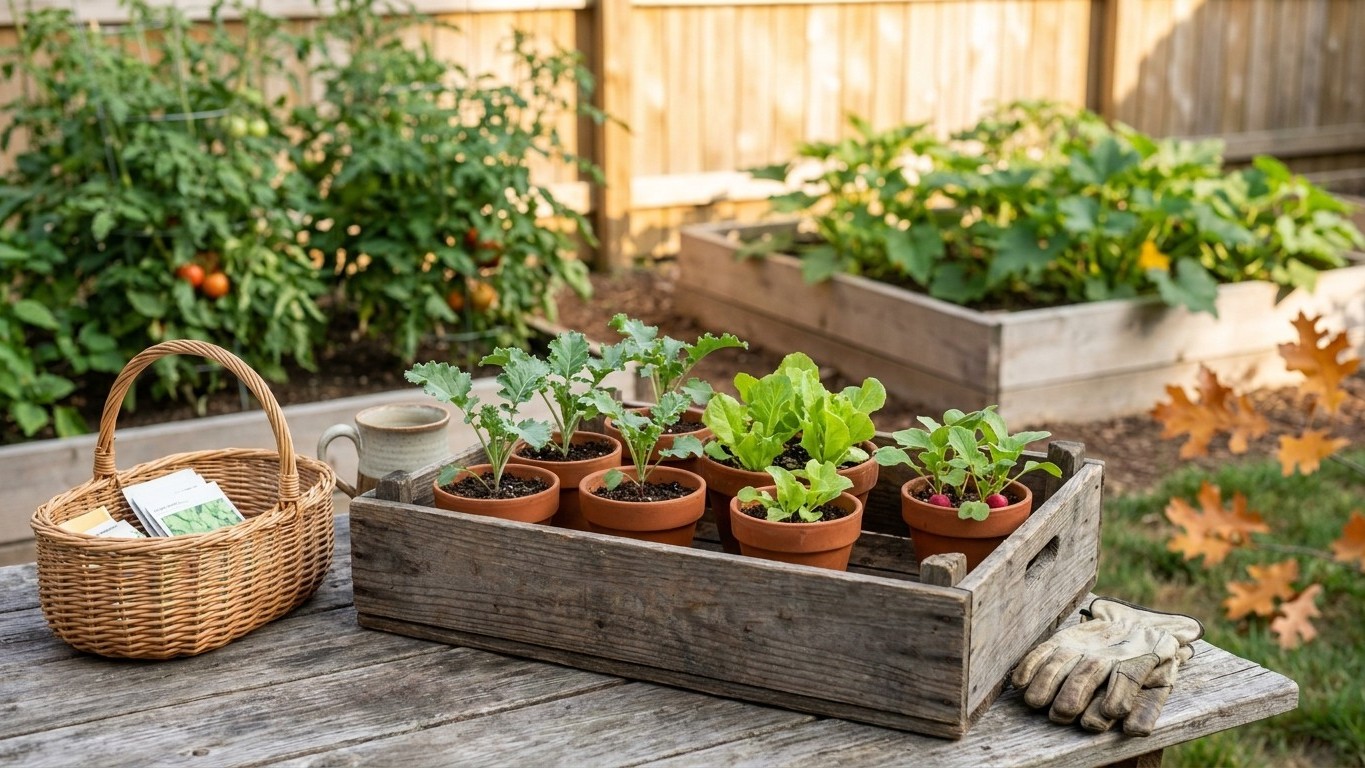

August in Saskatchewan sits in that stretch between peak growing season and the first real chill of fall. With an average last spring frost around May 18 and an average first fall frost around September 18 (Environment and Climate Change Canada, Saskatoon SRC station), the window for new plantings is closing fast this month. Quick greens and fall transplants still work early on; by month’s end, direct seeding for outdoor harvest is mostly done.
What goes in the ground in August

By August, Saskatchewan gardeners are not really asking “can I plant” so much as “do I still have time.” That distinction matters more than any date on a calendar. Soil temperature and day length have already peaked, and every seed dropped into the ground now is racing an average first fall frost of September 18, a mean date from Environment and Climate Change Canada’s Saskatoon SRC station, meaning in about half the years frost lands before that date, not after. Treat it as a soft deadline, not a guarantee.
Early in the month, that leaves roughly six weeks before frost risk climbs sharply. That’s enough time for anything that matures in 30 to 40 days: radishes, arugula, mesclun mixes, spinach, baby lettuce, and green onions grown from sets rather than seed. Bush beans planted in the first days of August can still make it in a warm pocket of the province, though it’s a tighter finish than most gardeners like. Quick turnips and beets grown for their greens also fit this window if seeded promptly.
Transplants started earlier under cover, cabbage, kale, and broccoli seedlings meant for a fall harvest, should go into the ground in the first half of the month at the latest. These crops tolerate a light frost once established, which buys extra weeks that direct-seeded warm-season crops simply don’t have.
By the back half of August, the math changes. With three to four weeks left before the average frost, only the fastest greens and cut-and-come-again crops make sense as new plantings. Anything that needs a long finish, carrots, winter squash, corn, is not a good bet started now; the plant will still be immature when the cold arrives.
| Crop | Days to maturity | Best planted by |
|---|---|---|
| Radish, arugula, mesclun | 25-35 days | Late August |
| Spinach, baby lettuce | 30-40 days | Mid to late August |
| Bush beans | 50-60 days | Very early August, tight finish |
| Fall cabbage, kale, broccoli transplants | Already growing | First half of August |
What to start under cover
Starting seeds under row cover, in a cold frame, or on a windowsill in August is less about getting a jump on next season and more about squeezing a few more harvests out of this one. Count backward from the average first fall frost of September 18: a crop that needs about 40 days to reach a pickable size, started under cover in the first week of August, still has roughly two weeks of buffer before the mean frost date, and the cover itself can push that further since row covers and cold frames often add a few degrees of protection.
Mache (corn salad), winter-hardy spinach varieties, and baby kale all suit this treatment. Sown under a floating row cover or in a cold frame in early to mid-August, they mature slowly as day length shortens and can often be harvested well past the point when an uncovered planting would have frozen out.
The two ways this goes wrong are opposite problems. Start too early, before the heat of midsummer has broken, and fast growers like lettuce can bolt, or transplants meant for the fall brassica bed end up rootbound and stressed in their trays while waiting for garden space to open up. Start too late, past the midpoint of August, and there isn’t enough runway left even with covers to bring a new sowing to a useful size before growth slows to a crawl in the shortening days.
Gardeners who also raise perennials or biennials for the following year, hollyhocks, foxglove, Canterbury bells, use August to sow them in trays or a nursery bed under light shade. These need a full season to establish roots before the ground freezes, so the count backward here isn’t from frost but from the shorter window before growth stops for good.
What is ready to pick
August is the payoff month in a Saskatchewan garden, the stretch when spring’s early sowings and June’s transplants turn into actual food on the table. Garlic planted the previous fall is usually lifted in late July or early August, once the lower third to half of the leaves have browned and dried; pulling it too late risks the bulbs splitting open in the ground. Onions follow a similar cue, their tops yellowing and flopping over as a sign the bulbs have stopped sizing up and are ready to cure.
New potatoes can be dug by hand from under flowering plants without disturbing the whole hill, giving a few meals of thin-skinned potatoes well before the main harvest later in the season. Peas and bush beans are ready when the pods fill out but before the seeds inside start to bulge and toughen the pod wall; checking every day or two during a warm stretch keeps them from going starchy on the vine.
Zucchini and cucumbers need the same frequent attention, since both can go from a reasonable size to an oversized, seedy vegetable within a few days of hot weather. Broccoli heads should come off while the buds are still tight and green, before any yellow flowers start to open across the head.
Saskatoon berries and raspberries, two of the province’s most reliable fruit crops, typically finish their main harvest through this period; berries that pull free with a gentle tug and show full color all the way around are at their best, while ones that resist are better left another day or two.
The jobs that matter this month

Watering rhythm probably matters more in August than in any other month, because this is when fruiting crops like tomatoes, beans, and squash are sizing up, and any stretch of drought stress shows up later as blossom end rot or split fruit. Deep, infrequent watering that reaches the root zone works better than a daily light sprinkle, which encourages roots to stay shallow right when the plant needs them to reach down for moisture.
Mulching pays off double at this point in the season: it holds soil moisture through hot spells and keeps weeds from setting seed before they’re pulled. A layer added now, around tomatoes, squash, and anything still filling out, does more good than the same mulch applied a month earlier when the soil was cooler and weeds hadn’t yet taken hold.
Staking and tying should be finished, not started, by August; sprawling tomato and pea vines that haven’t been supported yet are already tangled, and untangling them risks snapping stems loaded with fruit. Where support was skipped, it’s better to lay down a clean layer of straw under the vines than to force stems upright now.
Pest scouting matters because populations build fast in warm weather: Colorado potato beetle larvae, cabbage worms on brassicas, and aphid clusters on the undersides of leaves can go from a minor nuisance to a real problem within a week if left unchecked. A quick walk through the garden every few days, checking leaf undersides, catches most of these before they need anything stronger than hand-picking.
Garlic and onions lifted this month need proper curing, spread in a single layer somewhere warm, dry, and out of direct sun for two to three weeks, before they’re trimmed and stored. Skipping this step is the single most common reason a good harvest rots in storage a few weeks later.
What not to do in August
The classic August mistake in Saskatchewan is treating a warm afternoon as permission to start something new that needs a long season. Corn, winter squash, and a fresh round of tomato transplants might look fine going into the ground on a hot day in early August, but none of them can reach a useful harvest before the average first fall frost on September 18, and that date is a mean, not a worst case. Half the time, frost arrives earlier.
Nitrogen-heavy fertilizer applied late in the season is another common error. It pushes soft, leafy growth right when plants like tomatoes and peppers should be shifting energy toward ripening fruit, and that same soft growth is more vulnerable to an early cold snap than tissue that’s had a chance to toughen up. If feeding is needed this late, a lower-nitrogen, higher-potassium formulation supports ripening without the flush of new leaves.
Leaving garlic and onions in the ground past their cue is a quieter mistake but a costly one: bulbs that sit too long after the tops have died back start to resprout or split, and both faults shorten how long they’ll keep in storage.
Overwatering ripening tomatoes after a dry spell causes a sudden uptake of water that splits the skins, a problem that shows up almost overnight after a heavy rain or a big catch-up watering. Keeping the watering schedule steady, rather than swinging between drought and flood, avoids most of this.
Checking this against your own county
Everything above is built around averages from a single weather station, Saskatoon SRC, and Saskatchewan is not one climate. The north of the province sits weeks behind the south in both spring warm-up and fall cooldown, and elevation, tree cover, and proximity to lakes shift frost timing on top of that. Saskatoon’s hardiness zone, 3a under the Canadian system, describes that reference city alone; it isn’t a USDA zone and shouldn’t be lined up against American zone maps, since the Canadian system weighs seven climate variables against the USDA’s one.
Before locking in a planting decision for a specific county, check it against the Saskatchewan Ministry of Agriculture’s resources for growers, which cover local conditions the provincial average can’t.
Common questions
Can I still plant tomatoes in Saskatchewan in August?
Generally no. Tomato transplants need 60 or more days to fruit, and the average first fall frost lands September 18, a mean date that arrives earlier in roughly half of all years. New tomato plantings started in August rarely have time to ripen fruit outdoors.
When should garlic be harvested in Saskatchewan?
Most gardeners lift garlic in late July or early August, once the bottom third to half of the leaves have dried and browned. Pulling it earlier leaves undersized bulbs; leaving it too long risks the wrapper splitting in the ground.
What hardiness zone is Saskatchewan for gardening?
Saskatoon, the reference city for provincial climate normals, sits in Canadian zone 3a. That’s a different scale from the USDA system used in the United States, built on seven climate variables rather than one, so it shouldn’t be treated as equivalent to any single USDA zone.
How reliable is the September 18 average frost date?
It’s a mean value from Environment and Climate Change Canada’s Saskatoon SRC station, not a guaranteed safe date. In about half the years on record, the first fall frost arrives before September 18 rather than after, so treat it as the midpoint of a range, not a deadline to plan tightly against.
Gardeners who plant by the Moon can check the August 2027 moon planting calendar, a tradition rather than a proven method.