
South Carolina’s tomato pest calendar tracks the frost-free window. NOAA’s 1991-2020 climate normals put the last spring freeze near Charleston between February 28 and March 17, and the first fall freeze between November 20 and December 5, measured at the Charleston airport station. That stretch is long enough for early sap-suckers, midsummer fruit borers and late-season whiteflies to each take a turn on the same plants. Start checking the undersides of leaves and the newest growth weekly from the week you transplant, because catching any of these pests at the egg or nymph stage is the only reliable way to stay ahead of them here.
What this comes down to in South Carolina

The first few weeks after transplant decide most of the pest battle here — that’s the window when a tomato seedling has too few leaves to spare and every soft new shoot reads as an open invitation. Aphids move in on the undersides of those tender leaves almost immediately, and flea beetles arrive right alongside them, riddling foliage with tiny holes before the plant has any size to absorb the damage. What actually shows up depends on catching this stretch early.
Aphids

Aphids show up early, often within the first few weeks after transplant, clustering on the undersides of young leaves and on tender stem tips. Both nymphs and adults feed by sucking sap, which curls and yellows the leaf and leaves behind sticky honeydew that grows sooty black mold. A strong jet of water knocks down light infestations; insecticidal soap or horticultural oil handles the rest, and letting lady beetles establish in the bed does a lot of the work for free.
Flea Beetles

Flea beetles hit right around the same window as aphids, when transplants are still small and every leaf matters. The adult beetle is the damaging stage, chewing dozens of tiny round holes that give the foliage a shot-through look. Seedlings can be stunted badly before the plant is established. Floating row cover from transplant until flowering keeps them off; once flowers appear, the cover has to come off for pollination and you’re watching for beetle activity by eye instead.
Stink Bugs

Stink bugs move in as fruit starts to set and stay through the rest of summer. Both nymphs and adults pierce developing fruit to feed, and the damage shows up later as pale, cloudy spots or hard white patches under the skin, sometimes called cat-facing. The insect itself is often gone by the time you notice the fruit damage, so check stems and green fruit directly rather than waiting for ripe ones to show marks. Clearing nearby weedy hosts and hand-picking adults helps more than spraying after the fact.
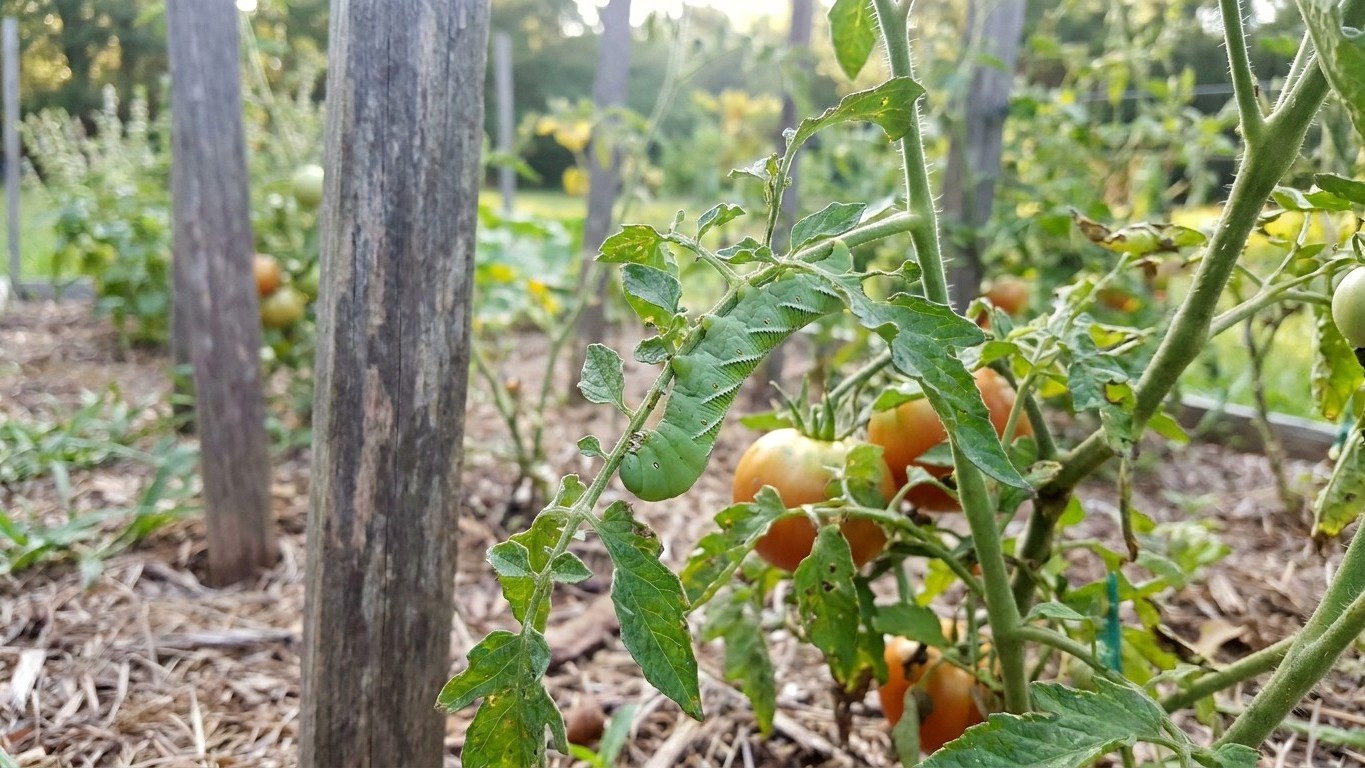
Tomato Hornworm

Hornworms arrive at the height of summer and can strip a plant of leaves in a couple of nights. The caterpillar itself does all the damage, and it’s easy to miss against the foliage until you spot dark green pellet droppings on the leaves below. Hand-picking works if you catch it early; Bacillus thuringiensis (Bt) sprays handle heavier infestations. Leave any hornworm carrying small white cocoons alone, since those are parasitic wasp eggs already working in your favor.
Tomato Fruitworm

Fruitworm, also sold under the name corn earworm, follows close behind the hornworm as fruit starts ripening. The caterpillar bores a clean entry hole near the stem end and hollows out the inside of the fruit, usually one fruit per caterpillar before it moves to the next. Bt and spinosad both work if applied while larvae are small; once a worm is deep inside a tomato, the fruit is a loss and should come off the plant.
Silverleaf Whitefly

Whiteflies build up latest, once summer heat is fully established, and are easiest to confirm by brushing a leaf and watching the small white cloud rise. The nymphs, flat and nearly clear, do the actual feeding damage on leaf undersides, causing yellowing and the same sooty mold aphids leave behind. Yellow sticky traps confirm an infestation early. Insecticidal soap or horticultural oil controls it without wiping out the predator insects that keep populations in check the rest of the season.
Working it out for your own garden
Any of the pests above can look like plant stress at first glance, so the identification method matters more than memorizing the list. Three checks get you to an answer almost every time.
- Where is the damage? Leaf-only injury points to aphids, flea beetles or whiteflies. Damage on stems and fruit points to stink bugs. Hollowed fruit points to hornworm or fruitworm.
- What life stage do you actually see? A caterpillar chewing leaves in real time is the hornworm. An insect that flies up in a cloud when disturbed is the whitefly. Something that jumps rather than flies is the flea beetle.
- Where does it fall in the season? Given NOAA’s frost window near Charleston of late February to mid March on one end and late November to early December on the other, a problem in the first month after transplant is far more likely to be aphids or flea beetles than fruitworm, which needs ripening fruit to attack.
That third check is the one gardeners skip, and it’s the most useful. If you know roughly how many weeks out from your own transplant date you are, you can rule out pests that haven’t had time to build a population yet. This is also the point where it pays to have already worked out your own tomato planting dates in South Carolina, since a plant set out at the early edge of the frost window carries a longer pest season, front to back, than one set out later.
What changes across the state
South Carolina’s pest pressure follows the same geography that shapes its frost dates. The reference figures above come from the Charleston airport station, and USDA’s hardiness map puts the state as a whole across zones 7a to 9a, which is a wide enough range that a single pest calendar cannot fit every county. The Lowcountry near the coast holds heat and humidity longer into fall, which tends to stretch the active window for aphids and whiteflies since both build populations fastest in warm, humid conditions. Move inland and upslope toward the Piedmont and the Upstate, and NOAA’s own caution on the frost data applies directly: that part of the state runs several weeks tighter at both ends of the season than the Charleston figures show, which compresses the whole pest rotation into a shorter stretch.
Elevation and distance from the coast matter more than latitude alone for how long each pest stays active, not just when it first shows up. A gardener in the Upstate is likely to see the same six pests as one near Charleston, just packed into a narrower window with less overlap between them. That’s worth knowing before you plan a spray schedule off a calendar built for the coast.
The mistakes this state punishes

The costliest mistake is treating the whole season as one long pest window and spraying broad-spectrum insecticide on a fixed schedule rather than in response to what’s actually present. That routine kills off the lady beetles and parasitic wasps that would otherwise handle aphids and hornworms for free, and it tends to hit pollinators right when fruit set depends on them.
The second mistake is skipping the early-season check on transplants because nothing looks wrong yet. Flea beetle and aphid damage compounds fast on small plants, and a transplant that goes into the ground at the early edge of the frost window near Charleston has more weeks of exposure to build up a population before you notice. Check new transplants at the one and two week mark, not just when you first spot a problem.
The third is ignoring stink bug damage because it doesn’t show until the fruit is picked. By the time cat-facing appears on a ripe tomato, the insect that caused it fed weeks earlier. Waiting for visible fruit symptoms before acting means you’re always a generation behind. Checking green fruit and stems directly during the summer catches it while treatment still matters.
Checking this against your county
Clemson Extension, South Carolina’s land-grant university extension service, publishes county-level guidance and can confirm which of these pests are active locally right now: clemson.edu/extension. If you’re still working out which tomatoes to plant before pest pressure becomes the concern, the state’s variety guide is the better starting point, and the pest calendar above assumes you’ve already settled on a planting date using the state’s frost window rather than a single day pulled from it.
Common questions
Are tomato hornworms poisonous or dangerous to touch?
No. The horn on the tail end looks alarming but doesn’t sting or bite. It’s safe to hand-pick them, though wearing gloves makes the job less unpleasant.
Why does my tomato look fine on the outside but white and pithy when I cut it open?
That’s usually stink bug feeding damage from earlier in the fruit’s development, not a disease. The insect punctures the fruit while it’s still green, and the damage only becomes visible once the tomato ripens around it.
Do I need to spray for aphids every time I see them?
Not necessarily. A small cluster on a few leaves is often brought under control by lady beetles or a strong water spray within a week or two. Reach for insecticidal soap only once populations are climbing across multiple plants.
Can I still use a plant that’s had whiteflies once the population is gone?
Yes, as long as the leaves have recovered and you’re not seeing sooty mold buildup. Whitefly populations crash on their own once natural predators or a cooler stretch catches up with them, and the plant usually outgrows the damage if it wasn’t heavy.