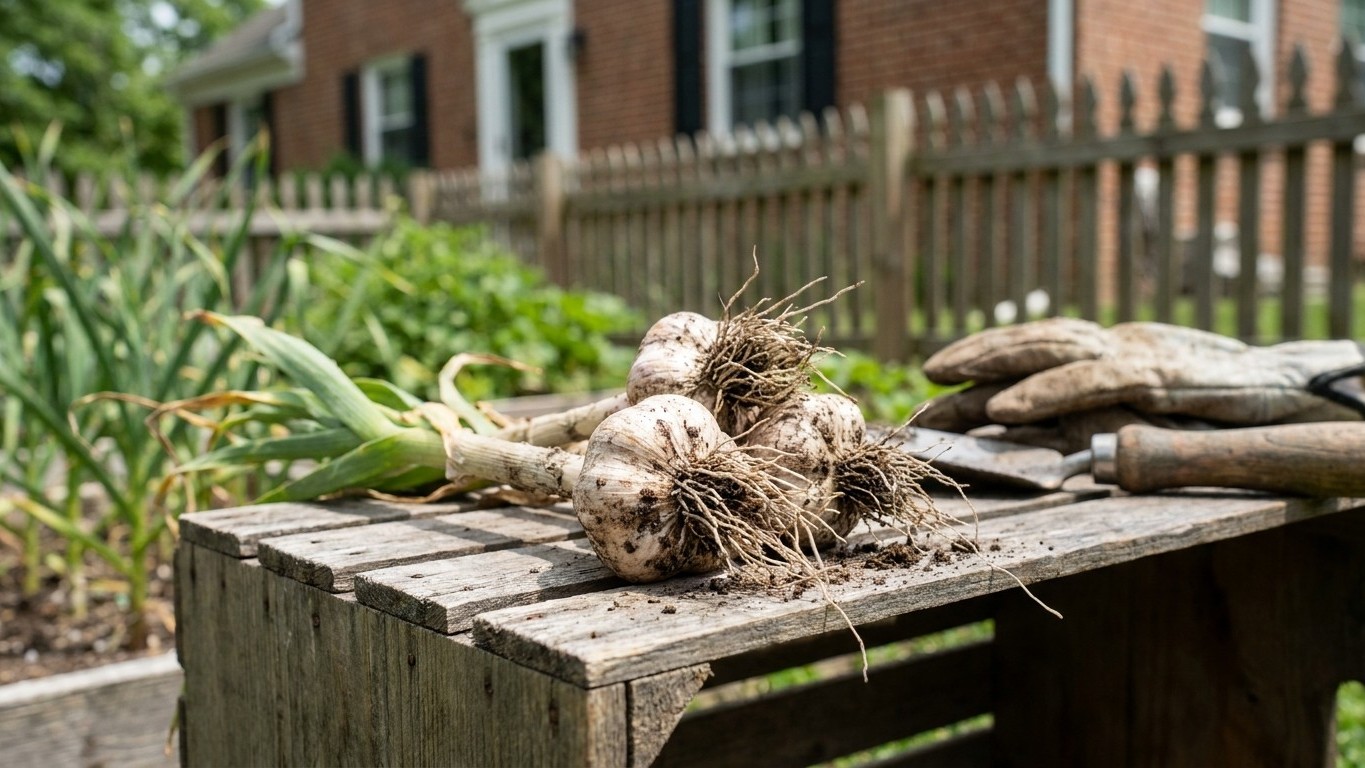

Garlic in South Dakota is usually ready to lift in mid-to-late July, roughly nine to ten months after fall planting, once the lower leaves have browned and died back while the top few stay green. Curing takes two to four weeks in a dry, shaded, airy spot before you trim, sort, and move the bulbs into cool, dark storage for winter.
When garlic is ready to lift in South Dakota
The calendar gets you close, but the plant tells you the real story. Garlic signals harvest through its foliage, not through a date on a wall. When roughly 40% to 50% of the leaves have gone brown and papery while the upper leaves remain green, the bulb has typically stopped bulking and started sealing itself into wrapper layers. Pull too early and you get small cloves with loose, unformed skins. Wait too long and the wrappers split, exposing cloves to soil moisture and rot.
Reading the plant instead of the calendar
Before pulling the whole row, dig one test bulb and check it by hand. A ready bulb has plump, well-defined cloves and wrapper layers that are still mostly intact, not paper-thin or already flaking apart. If the cloves feel loose inside the skin or the wrappers have started to disintegrate in the ground, you’ve waited a bit too long, and the crop should come out immediately regardless of leaf color.
Why the fall planting date shapes the summer harvest
Garlic planted in autumn spends the cold months establishing roots before pushing top growth the following spring, so how it was planted the previous fall has a real effect on harvest timing the next summer. For gardeners near Sioux Falls, NOAA’s 1991-2020 Climate Normals (station USW00014944) put the first fall freeze in a 30% to 70% probability band running from September 24 to October 4. That’s a midpoint, not a guarantee: in roughly half of all years, the first freeze lands later than that window, sometimes well into October. Fall planting decisions built around this window should account for that spread rather than treating either end as fixed. Gardens outside Sioux Falls, especially rural properties and anything at higher elevation, tend to see frost arrive earlier than the airport station reports, sometimes by a week or two, so check conditions in your own county before leaning on this figure. SDSU Extension (https://extension.sdstate.edu/) is the county-level resource for confirming local timing.
Curing it, and where to hang it here
Curing is the step that turns a freshly dug bulb into something that will actually keep. Skip it or rush it, and even a perfectly timed harvest ends up soft and moldy by December.
Why curing matters and how long it takes
Fresh-pulled garlic still carries moisture in the neck and outer layers. Curing dries that tissue down so the neck tightens and seals, which is what keeps storage organisms out over the following months. In practice, that means two to four weeks of drying with airflow around the bulbs, not stacked or piled where moisture gets trapped. Skin condition, bulb size, and how humid the air has been all affect how long a given batch needs, so check a sample bulb periodically rather than curing on autopilot.
Finding the right spot in a South Dakota outbuilding
South Dakota’s summer air runs dry compared to much of the country, which actually works in a grower’s favor here. A garage, open shed, covered porch, or barn aisle with cross-ventilation and no direct sun usually cures garlic well without any special equipment. Direct sunlight is the one thing to avoid outright, since it can scorch wrappers and even partially cook cloves near the surface. Bundling stems together and hanging them from rafters, or laying bulbs in a single layer on mesh screens or repurposed window screens, both work, as long as air moves freely on all sides of each bulb.
Skip curing in a closed basement or an attached garage that traps humid air near a laundry vent. Trapped moisture is the enemy of curing, and it undoes weeks of good field work in a matter of days if bulbs sit in damp, stagnant air.
Storing it through a South Dakota winter
Once cured, garlic needs a storage environment that’s cool, dark, and dry, with steady conditions rather than swings between warm and cold. That’s a different target than the near-freezing, high-humidity setup that works for carrots or potatoes, and mixing the two up is one of the most common storage mistakes home growers make.
Prepping bulbs before they go into storage
Trim roots close to the base plate, cut stems down to an inch or two above the bulb (unless you’re keeping some braided), and brush off loose dirt without washing the bulbs. Washing introduces moisture right before storage, which defeats the purpose of curing in the first place. Sort out anything with soft spots, discoloration, or a strong odor before it goes into long-term storage, since one bad bulb can spread rot to its neighbors in a bin or braid.
Where storage actually holds up over a South Dakota winter
An unheated closet, an insulated garage that stays above freezing, or a cool interior room away from furnace vents all tend to work better than a true root cellar, which usually runs colder and more humid than garlic wants. The goal is a spot that avoids hard freezing, since freeze-thaw cycles turn cloves mushy, and avoids the warm, dry heat of a furnace room, which speeds up sprouting. Mesh bags, cardboard boxes with ventilation holes, or open baskets all allow the airflow that bulbs need; sealed plastic bags trap moisture and invite mold within weeks. Checking the stored garlic every few weeks through winter, pulling any bulb that’s softening, keeps a single problem bulb from taking out the rest of the batch before spring planting rolls around again.
What goes wrong here
Most storage failures trace back to one of a handful of repeat offenders, and nearly all of them are avoidable with a change in timing or airflow rather than any special product.
Timing and curing mistakes
Harvesting by date instead of by leaf condition is the most common error, since a cool, wet spring can push maturity later than the previous year’s timing suggested. Curing too fast, by stacking bulbs in a pile or leaving them in direct sun to “speed things up,” also shows up often. Both problems trace back to skipping the leaf-and-wrapper check described above rather than trusting a calendar.
Pests and rot in storage
SDSU Extension documents wireworms as a pest affecting root and underground crops in this territory, and garlic’s underground growth habit puts it in that same risk category during the growing season, particularly in ground that was previously in sod or pasture. Beyond pest pressure, soft rot showing up in storage almost always traces back to moisture, either from skipping the cure entirely, storing bulbs in sealed plastic, or letting condensation form when garlic moves from a cold garage into a warm kitchen. Checking bulbs by hand once a month through the winter catches these problems before they spread through an entire batch.
Common questions
Can I harvest garlic based on the calendar alone in South Dakota?
Not reliably. Leaf die-back and a test-dig on a sample bulb give a far more accurate read than any fixed date, since spring weather shifts maturity from one year to the next.
Does South Dakota’s dry summer air change how I should cure garlic?
It generally helps. Lower ambient humidity through the growing region makes garages, sheds, and covered porches workable curing spots without added ventilation equipment, as long as bulbs stay out of direct sun.
Should stored garlic go in the refrigerator over winter?
No. A refrigerator’s cold, humid environment encourages sprouting and softening. A cool, dry, dark room or unheated closet that stays above freezing works better for long-term storage.
Where can I check frost dates for my specific county?
The Sioux Falls station figures from NOAA cover one reference point; conditions vary by county and elevation. SDSU Extension (https://extension.sdstate.edu/) is the resource for confirming local planting and harvest timing where you garden.