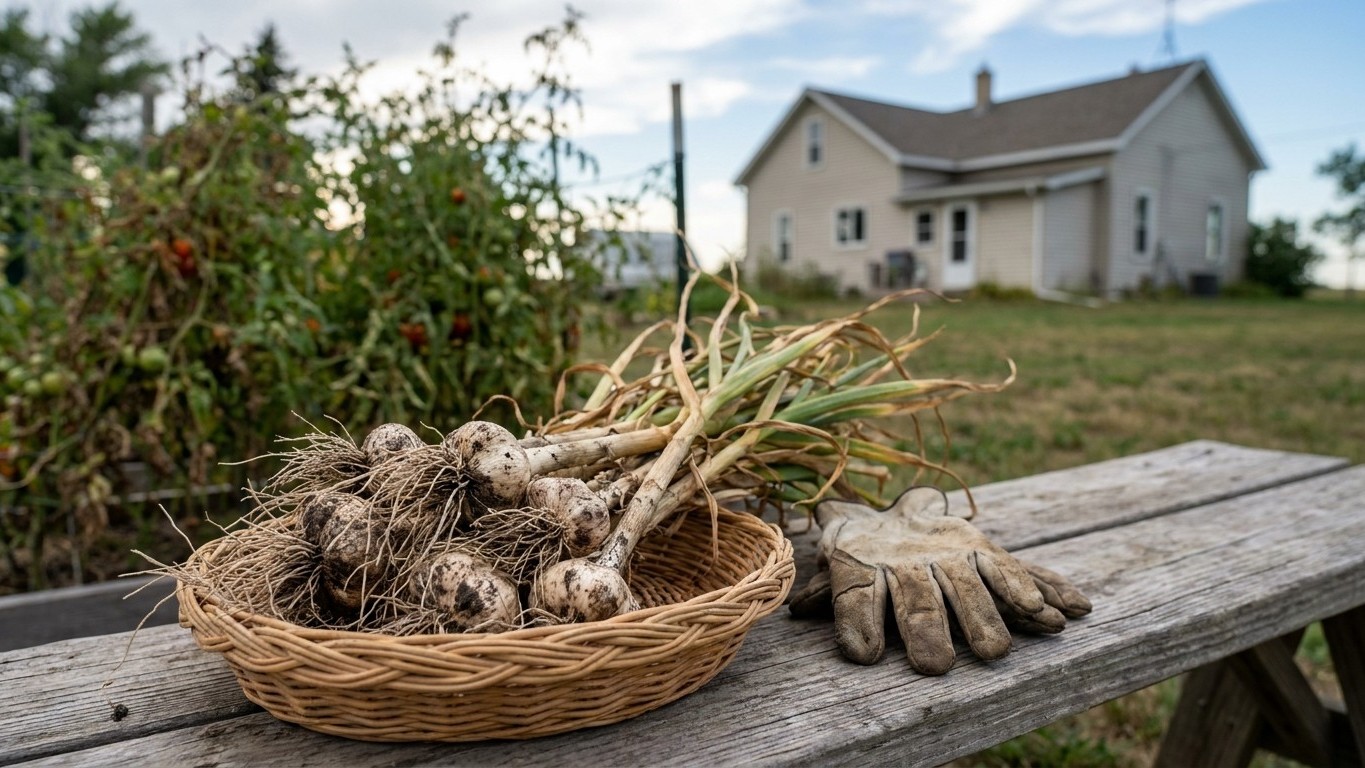

One round bulb, no cloves — that’s what a fall-planted garlic patch gives you when the winter cold never really reaches the clove. The bud inside needs weeks of real cold to split into a head, and gardeners here sometimes mulch too heavy or plant too late, insulating the clove right out of the chill it’s counting on. South Dakota winters carry plenty of cold to spare, roughly four times what a clove requires, so the failures that do happen almost always trace back to planting timing or a snow-free stretch, not to the climate itself.
Will garlic get the cold it needs in South Dakota

A garlic clove is not just a seed. It is a bud that has to sense a real stretch of cold after planting or it will not divide. Skip that cold and you dig up a single round bulb in midsummer instead of a head made of individual cloves. This is the one variable that separates a good garlic harvest from a disappointing one, and it has nothing to do with soil or fertilizer.
NOAA’s 1991-2020 Climate Normals, recorded at the station near Sioux Falls, show 30.4 weeks of the year averaging below 40°F. University of Georgia Extension bulletin C854 sets the requirement at six to eight weeks of sustained cold following planting. South Dakota’s winter delivers roughly four times the minimum a clove needs, which means vernalization failure is not something growers here typically have to plan around.
Where this figure comes from, and where it does not apply
That 30.4-week figure is a single reference station, not a state average. Western South Dakota, especially at higher elevation near the Black Hills, almost certainly runs colder for longer, not warmer. A grower in Rapid City or in a river valley that pools cold air should expect at least as much chilling as Sioux Falls sees, often more. Check your own county’s data through your local extension office before assuming the Sioux Falls number applies exactly to your garden.
The only realistic way to undersupply cold here is to plant very late, after the ground has already started to freeze hard, or to store cloves somewhere warm all winter instead of putting them in the ground — timing that follows the garlic planting dates guide for South Dakota should keep you well within the window. Growers coming from a much milder state, like growing garlic in Tennessee, are used to worrying about this every year. In South Dakota, you generally are not. If you do end up with cloves that missed their planting window, you have two real options:
- Refrigerate the cloves at standard fridge temperature for six to eight weeks before planting, mimicking the cold they missed in the ground, or consult Garlic Varieties That Suit South Dakota Winters to choose one better suited to a shorter chilling period.
- Switch to a softneck variety for that season, since softnecks divide reliably with less cold than hardnecks demand.
When to put the cloves in
Garlic wants enough time in fall soil to grow roots before the ground locks up, but not so much time that it pushes a lot of leaf growth that then gets damaged by hard freezes. That balance is why the varieties in this guide are all set out in the same narrow window: early September to mid September.
NOAA’s 1991-2020 normals place the first fall freeze (32°F) near Sioux Falls somewhere between September 24 and October 4. Treat that as a band, not a single safe date. Planting in early to mid September gives cloves roughly three to six weeks of root development before that freeze arrives, which matches what most garlic growers aim for: enough root to anchor the plant through winter, without enough top growth to invite frost damage to the leaves.
What shifts this window in your own garden
Elevation matters more in South Dakota than most people expect. Ground in the western part of the state, particularly near the Black Hills, tends to freeze earlier than the Sioux Falls reference station suggests, so growers there should lean toward the earlier end of the planting window, not the later end. Low-lying ground near rivers or reservoirs collects cold air overnight and can see frost days before the surrounding high ground does. If your garden sits in a frost pocket, plant earlier than a neighbor on a slope above you.
Which types suit South Dakota
Hardneck and softneck garlic are not interchangeable, and picking between them here comes down almost entirely to winter. Hardneck garlic wants a real, sustained cold season to divide well and to send up the scape it is known for. Softneck garlic tolerates a much milder winter, and in exchange it stores considerably longer in the pantry, often eight to twelve months against a hardneck’s four to six.
Given that NOAA’s 1991-2020 normals put 30.4 weeks of the growing season below 40°F near Sioux Falls, hardneck is the safer default choice across most of South Dakota. The winter here is not marginal for hardneck the way it is in states further south. Good hardneck options for this climate include Bavarian Purple, Blue Music, Chesnok Red, Duganski, Fall Festival, Georgian Crystal, Georgian Fire, German Red, German White, and Ivan.
Softneck is still worth growing here if long storage matters more to you than scapes, or if you want garlic that braids well. Early Red Italian, Inchelium Red, Italian Late, and Lorz Italian all handle South Dakota’s winter without trouble, since the cold here is well above what a softneck needs, not below it.
| Variety | Type | Planting window |
|---|---|---|
| Bavarian Purple | Hardneck | Early to mid September |
| Blue Music | Hardneck | Early to mid September |
| Chesnok Red | Hardneck | Early to mid September |
| Duganski | Hardneck | Early to mid September |
| Fall Festival | Hardneck | Early to mid September |
| Georgian Crystal | Hardneck | Early to mid September |
| Georgian Fire | Hardneck | Early to mid September |
| German Red | Hardneck | Early to mid September |
| German White | Hardneck | Early to mid September |
| Ivan | Hardneck | Early to mid September |
| Early Red Italian | Softneck | Early to mid September |
| Inchelium Red | Softneck | Early to mid September |
| Italian Late | Softneck | Early to mid September |
| Lorz Italian | Softneck | Early to mid September |
Soil and bed preparation
Drainage comes before everything else. A garlic clove sits in that same patch of ground for eight to nine months, through freeze, thaw, and every spring rain in between. Standing water rots a clove long before white rot or any other soil disease gets the chance to. If your soil is heavy clay, build a raised bed or a mounded row rather than planting at grade, so winter meltwater has somewhere to go besides straight down onto the bulb.
Work in a couple of inches of aged compost a few weeks ahead of planting, not the same week. Fresh, un-composted manure or a heavy dose of nitrogen right before planting pushes soft, lush top growth that is more vulnerable to fall frost damage and slower to shut down for winter. A modest, well-rotted amendment is enough for garlic, which is not a heavy feeder in its first few months in the ground.
Loosen the soil to a full spade’s depth and clear out rocks and clumps before you plant. Garlic roots need to push down and anchor the clove before the ground freezes, and compacted or rocky soil slows that process at exactly the time of year the plant has the least margin to spare. Test your soil’s pH and fertility ahead of planting rather than guessing. Your county extension office can run that test and tell you what, if anything, needs correcting before fall.
What the climate here favours, and what it does not
UC IPM’s Pest Management Guidelines for onion and garlic (UC ANR Publication 3453) publish soil temperature ranges for the major garlic diseases. The figures below come from South Dakota’s growing-season air temperatures, not soil, and soil lags air by weeks and swings less. A month that averages inside a disease’s range does not mean that disease is active every day of that month, only that the climate leans toward it more often than not.
- White rot (Sclerotium cepivorum): mean air temperature falls inside the published 50 to 75°F range in four months of the growing season, September, May, June, and July, including one month at the pathogen’s published optimum. This is the disease South Dakota’s climate leans toward most.
- Fusarium basal rot (Fusarium oxysporum f. sp. cepae): falls inside its published 59 to 90°F range in three months, September, June, and July.
- Southern blight (Sclerotium rolfsii): no month of the growing season reaches its published 86 to 95°F optimum. Less active here, not absent.
- Pink root (Setophoma terrestris): no month reaches its published 75 to 85°F optimum. Again, less active, not impossible.
None of this means a clean South Dakota garden is protected. White rot in particular survives in soil for years once introduced and travels almost exclusively on infected planting stock, not on the wind. Buying certified seed garlic and rotating away from any bed that has grown alliums recently does more to keep these diseases out than the local temperature ever will.
Getting it through the winter
Mulch goes down after the ground has had its first hard cold snap but before it locks up solid, once the cloves have had time to root but before deep freeze sets in. A loose layer of straw, several inches deep, insulates the soil enough to smooth out the freeze-thaw swings that cause heaving, without keeping the ground so warm that it delays dormancy.
Heaving is the real winter risk here, not cold itself. A clove planted too shallow, or left unmulched through a warm spell followed by a hard freeze, can be pushed partway out of the soil as the ground expands and contracts. Once a clove is sitting half-exposed, it dries out and its roots snap, and there is little you can do to fix that mid-winter. Plant at a full two to three inches of depth and keep that mulch layer intact through the coldest months rather than checking on it repeatedly.
Pull the mulch back gradually in spring once new green shoots are visible, rather than stripping it all at once. Leaving a thin layer down a little longer protects new growth from a late cold snap without smothering it. Growers in a colder state like growing garlic in Maine often leave mulch on even heavier and longer, since their ground stays frozen deeper into spring than South Dakota’s typically does.
Harvest and curing here
Reading the leaves, not the calendar
Garlic tells you when it is ready far more reliably than a date on a calendar does. Lift bulbs once roughly the bottom half of the leaves have browned and died back while the top few are still green. Pull too early and the wrapper layers around the bulb have not fully formed, so the bulb won’t store well. Wait too long past that point and the wrapper can split, exposing individual cloves to soil and moisture.
Dig rather than pull, using a garden fork to lift the whole bulb intact. Yanking a bulb by its stalk in dry soil can snap the neck and leave cloves in the ground.
Curing before storage
Curing is where a lot of otherwise good garlic gets ruined after the hard part is already done. Move whole plants, roots and leaves still attached, to a shaded, well-ventilated spot out of direct sun. A covered porch, open shed, or garage with airflow works. Leave three to four weeks for the outer wrappers to dry down and seal.
South Dakota’s midsummer air tends to run dry, which favors curing, but a stretch of humid or rainy weather during harvest changes that quickly. If the air stays damp for more than a few days running, add a fan to keep air moving over the bulbs. Garlic that cures in still, humid air is prone to mold at the neck, and that rot can spread through an entire storage batch before you notice it.
Local help
County-level frost dates, soil test results, and current disease alerts all vary across South Dakota more than a single Sioux Falls reference station can capture. Contact SDSU Extension at extension.sdstate.edu before you finalize a planting date or diagnose a problem in the field, since their county offices can give you numbers specific to your own soil and elevation.
Common questions
Can I Plant Garlic in spring instead of fall in South Dakota?
You can, but the bulbs will usually come out small and undivided, since spring-planted cloves miss most or all of the extended cold period they need to split. If you missed the fall window, refrigerating cloves for six to eight weeks before a spring planting gets you closer to a real harvest than planting straight from the bag.
How deep should I plant the cloves?
Set each clove pointed end up, about two to three inches deep, spaced roughly six inches apart. Shallower planting increases the risk of frost heave over winter, which is the main way garlic fails here once it’s in the ground.
Can I grow garlic from a bulb I bought at the grocery store?
You can, but it carries real risk. Grocery garlic is rarely labeled by variety, is often treated to slow sprouting, and can carry soilborne pathogens like white rot into a garden that doesn’t have them yet. Certified seed garlic from a known source costs more but avoids introducing a problem that can persist in soil for years.
Why did my garlic only produce one big clove instead of a full head?
That’s usually a sign the clove didn’t get enough cold after planting, called vernalization failure. It happens most often when garlic goes in too late in fall, is stored somewhere warm all winter instead of in the ground, or when a softneck variety is planted somewhere with barely any winter at all. In South Dakota, it’s more likely to trace back to a very late planting date than to the climate itself.
Do I need to cut off the scapes on my hardneck garlic?
Yes, cutting the curling flower stalk once it appears redirects the plant’s energy into the bulb instead of the scape, and most growers see a modest increase in bulb size from doing it. The scapes themselves are edible and often used the same way as green garlic.