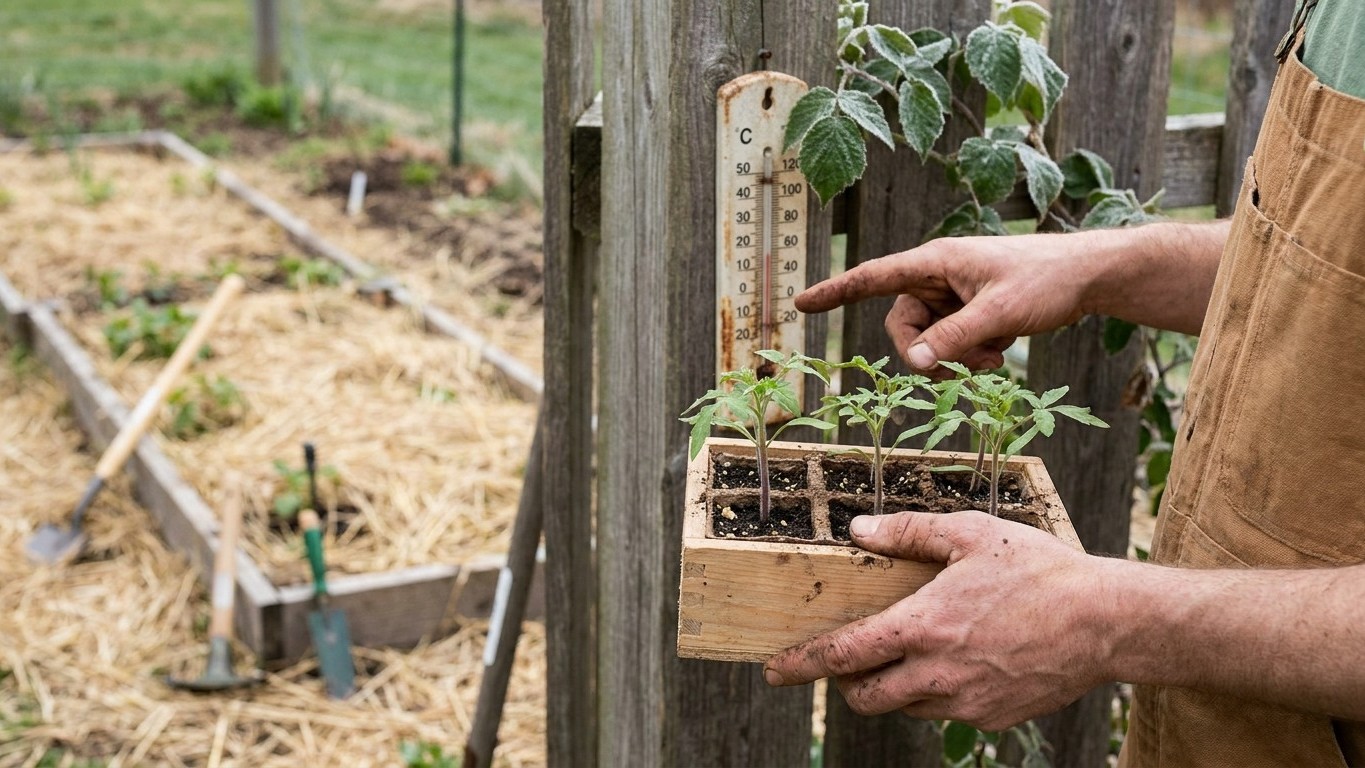

Tomato transplants can go into Vermont soil once the risk of a freeze has passed, and at Burlington that stretch falls between April 30 and May 10, according to NOAA’s 1991-2020 climate normals for station USW00014742. Colder pockets of the state push that later, sometimes by weeks. Check your own garden’s frost history against Burlington’s before you commit to a date, and default to the later half of the window if you garden away from Lake Champlain.
What this comes down to in Vermont

Set tomato transplants out too early along Lake Champlain and you won’t lose the plants outright — you’ll lose three weeks of growth to a cold night that stunts them just enough, and by August you’re still waiting on green fruit while the neighbor with the same seed packet is already canning. Guess wrong the other way, planting too late, and an early September frost catches everything unripe. Vermont’s frost window is real, it’s wide, and it’s the whole difference.
Do the subtraction and Burlington’s frost-free season runs roughly 146 to 166 days, depending on where within each range the actual freeze lands in a given year. That is a wide season by Vermont standards, and it is why the state’s mildest gardening ground sits along the lake. Move inland or uphill and the number drops, sometimes by a lot, which is a separate concern covered further down. For now, the working answer is this: don’t set tomato transplants outside before the last-frost window has passed, and don’t expect a single calendar date to apply to your yard just because it worked for a neighbor’s.
For which cultivars actually have a realistic shot at ripening in a Vermont season, see Tomato Varieties That Ripen in Time in Vermont. For the insects and diseases that show up on that timeline, see Tomato Pests in Vermont: Which Ones Actually Show Up Here. If you haven’t grown tomatoes here before, the general rundown on growing tomatoes in Vermont covers soil prep and staking.
Working it out for your own garden
The method has two halves: counting backward to find when to start seed, and counting forward to check whether a cultivar’s days-to-maturity fits before fall frost. Both use the same Burlington frost windows from NOAA’s 1991-2020 normals, and both produce a range, not a single day, because you’re subtracting or adding a fixed number of weeks to a range that already spans ten days.
Counting back for seed-starting
Most tomato seed packets call for starting indoors six to eight weeks before the transplant date. Apply that to Burlington’s April 30 to May 10 last-frost window and you land somewhere in the first half of March to the tail end of March, depending on how much lead time the cultivar wants and where in the frost window your actual last freeze falls that year. That’s a three-week band, not a date, and it’s supposed to be: the width of the band is the honest answer, not a rounding error to be tidied away.
Counting forward to check the fall end
Take a named cultivar’s catalogue days-to-maturity, add it to the transplant date, and compare the result to the first fall frost. ‘Fourth of July’, a hybrid slicer listed at around 49 days to maturity, transplanted at the earliest edge of Burlington’s window (April 30) ripens around June 18; transplanted at the latest edge (May 10) it ripens around June 28. Either way that’s roughly three months of clear margin before Burlington’s October 3-13 fall frost. ‘Brandywine‘, an indeterminate pink heirloom beefsteak often listed at 80 to 100 days, transplanted May 10 and counted out at 100 days lands close to August 18, still ahead of frost at Burlington, but with only about six to eight weeks of harvest window left instead of three months.
| Cultivar | Days to maturity (from transplant) | Approx. ripens (Burlington window) | Margin before Oct 3-13 frost |
|---|---|---|---|
| ‘Fourth of July’ | ~49 days | mid to late June | wide, roughly three months |
| ‘Brandywine’ | ~80-100 days | late July to mid August | narrow, roughly six to eight weeks |
That shrinking margin is the whole story. At Burlington, both cultivars finish. Move to a shorter growing season elsewhere in the state and the Brandywine margin is the one that disappears first, a point the next section picks up directly.
What changes across the state
Burlington’s numbers describe one specific place: a lake-moderated station on Lake Champlain, in the mildest corner of Vermont. The rest of the state does not share that climate. NOAA’s own caution on this data is explicit that the Green Mountains and the Northeast Kingdom run a substantially shorter frost-free season than the Champlain Valley does.
Elevation is the biggest lever. Cold air sinks, so valley bottoms and hillside hollows tend to freeze later in spring and earlier in fall than a slope just above them, a pattern gardeners here call a frost pocket. Distance from Lake Champlain is the second lever: the lake holds heat into fall and releases it slowly, which is why the shoreline towns freeze later than towns thirty miles east at the same elevation. Latitude matters too, but less than either of those: a garden in the Northeast Kingdom loses growing season to both its northerly position and its higher, colder terrain at once, which is why that region and the high Green Mountain valleys sit at the cold end of Vermont’s USDA hardiness range.
The USDA’s Plant Hardiness Zone Map, using the 1991-2020 normals, places Vermont across zones 3b to 5b. That five-zone spread inside one small state tells you what the frost data already implies: a planting date that works at Burlington can be two to three weeks premature in a Northeast Kingdom hill town or a Green Mountain valley. There is no single correction factor to apply, because the exact shift depends on your specific elevation, aspect and distance from open water, none of which a state-wide dataset can resolve. The only reliable fix is a local one: watch your own soil and your own microclimate, and treat Burlington’s window as the earliest plausible date in the state rather than a default.
The mistakes this state punishes

The most common failure is treating a warm stretch in April as permission to plant. Vermont springs run hot-cold-hot, and a few 70-degree days ahead of the frost window do nothing to change soil temperature at root depth. Cold, wet soil stunts a young tomato plant even if the air never drops to freezing, and a plant that’s been stalled for two weeks rarely catches up over the rest of the season. Wait out the full frost window before transplanting, not just the first mild spell that shows up inside it.
The second failure is choosing a cultivar for its flavor reputation without checking its days-to-maturity against the season length available. A 90-to-100-day heirloom like ‘Brandywine’ finishes at Burlington with room to spare, as the arithmetic above shows, but the same cultivar planted at a higher, colder site with a season closer to the low end of Vermont’s range can run out of time before the fruit sizes up, let alone ripens. If your garden sits away from the lake or above the valley floor, that’s the moment to shift toward a shorter-season pick rather than assume Burlington’s numbers apply. The Vermont varieties guide lays out which cultivars carry enough margin to be worth the risk in a shorter season.
The third is ignoring the fall end of the calendar entirely. Gardeners plan the spring transplant date carefully and then forget that the first fall frost is just as real a deadline as the last spring one. A late-set, long-season plant can still be carrying green fruit when the first hard freeze of October hits, and there’s no way to un-lose that harvest once it’s frozen on the vine.
Checking this against your county
Everything above is built on one Burlington station, and Burlington is not your county unless you actually garden near the lake. Before you lock in a planting date, check your own frost history and, if you can find it, your county’s typical frost pattern against Burlington’s. The University of Vermont Extension is the state’s land-grant extension service and the right first call for anything county-specific, including local frost records and a Vermont-specific tomato planting guide. A phone call or a look at their published guidance beats guessing from a state-wide average every time.
Common questions
Can I just direct-seed tomatoes outside instead of starting indoors?
No, not in Vermont. The frost-free season, even at its longest around Burlington, isn’t long enough for a tomato seed sown outdoors to grow, flower and ripen fruit before fall frost. Start seed indoors and transplant out once the last-frost window has passed.
What happens if I plant before the frost window closes?
You’re gambling on the early end of a range that NOAA describes as having a 30 to 70 percent freeze probability across those dates, meaning a freeze is a real possibility right up to the late end of it. A single freeze event can kill unprotected transplants outright, so if you plant early, be ready to cover the plants on any night forecast near freezing.
Is it better to transplant at the early or late end of the window?
The later end is the safer bet almost everywhere in the state, and especially away from Lake Champlain, since the caution in NOAA’s own data notes that higher and more inland parts of Vermont run a shorter season than Burlington’s. The early end only makes sense right along the lake shore or if you’re using season-extending covers.
Do row covers or wall-o-water devices change these dates?
They can let you set plants out a bit ahead of the average window by buffering the plant from a light frost, but they don’t change the underlying freeze risk on a hard-freeze night. Treat them as insurance for the edges of the window, not as a reason to ignore it altogether.
Some gardeners also time this by the Moon: when to plant tomatoes by the moon, as almanac tradition rather than fact.