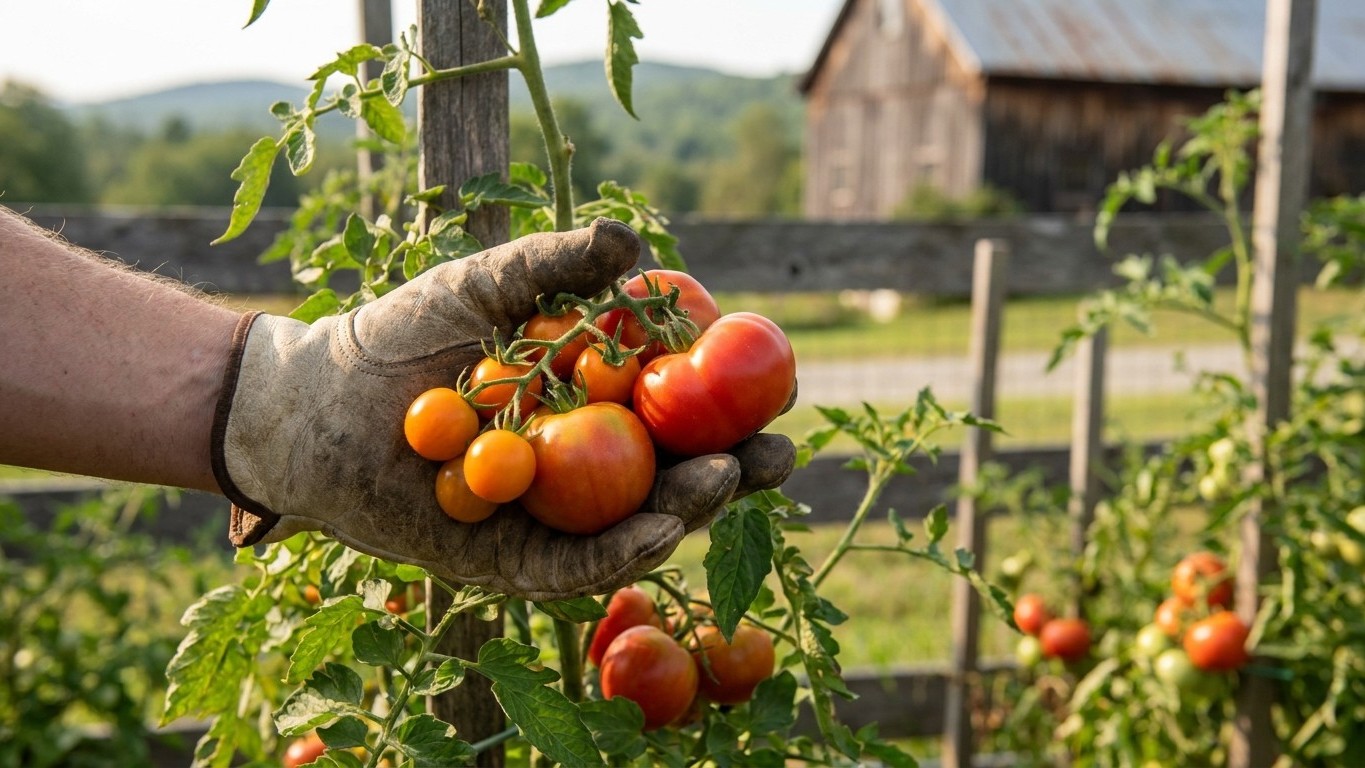

Near Burlington, NOAA’s 1991-2020 climate normals put the first fall frost at October 3 to October 13, and the last spring frost at April 30 to May 10. That window is long enough for most tomatoes rated up to about 75 days from transplant, and some rated up to 78 in a normal year. Check a variety’s days-to-maturity number against that window before you buy the seed packet, not after you’ve already got seedlings on a windowsill.
What this comes down to in Vermont

Once you’ve handled the basics of growing tomatoes in Vermont, the variety you pick is what decides whether you’re eating fruit by August or watching green tomatoes sit on the vine when the first freeze comes through. Near Burlington, NOAA’s 1991-2020 normals put that first fall frost at October 3 to October 13, and the last spring frost at April 30 to May 10. Days to maturity is counted from transplant, not from seed, so a 55-day variety set outdoors in mid to late May is producing ripe fruit in mid July, not sometime in August.
The list below runs from the shortest season to the longest, so you can see exactly where the line sits for your own garden and your own elevation.
Sakura

Sakura needs about 55 days from transplant and is indeterminate, meaning it keeps setting new fruit until frost. Set out mid May to late May, it reaches first ripe fruit around mid July, which leaves roughly 77 days of margin before the Burlington-area frost window opens. It’s a red cherry tomato meant for snacking and salads, and its resistance to nematodes, tomato mosaic virus and fusarium wilt races 1 and 2 makes it one of the safest bets on this list.
Glacier

Glacier also needs about 55 days and carries the same 77 days of margin, but it’s determinate rather than indeterminate, so the whole crop ripens over a few weeks instead of trickling in until frost. That suits anyone who wants to can or freeze a batch all at once rather than pick a handful every day. It’s a compact plant, which also makes it a reasonable choice for a container on a deck or a cold, exposed spot.
Sun Gold

Sun Gold runs 57 days from transplant and lands about 75 days of margin before the Burlington-area frost. The fruit is a small orange-gold cherry tomato, sweeter than most reds, good straight off the vine. It resists tobacco mosaic virus and fusarium wilt race 1, both useful where tomatoes have been grown in the same bed for several years running.
Juliet

Juliet takes 60 days from transplant, first ripe fruit landing in late July with about 72 days of margin. The fruit is a red grape-shaped tomato good for roasting, sauce or eating whole, and it carries intermediate resistance to both late blight and early blight, which matters in a state where damp summers give both diseases plenty of chances to take hold.
Amalfi

Amalfi needs 68 days from transplant and finishes with about 64 days of margin, first ripe fruit in late July. It’s a determinate paste tomato bred for sauce and canning, and its intermediate resistance to nematodes, late blight and early blight makes it a solid pick for anyone who’s had blight wipe out a planting before.
Cherokee Purple

Cherokee Purple takes 72 days from transplant, reaching first ripe fruit in early August with about 60 days of margin. It’s a heirloom slicer with dusky purple-pink flesh, prized for flavor rather than yield or toughness, and it carries none of the disease resistance bred into the newer hybrids on this list, so it’s worth watching the foliage closely through a wet stretch.
Big Beef Plus
Big Beef Plus also needs 72 days and shares that 60-day margin, first ripe fruit in early August. It’s a large red beefsteak for slicing, and it resists nematodes, gray leaf spot and tomato mosaic virus, which makes it a more forgiving choice than Cherokee Purple if disease pressure is a concern.
Tiren
Tiren runs 75 days from transplant, first ripe fruit in early August, leaving about 57 days of margin. It’s an indeterminate paste tomato for sauce, resisting verticillium wilt, tomato mosaic virus and fusarium wilt race 1. That margin is still workable near Burlington but starts to feel tight in a cold, wet spring that delays transplanting.
Celebrity Plus
Celebrity Plus is the longest-season variety on this list, needing 78 days from transplant and finishing with only about 54 days of margin, first ripe fruit in early August. It’s a determinate all-purpose slicer with resistance to nematodes, gray leaf spot and tomato mosaic virus. That’s fine in a normal year near Burlington, but it’s the one variety here where a cold spring or an early frost genuinely puts the harvest at risk, especially away from the lake.
Working it out for your own garden
The arithmetic behind every date on this page runs the same way, and you can do it yourself for any variety not listed here. NOAA’s 1991-2020 normals put the Burlington-area last spring frost at April 30 to May 10, so soil generally isn’t warm enough to set out tomato transplants until some point in that stretch, typically mid to late May once nights stay reliably above the low 50s. That’s covered in more detail in Tomato Planting Dates in Vermont: Counting Back From Your Frost Window. Add the days-to-maturity figure from the seed packet to that transplant range, and you get a ripening window, itself a range because both ends are approximate.
A worked example, and where the line falls
Take Big Beef Plus, 72 days from transplant. Set out mid to late May, it reaches first ripe fruit in early August. NOAA’s 1991-2020 normals put the Burlington-area fall frost at October 3 to October 13, so that leaves roughly 60 days of margin, plenty of cushion even in a cool year.
Now push past what’s on this list. An 85-day paste tomato transplanted on that same mid-to-late-May schedule wouldn’t reach first ripe fruit until the second half of August, and any setback from a wet spring or an early cutworm attack pushes that further toward September. That leaves less than three weeks of margin before the Burlington frost window opens, not much of a cushion if August runs cool or frost lands on the early side of NOAA’s range. That’s the line: past about 75 to 78 days from transplant near Burlington, and sooner almost everywhere else in the state, a variety is gambling with the season instead of working with it.
- Find the days-to-maturity number on the seed packet or catalogue listing.
- Add it to your expected transplant date, which for most of the state falls after the local last-frost window.
- Compare the resulting ripening range against your local first-fall-frost range.
- If the margin is under about four weeks, treat that variety as a gamble, not a plan.
What changes across the state
Vermont is not one climate, and the Burlington figures above come from a station on Lake Champlain, the mildest corner of the state. The USDA’s Plant Hardiness Zone Map puts the whole state at 3b to 5b, and that spread reflects a real difference on the ground. Burlington sits toward the milder end of that range, buffered by the lake, which moderates both spring and fall temperatures and holds off frost longer than inland ground at the same latitude.
Move up into the Green Mountains or out into the Northeast Kingdom, and the growing season runs substantially shorter than what the Burlington normals describe, both later to warm in spring and earlier to freeze in fall. Elevation matters as much as latitude here. A garden a few hundred feet higher than a neighboring valley floor can lose real growing days on both ends of the season, which is exactly why a 78-day variety that finishes comfortably near the lake can run out of time a short drive away.
South of Burlington, along the Connecticut River valley, some pockets hold heat a bit better than the surrounding hill country, though nothing in the state approaches the lake’s buffering effect. The practical takeaway is that the Burlington window is a starting point for the mildest ground in the state, not a number to apply blind to a garden at elevation or tucked into a cold hollow.
The mistakes this state punishes

The most common mistake is trusting a warm stretch in April. Vermont’s spring temperatures swing hard, and NOAA’s 30 to 70 percent freeze-probability band around April 30 to May 10 near Burlington means a real frost risk persists well past the point where the ground finally feels like spring. Setting transplants out during an early warm spell, only to lose them to a freeze days later, costs most of a month once you account for reseeding and regrowing.
The second is picking a long-season variety for a short-season spot. Celebrity Plus and Tiren both work near Burlington in a normal year, but the same variety planted at elevation or in the Northeast Kingdom can run out of season before the fruit fully ripens. Match the days-to-maturity number to your actual local frost window, not to the mildest figure you’ve seen for the state.
The third is ignoring the disease pressure that a damp Vermont summer brings, particularly late blight and early blight. Varieties like Juliet and Amalfi carry intermediate resistance to both, which buys real time in a wet year, while heirlooms like Cherokee Purple carry none and need closer watching. For the pests and diseases that actually show up here and roughly when, see Tomato Pests in Vermont: Which Ones Actually Show Up Here.
Checking this against your county
Every figure above comes from the Burlington-area station in NOAA’s climate normals, and it’s a starting point, not an instruction for your specific ground. Confirm your own frost dates and season length with your county’s UVM Extension office before betting a summer on a longer-season variety. UVM Extension, the state’s land-grant university extension service, maintains local offices and its own tomato guidance at uvm.edu/extension, and that’s the right place to check conditions specific to your county rather than the state-wide range.
Common questions
Can I grow a 90-day tomato in Vermont?
Not reliably near Burlington on an open-ground schedule, and not at all in most of the rest of the state. A 90-day variety transplanted in the mid-to-late-May window would need to ripen in the second half of August at the earliest, leaving almost no cushion before NOAA’s fall frost normals close the season in early to mid October. A high tunnel or other season-extension setup changes that math, but that’s a separate project from picking a variety.
Do I really need disease-resistant varieties?
You don’t need them everywhere in the state, but they earn their keep in a wet year. Vermont’s summers bring enough humidity that late blight and early blight show up most seasons somewhere in the state, and a variety like Juliet or Amalfi with intermediate resistance to both can keep producing through conditions that would defoliate an heirloom with no resistance at all.
What’s the real difference between determinate and indeterminate for a short season?
Determinate varieties like Glacier or Celebrity Plus ripen most of their fruit over a few weeks and then taper off, which suits anyone canning or freezing a batch all at once before frost. Indeterminate varieties like Sakura or Big Beef Plus keep flowering and setting new fruit right up until frost kills the plant, which means a longer trickle of fresh tomatoes but no single big harvest day.
A late frost killed my transplants, what do I replant with?
A short-season cherry or grape tomato is the safest replant option this late in the game. Sakura, Sun Gold and Juliet all run 55 to 60 days from transplant, so even a replant in early to mid June still leaves enough of the Burlington-area season, based on NOAA’s October 3 to October 13 frost normals, to bring in a real harvest before frost returns.