
Vermont tomato pests follow the same cool-climate lineup you’d find across the Northeast: cutworms and flea beetles at transplant, aphids and Colorado potato beetles through the middle of summer, hornworms and fruitworms as the season peaks and the crop is closest to harvest. None of them care about a calendar date, only about plant stage and weather, and pressure keeps building right up until frost shuts the garden down. NOAA’s 1991-2020 climate normals put Burlington’s first fall frost between October 3 and October 13, and in most years the last hornworms and fruitworms are still working the vines when that window opens. Start scouting the week you set out transplants, not after you spot chewed leaves.
What this comes down to in Vermont

The short answer: Vermont sees a fairly small, predictable set of tomato pests, and they show up in a fairly predictable order tied to plant stage rather than a fixed date. Cutworms and flea beetles hit seedlings right after you move them into the garden. Aphids build through the cooler, damper stretches of early and midsummer. Colorado potato beetles, hornworms, and fruitworms arrive as the plants bulk up and start setting fruit. Knowing the order matters more than knowing the exact week, because the trigger is what the plant is doing, not what the thermometer says.
Cutworms

Cutworms are the pest of the first two weeks after transplant. They feed at night and hide in the soil by day, so the first sign is usually a seedling lying on its side with the stem severed clean at the soil line. A cardboard collar pushed an inch into the soil around each stem at planting time stops them cold; once a stem is cut, the plant is done.
Flea Beetles

Flea beetles show up on the same young seedlings, chewing dozens of tiny round holes that make the leaf look like it took buckshot. Seedlings can outgrow light damage once they’re established, but a heavy hit on a small transplant can stall it for good. Floating row cover laid over the bed right after transplanting keeps the beetles off until the plants are big enough to shrug off the damage.
Aphids

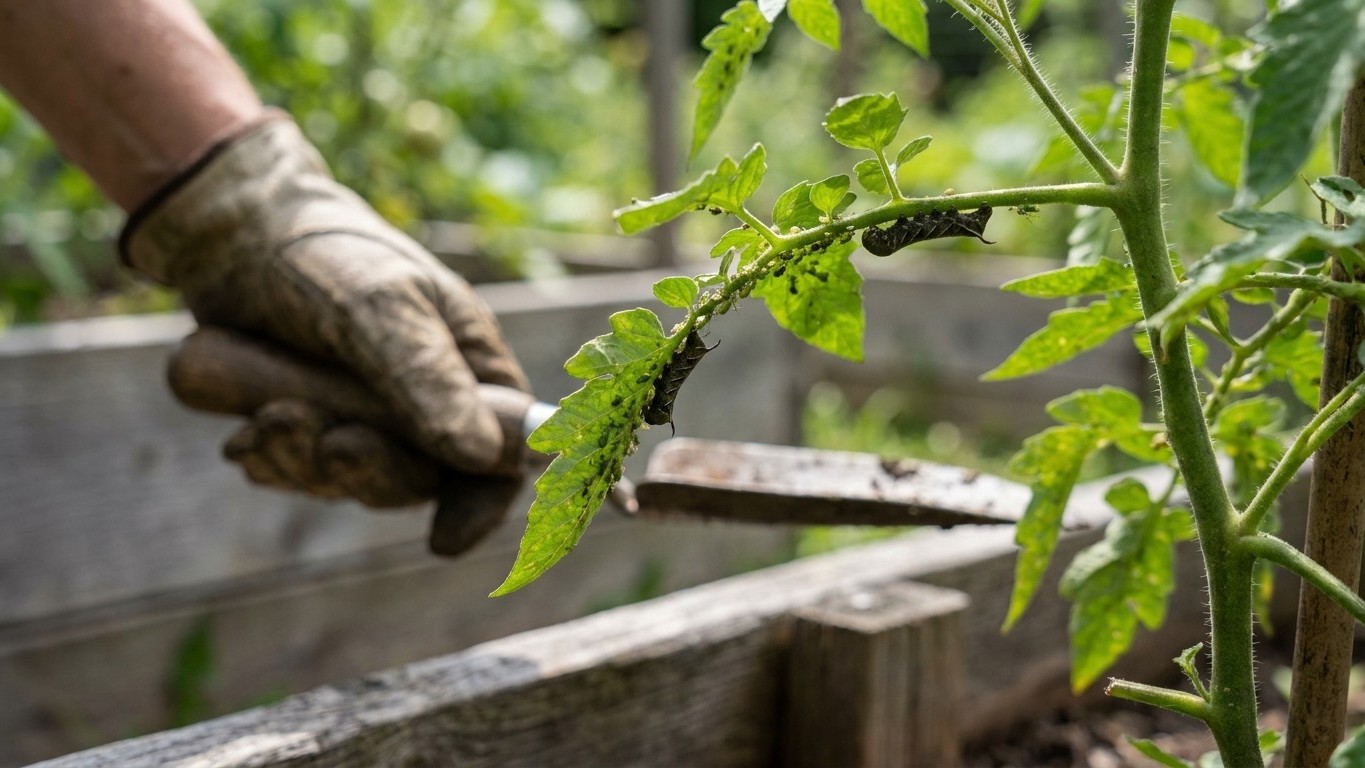
Aphids cluster on stems and the undersides of leaves, sucking sap and leaving behind a sticky residue that can turn leaves curled and yellow. A strong jet of water knocks most colonies down, and insecticidal soap handles the rest; heavy aphid pressure is usually a sign the plants are stressed from crowding or uneven watering, so fixing that helps as much as any spray.
Colorado Potato Beetle

The striped adult beetle and its red, humpbacked larvae both feed on tomato foliage, though they prefer potato when it’s around. Hand-picking beetles and squashing egg clusters on the underside of leaves keeps small infestations from becoming defoliation.
Tomato Hornworm

Hornworms strip whole branches down to bare stems seemingly overnight, and the caterpillar itself is so well camouflaged that the dark droppings on the leaves below it are often the first thing you notice. They’re large enough to hand-pick once you spot them.
Tomato Fruitworm

Fruitworms bore directly into green or ripening fruit, leaving a clean entry hole and a hollowed-out interior. Damage usually shows up right at fruit set, and once a fruitworm is inside the fruit there’s no fixing that one, only preventing the next generation.
Working it out for your own garden
The fastest way to identify what’s actually eating your plants is to work backward from the damage pattern, not from a photo of the insect. Walk the row and check the signs below before reaching for any spray.
| What you see | Likely pest | When it shows up |
|---|---|---|
| Stem severed at the soil line, seedling toppled over | Cutworm | Right after transplant |
| Small round holes shot through young leaves | Flea beetle | Early season, on new transplants |
| Clusters of tiny insects and sticky residue on leaves | Aphid | Anytime, worse in cool damp stretches |
| Striped beetles and red humpbacked larvae stripping leaves | Colorado potato beetle | Midsummer |
| Foliage stripped to bare ribs, dark droppings below | Tomato hornworm | Mid to late summer |
| Clean holes bored into green or ripening fruit | Tomato fruitworm | Late summer, at fruit set |
Timing your scouting to plant stage rather than the calendar is what makes this method hold up whether your soil warmed up on schedule or two weeks late. If you’re still working out when your own transplants actually go in the ground, that’s the question the Tomato Planting Dates in Vermont: Counting Back From Your Frost Window page answers, and it directly sets the window when cutworms and flea beetles are a real threat versus a non-issue. A seedling that’s been in the ground three weeks and has six true leaves is past the point where cutworms matter, so don’t keep collars on plants that have outgrown the risk; save that attention for whatever you transplant next.
For midsummer and late-season pests, the check is less about the calendar and more about which of your plants are fruiting. A hornworm or fruitworm problem on a plant that hasn’t set fruit yet is unlikely; concentrate your scouting on plants that already have green tomatoes on them.
What changes across the state
Every figure above comes from conditions at or near Burlington, and Burlington sits in the mildest corner of Vermont, right on Lake Champlain. The lake moderates temperature swings in both directions, so pest activity there starts a bit earlier in spring and keeps going a bit later in fall than it will in the Green Mountains or the Northeast Kingdom. The USDA’s hardiness map puts the state across zones 3b to 5b, and that spread is the clearest sign of how much elevation and distance from the lake change things: a garden in a mountain valley or up in the Kingdom is working with a noticeably shorter, cooler season than one in the Champlain Valley.
A shorter season doesn’t mean fewer pests, it means a compressed window for all of them. Aphids and Colorado potato beetles still show up, but the whole cycle from transplant to first frost happens faster, so there’s less margin for letting a problem sit before dealing with it. Gardeners at higher elevation or farther from the lake should scout on the same plant-stage cues, just expect the whole sequence to run tighter from one end of the season to the other. This is also part of why the right cultivar for a short mountain season is a different conversation than the right cultivar for the Champlain Valley; the Tomato Varieties That Ripen in Time in Vermont page works through that trade-off separately from pest pressure.
Wind exposure and soil drainage matter too, though less predictably. Cutworms tend to be worse in beds that were sod or heavily mulched the previous fall, since that’s where the moths lay eggs. A well-drained bed that warms up quickly in spring gets seedlings past the vulnerable cutworm stage faster, regardless of what part of the state you’re in.
The mistakes this state punishes

The single most common mistake is treating a warm stretch in late spring as proof the pest threat has passed. A few 70-degree days can make a cutworm collar feel unnecessary, but the moths that lay cutworm eggs aren’t reading the same forecast, and a cold snap right after a warm spell is exactly when stressed young transplants take the worst damage. Skip the collar and you’re gambling on weather that Vermont doesn’t reliably deliver.
The second is waiting for visible damage before scouting at all. Hornworms are so well camouflaged that by the time you spot the caterpillar itself, it’s often already stripped a branch bare. Checking the undersides of leaves and the ground beneath the plant for droppings, once a week starting at fruit set, catches the problem while it’s still one caterpillar instead of three.
The third is spraying broadly and early out of caution. A broad-spectrum insecticide applied at the first sign of aphids also kills off the small parasitic wasps and ladybugs that would otherwise keep aphid numbers down on their own. On a crop already growing on a tight season, as most of Vermont’s is, losing those beneficial insects early tends to cost more than the aphids would have.
Checking this against your county
Every pest and pattern here is a starting point for the state as a whole, built around conditions at Burlington, and your own county can run earlier, later, or with different pest pressure entirely depending on elevation and local microclimate. Before you plan a spray schedule around any of this, check with your county office of growing tomatoes in Vermont, and confirm current pest guidance with UVM Extension at uvm.edu/extension, which tracks conditions across the state’s counties rather than one reference station.
Common questions
Do I need to spray for cutworms if I don’t see any yet?
No, not as a preventive spray. A physical collar around the stem at transplant time does the same job without putting anything on the plant, and it’s the standard fix rather than a chemical one.
Are hornworms dangerous to touch?
No, tomato hornworms don’t bite or sting despite the alarming horn at the tail end. The horn is soft and harmless; it’s just for looks. Hand-picking them off the plant is safe and effective.
Why do my aphids keep coming back after I spray them off?
Because a water spray or soap treatment kills what’s on the plant that day but doesn’t stop new aphids from arriving or eggs from hatching. Repeat every few days through an active infestation, and address whatever is stressing the plant, since stressed tomato plants tend to attract heavier aphid pressure.
Is it too late to plant tomatoes if I already have flea beetle damage on my seedlings?
Usually not. Established tomato plants can outgrow light flea beetle feeding once they’re past the seedling stage, so damage on a young transplant isn’t a reason to start over. Cover the plants with row cover until they’ve put on a few more sets of true leaves and the risk mostly passes on its own.