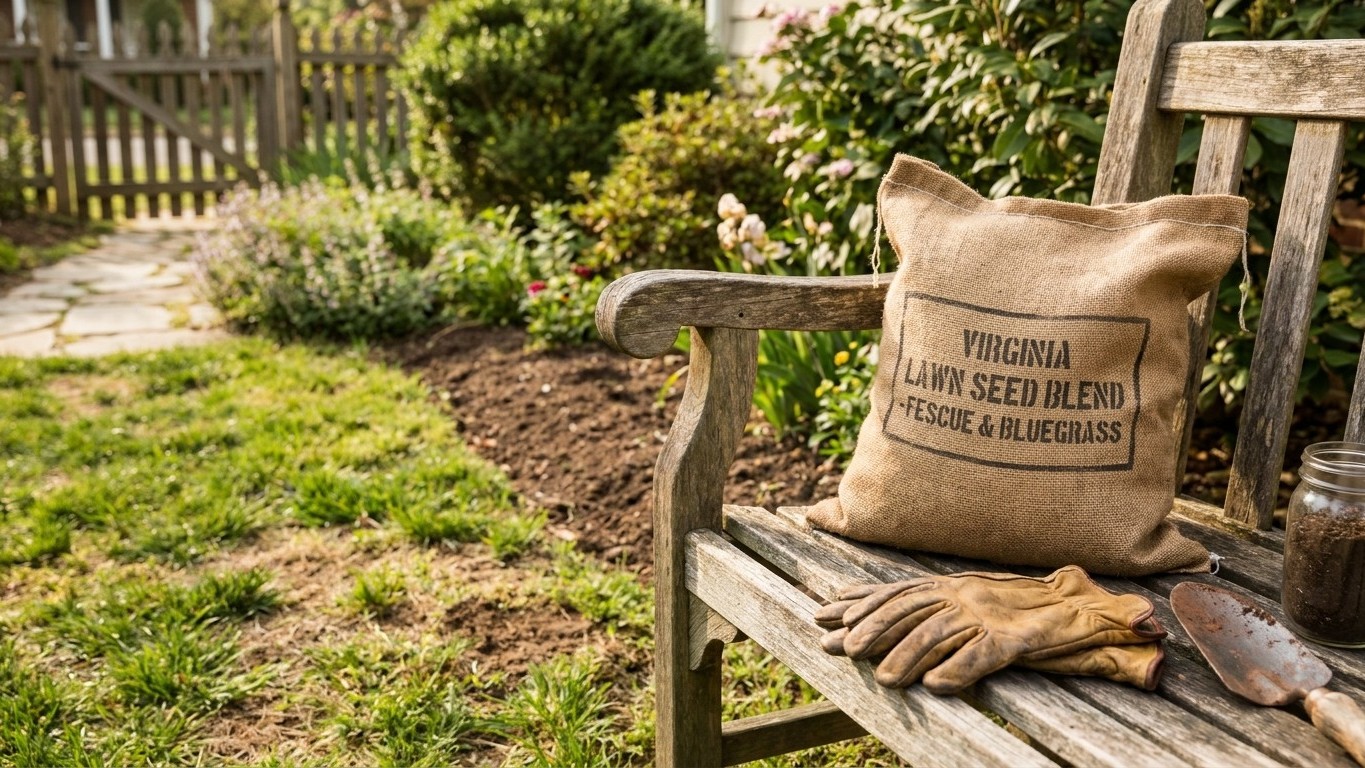

Virginia’s transition zone is the reason no single bag of seed will keep a lawn here green all year. Too hot for cool-season grass to survive summer without stress, too cold for warm-season grass to hold color past the first freeze — every species sold for this state gives up something. Tall Fescue trades summer toughness for winter green. Zoysia and Bermuda trade winter color for summer density. The right pick depends on which trade-off you can live with, not on which bag claims “best.”
The short answer for Virginia
There is no single best grass seed for a Virginia lawn, because Virginia Beach and most of the rest of the state sit in what turf agronomists call a transition zone: too hot for cool-season grass to stay green through summer, too cold for warm-season grass to stay green through winter. Clemson Cooperative Extension’s HGIC 1214 fact sheet lists five species grown across this zone: Tall Fescue, Kentucky Bluegrass and Perennial Ryegrass on the cool-season side, Zoysiagrass and Bermudagrass on the warm-season side. Each one gives up something. Before comparing them, make sure the basics of Virginia Lawn Care, a soil test and a look at drainage, are already sorted, since no seed choice fixes a bad site.
What the choice actually depends on
A cool-season lawn, and Tall Fescue is by far the most planted of the three in this zone, stays green from fall through spring and only struggles for the hottest, driest stretch of summer. A warm-season lawn, Zoysiagrass or Bermudagrass, holds its color and density through that same stretch, then goes dormant and tan, not dead, from the first hard freeze until spring green-up. NOAA’s 1991-2020 climate normals for the Oceana station near Virginia Beach put the first fall freeze at November 10 to November 24, so a warm-season lawn there is out of active growth for roughly five months of the year.
The right answer depends on how much you use the lawn in winter, how much you’re willing to irrigate in summer, and whether a lawn that looks the same in January as it does in June actually matters to you. If green in February is the priority, that already points toward the cool-season side, whatever the summer cost. If July and August matter most, when Virginia’s heat and humidity are hardest on turf, the warm-season grasses carry less risk. The trade-off runs statewide, though the exact dates shift by region, covered further down.
Working through the year

Once you know which season’s grass you’re growing, the maintenance calendar splits into two different years, and Clemson Cooperative Extension publishes a separate one for each species: HGIC 1219 for Tall Fescue, HGIC 1216 for Bermudagrass, and HGIC 1217 for Zoysiagrass. Use the one that matches the grass already in the ground, not the one that matches the season you happen to be reading this in. For the week-by-week version of these tasks laid across the full calendar year, see The Virginia Lawn Care Calendar, Month by Month.
Tall Fescue

Tall Fescue is the cool-season workhorse of this zone. Clemson’s HGIC 1219 calendar times its heaviest feeding and any overseeding for early fall, while the grass is rebuilding roots after summer stress, with a lighter feeding again in late fall. Spring nitrogen is kept light on purpose, and mowing height is raised through summer rather than lowered, because a Tall Fescue lawn cut short going into a hot, dry stretch is the fastest way to lose it. Fall, once nights cool, is also the window that calendar sets aside for aeration and overseeding.
Kentucky Bluegrass

Kentucky Bluegrass spreads by rhizomes and can knit over bare patches better than a bunch-type grass, which is why it shows up in Tall Fescue seed blends sold in this region. Grown alone, it’s slower to establish and less tolerant of Virginia’s summer heat and humidity than Tall Fescue, so it’s rarely planted as a stand-alone lawn here.
Perennial Ryegrass

Perennial Ryegrass germinates faster than either Tall Fescue or Kentucky Bluegrass, sometimes showing green in under a week, which is why blends add it to hold soil while the slower seedlings establish. It’s a bunch-type grass with no rhizomes or stolons, so a stand grown alone thins out within a couple of seasons and isn’t a realistic long-term lawn on its own in this zone.
Zoysiagrass

Zoysiagrass is the warm-season option that builds the densest, most weed-resistant stand once established, and Clemson’s HGIC 1217 calendar puts its nitrogen and mowing work in late spring through summer, when it’s actively growing. It’s also the slowest of the warm-season grasses to fill in from plugs or sprigs, sometimes taking more than a full season, which is the price of that density later. Expect it to go dormant and turn tan at the same fall freeze that ends fescue’s stressful season and starts its recovery.
Bermudagrass

Bermudagrass grows and spreads faster than Zoysiagrass, filling bare soil in weeks rather than a season, and it takes summer heat and drought better than any grass on this list. Clemson’s HGIC 1216 calendar concentrates its feeding in the warm months and calls for the mower kept low, well below a fescue’s summer height. The same speed that fills a lawn fast also sends it into flower beds and over sidewalks if it isn’t edged, and it typically goes dormant and pale brown earlier in fall than Zoysiagrass.
| Grass | Season type | Spreads by | Main trade-off |
|---|---|---|---|
| Tall Fescue | Cool-season | Bunch, no runners | Green fall to spring, stressed in peak summer heat |
| Kentucky Bluegrass | Cool-season | Rhizomes | Fills gaps in a fescue blend, weak alone in heat |
| Perennial Ryegrass | Cool-season | Bunch, no runners | Fast nurse grass, thins out after a season or two |
| Zoysiagrass | Warm-season | Stolons and rhizomes | Dense and weed-resistant, slow to establish, dormant in winter |
| Bermudagrass | Warm-season | Stolons and rhizomes | Fast and heat-tough, aggressive spreader, dormant in winter |
What changes across Virginia
Every date and zone label in this piece is anchored to Virginia Beach, specifically the NAS Oceana weather station NOAA uses for its 1991-2020 climate normals. That’s the mild, coastal end of the state, and the rest of Virginia runs behind it, not ahead.
Elevation and latitude both push the season later
Move inland and north toward Northern Virginia and the Piedmont, and the growing season shortens from both ends: spring green-up starts later and the first fall freeze arrives earlier than the Virginia Beach window of November 10 to November 24 that NOAA records. Move west into the Blue Ridge and the mountains of southwest Virginia, and elevation does the same thing again, on top of the latitude effect. A fescue lawn at altitude in a county like Highland or Bath is working with a shorter, cooler summer than one in Virginia Beach, which is actually easier on cool-season grass, while a Bermudagrass lawn attempted at that elevation fights a much longer dormant season than the coastal figures above suggest.
The transition zone label itself shifts too. Far southwest Virginia and the higher Blue Ridge counties run cool enough, for long enough, that they lean closer to a straightforward cool-season climate, where Tall Fescue alone does better and warm-season grass makes less sense at all. The Eastern Shore and the far southeast, closest to Virginia Beach’s own conditions, sit deepest in the transition zone, where the trade-off between the two grass types is sharpest. Nothing here is a hard boundary. Soil, slope and shade change the local picture as much as regional climate does, which is why a county-level check, covered below, matters more than a statewide rule.
The mistakes this climate punishes
Most lawn failures in this zone trace back to a calendar or a habit borrowed from a different climate. The mistakes below aren’t universal turf errors, they’re specific to running a transition-zone lawn in coastal and central Virginia.
- Feeding a warm-season lawn nitrogen in September or October
- Sowing cool-season grass seed in late spring instead of fall
- Mowing Tall Fescue short right before a hot, dry stretch
- Treating winter brown on Zoysiagrass or Bermudagrass as a dead lawn
Why these show up months later, not right away
Feeding Bermudagrass or Zoysiagrass late in the year pushes soft new growth right as the grass should be hardening off for winter dormancy, and that soft growth is what gets damaged when the first fall freeze arrives, sometime in the November 10 to November 24 window NOAA records for Virginia Beach. The damage doesn’t show until the following spring, when the fed patches come back thin or dead while the rest of the lawn greens up normally.
Sowing Tall Fescue, Kentucky Bluegrass or Perennial Ryegrass seed in May instead of fall is the reverse problem. The seedlings germinate into summer heat they can’t handle, and most of that seeding is dead by August regardless of how much it’s watered. Cool-season seed belongs in a cooling season, not a warming one.
Cutting Tall Fescue down to a short, tidy height right as summer heat sets in removes the leaf area the plant needs to shade its own root zone. The lawn doesn’t wilt the day of the cut. It thins out three or four weeks later, once the roots have baked, and by then a taller mowing height is a repair, not a prevention.
A Zoysiagrass or Bermudagrass lawn that turns tan after the first freeze is dormant, not dying, and reseeding or replacing it in November wastes both seed and money. It comes back on its own once soil temperatures rise in spring, on the schedule set out in Clemson’s HGIC 1216 and HGIC 1217 calendars.
Checking this against your county
Every figure above is anchored to Virginia Beach. Your own county can run weeks earlier or later, especially anywhere west of the fall line or up in elevation, so the frost window and the transition-zone label here are a starting point, not a local forecast.
Virginia Cooperative Extension keeps county-level offices that adjust these figures for local soil and climate, and the Virginia Cooperative Extension directory is the fastest way to find the office covering your address. A local agent can confirm which grass calendar actually applies to your elevation and how far off the Virginia Beach dates your county runs.
Common questions
Can I mix Bermudagrass and Tall Fescue in the same lawn?
Not as a stable long-term lawn. They sit on opposite ends of the growing calendar, so wherever they meet, one is dormant while the other is actively growing and will crowd it out over a few seasons. Most transition-zone yards choose one species for the main lawn and accept that the other will creep in from a sunny edge or a neighbor’s yard regardless.
Why is my Zoysiagrass still brown in early spring?
Zoysiagrass is one of the last warm-season grasses to green up, and a tan lawn well into spring is normal dormancy, not damage. It follows soil temperature, not the calendar, so a cool, wet spring pushes green-up later than a warm one does. Pull back a few blades and check for green at the crown before assuming the lawn is dead.
Is it too late to seed Tall Fescue if I missed fall?
Spring seeding of Tall Fescue is possible but riskier in this zone, since the seedlings have only a few cool months to root before summer heat arrives. A light spring seeding to patch bare spots can work, but treat fall as the real seeding window and use spring only to fill gaps, not to establish a new lawn from scratch.
Will Kentucky Bluegrass survive on its own in a Virginia yard?
It can survive, but it thins out under summer heat and drought faster than Tall Fescue does when grown alone, which is why it’s almost always sold blended into a fescue seed mix in this climate rather than as a straight stand. If an existing lawn is pure bluegrass and thinning every summer, overseeding it with Tall Fescue in fall is the usual fix.