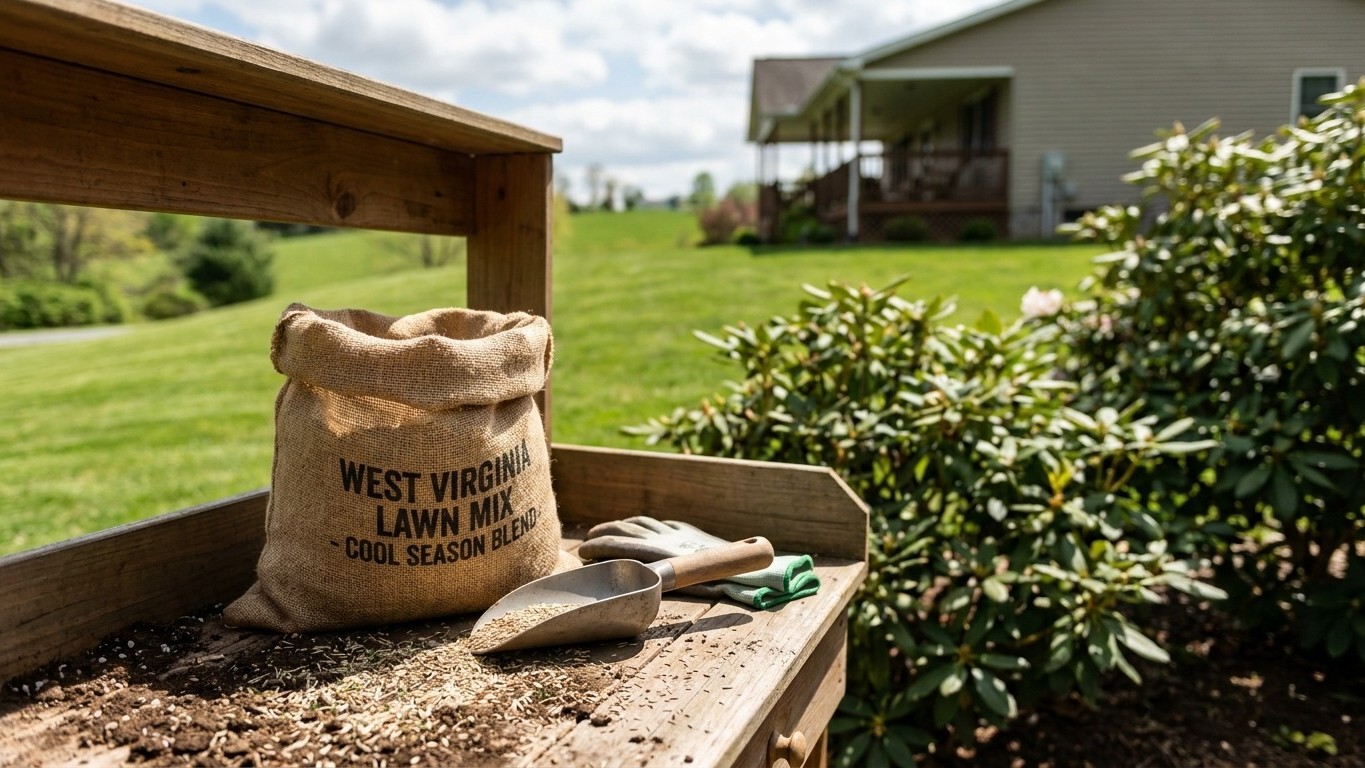

Elevation and shade, not the calendar, are what decide which grass seed works on a West Virginia lawn. A Charleston river valley and a Pocahontas County ridge sit in the same state but almost different climates, which is why turf-type tall fescue ends up the safest bet for most yards here — it shrugs off drought, foot traffic, and partial shade better than Kentucky bluegrass, fine fescue, or perennial ryegrass manage together. Warm-season grasses never enter the conversation; the winters simply won’t let them survive.
The short answer for West Virginia
For most West Virginia yards, a turf-type tall fescue is the safest single pick. It tolerates drought, foot traffic and partial shade better than the other cool-season options Clemson Cooperative Extension’s HGIC 1214 lists for this climate: Kentucky bluegrass, fine fescues, perennial ryegrass and rough bluegrass. None of those five is a warm-season grass like bermuda or zoysia, and none of the warm-season species belongs here at all. West Virginia’s winters are too cold and its growing season too short for warm-season turf to hold color or survive without dying back hard.
What changes the answer is the site, not the state. A steep, sun-baked bank calls for tall fescue’s deep root system over bluegrass’s shallower one. A dense shade bed under old maples needs a fine fescue or rough bluegrass instead, since none of the others tolerate low light as well. A yard that gets mowed and fed on a tight schedule can carry Kentucky bluegrass’s higher input needs and get a denser, self-repairing lawn in return. A yard seeded once and left alone does better with tall fescue’s tougher, clump-forming habit.
The other variable is elevation, which the next section covers in more detail. Charleston’s river-valley climate is not the same as the climate on a ridge in Pocahontas County, and the frost dates and seeding windows shift with it. Before you buy seed, it helps to know where your property sits on that gradient, because it changes how much margin you have to work with in fall.
Working through the year

Ranking the realistic species
Here is how the five cool-season grasses Clemson HGIC 1214 and Penn State Extension list for this climate stack up against each other, and what each one costs you in exchange for its strengths.
| Species | Drought tolerance | Shade tolerance | Wear tolerance | What it costs you |
|---|---|---|---|---|
| Tall Fescue | High | Moderate | High | Coarser blade, clumps if patched with a different type |
| Kentucky Bluegrass | Low | Low | Moderate | Needs more water and nitrogen to stay dense |
| Fine Fescues | Moderate | High | Low | Thins out fast under regular foot traffic |
| Perennial Ryegrass | Low | Low | Moderate | Fast to establish but short-lived on its own |
| Rough Bluegrass | Very low | High | Low | Only earns its keep in wet, shaded ground |
Perennial ryegrass rarely carries a lawn by itself. It germinates fast enough to work as a nurse grass mixed with tall fescue or Kentucky bluegrass, holding the soil while the slower species fill in, then it thins out over a season or two as the others take over.
Timing the sow
Fall is the reliable window for all five species, because cool soil and shortening days favor root growth over top growth. Counting back six to eight weeks from NOAA’s Charleston frost range of October 18 to November 1 lands the sowing window in late August to early September for that valley, not a single date. That’s wide enough to build real root mass before the ground goes cold, and it beats spring seeding, which pushes tender seedlings straight into the heat and dry spells of the following summer before they’ve had a full season to root in.
Once seed is down, the follow-up mowing height, nitrogen rate and aeration schedule for tall fescue follow the sequence in Clemson Cooperative Extension’s HGIC 1219 Tall Fescue Maintenance Calendar, though that calendar is written for South Carolina’s frost dates and needs shifting later to match West Virginia’s shorter season. For the month-by-month version adjusted to this state’s timing, see The West Virginia Lawn Care Calendar, Month by Month, which lines the same tasks up against local frost windows instead of Charleston’s alone.
What changes across West Virginia
NOAA’s frost figures above come from the Charleston station, sitting low in the Kanawha Valley, and that placement matters more than the state’s small size suggests. The eastern highlands, around Pocahontas, Randolph and Webster counties, run a thousand feet or more above the valley floor in places, and NOAA’s own caution on the Charleston data applies directly there: higher ground freezes noticeably earlier in fall than the river valley does. A tall fescue lawn seeded on a ridge needs to go in earlier than the late August to early September window that works for Charleston, or the seedlings run out of growing season before frost shuts them down.
The river valleys themselves, the Kanawha, the Ohio and the lower Monongahela, sit at the warm end of the state’s cool-season range. They hold heat longer into fall and warm up sooner in spring, which is why Charleston’s frost dates run later than most of the state around it. A lawn in Huntington or Parkersburg, both in low river valleys, likely has a seeding window close to Charleston’s. A lawn in the Eastern Panhandle’s higher ground, or up toward Canaan Valley, does not, and should lean on the earlier end of any range rather than the later end.
None of this changes which species belong in West Virginia. Every part of the state stays in the cool-season camp; the elevation gradient only moves the calendar, not the plant list. What it does change is how much slack you have. A valley lawn seeded a week late in September still has a reasonable shot at rooting in before frost. A highland lawn seeded a week late may not.
The mistakes this climate punishes
A handful of errors show up every year in West Virginia lawns, and each one has a specific season where the damage becomes visible rather than staying hidden.
- Seeding cool-season grass in late spring: germinates fine in cool May soil, then the seedlings die off through the first real heat of July before roots are deep enough to survive drought.
- Cutting tall fescue or bluegrass short in midsummer: scalped turf loses the leaf area it needs to shade its own roots, and the lawn browns hard within two to three weeks of a hot, dry stretch.
- Heavy nitrogen feeding in July and August: pushes soft, lush growth right when brown patch and other fungal diseases are most active in humid weather, and the disease shows within days of the flush.
- Waiting until spring to overseed bare patches: spring-sown seedlings compete against weeds and summer heat with far less root time than a fall sowing gets, and the patch often fails again by August.
- Treating brown summer turf as dead: cool-season grass goes dormant and tan in drought, it does not die, and mowing or fertilizing it hard during dormancy causes more damage than the drought itself.
The common thread in all five is timing against the grass’s own growth cycle rather than the calendar on the wall. Cool-season species in this state want their nitrogen, their seed and their lowest mowing heights concentrated in spring and fall, and want to be left mostly alone through the hottest stretch of summer. A lawn care routine built for a warm-season lawn further south, or copied from a bag of fertilizer meant for one, works against a West Virginia lawn instead of for it. Anyone starting from scratch benefits from reading through West Virginia Lawn Care before buying seed, since the species choice and the maintenance routine are really one decision, not two.
Checking this against your county
The figures here come from the Charleston station and from Clemson Cooperative Extension’s cool-season guidance, both written for conditions that are close to, but not identical to, every county in West Virginia. Before you commit to a sowing date or a fertilizer rate, check it against your county’s own office through WVU Extension, which can confirm local frost timing and take a soil sample to settle the nitrogen and lime question for your specific yard.
A county agent can also tell you whether your address sits closer to the valley end of the state’s cool-season range or the highland end, which is the single biggest factor in whether you sow in late August or push earlier into the month.
Common questions
Can I grow zoysia or bermuda in West Virginia?
Not reliably. Both are warm-season grasses, and West Virginia’s winters are cold enough that they will brown out for most of the year and often thin out or die over a hard winter rather than simply going dormant like a cool-season lawn does.
What’s the fastest grass seed for West Virginia?
Perennial ryegrass germinates the quickest of the five cool-season species used here, often within a week or two in warm, moist soil. It’s a good nurse grass mixed with tall fescue or Kentucky bluegrass, but it thins out on its own within a season or two and shouldn’t be sown as the only species.
Is it too late to seed if I missed the fall window?
You can still seed in spring, but expect a harder summer for the new grass. Spring-sown cool-season seedlings go into their first hot, dry stretch with far less root depth than a fall-sown lawn gets, so water more often and don’t expect full density until the following fall.
Do I need to mix species or can I just plant one?
A single species works fine if the site is uniform, sunny and low-traffic, which favors straight tall fescue. Yards with mixed sun and shade, or high foot traffic in some areas and none in others, generally do better with a blend so each patch of ground gets a species suited to it.